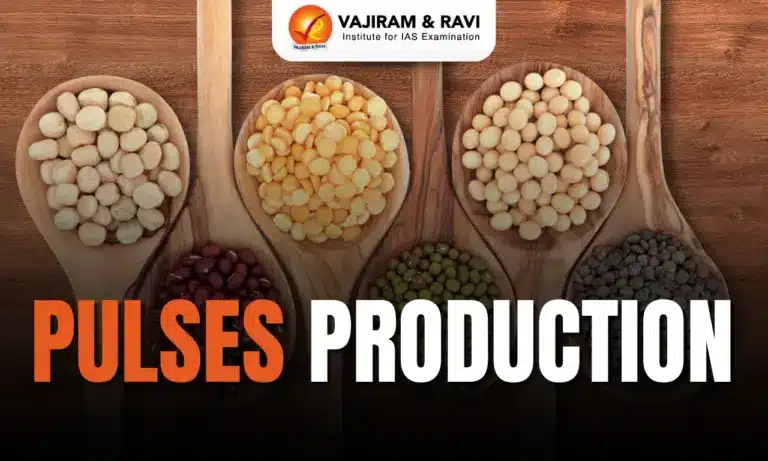
Pulses Production Latest News
- NITI Aayog has unveiled a roadmap to boost pulses production in India, aiming for self-sufficiency and reduced import dependence by 2047.
Introduction
- Pulses are central to India’s food and nutritional security, providing protein-rich diets while also contributing to sustainable agriculture through nitrogen fixation and low water requirements.
- India is the world’s largest producer, consumer, and importer of pulses, making self-reliance in production a national priority.
- Recognising this, NITI Aayog has released a report titled “Strategies and Pathways for Accelerating Growth in Pulses towards the Goal of Atmanirbharta”, laying out a comprehensive roadmap to reduce import dependency and enhance domestic production.





Pulses Production in India
- India’s diverse agro-climatic conditions allow the cultivation of 12 pulse crops across kharif, rabi, and summer seasons.
- Major producing states, Madhya Pradesh, Maharashtra, and Rajasthan, account for over 55% of production, while the top ten states contribute over 91% of the national output.
- Historically, the country’s dependence on imports was high. Production dipped to 16.35 million tonnes (MT) in 2015-16, necessitating 6 MT of imports.
- However, government interventions, including the National Food Security Mission (NFSM) and Minimum Support Price (MSP) policies, improved output significantly.
- By 2022-23, production rose by nearly 59.4% to 26.06 MT, with productivity increasing by 38%. Import dependence simultaneously fell from 29% to just 10.4%.
- Despite this progress, challenges persist. Nearly 80% of pulses cultivation is rain-fed, making production vulnerable to climatic fluctuations.
- The sector supports the livelihood of over five crore farmers and their families, underscoring the importance of a stable policy framework.
NITI Aayog’s Recommendations
- NITI Aayog’s roadmap emphasises tailored interventions for different states and districts to boost productivity and sustainability. Key recommendations include:
- Area Retention and Diversification: Encouraging region-specific crop clusters to optimise cultivation.
- Technology Adoption: Promoting customised farming technologies suited for varied agro-ecological sub-regions.
- Seed Quality and Distribution: Focusing on high-quality seed treatment kits and ensuring widespread distribution, particularly in 111 high-potential districts that contribute 75% of national output.
- Cluster-Based Hubs: Introducing the “One Block–One Seed Village” model through farmer-producer organisations (FPOs) to enhance local productivity.
- Mission for Atmanirbharta in Pulses: A six-year initiative targeting key crops such as pigeonpea, black gram, and lentil to further strengthen self-sufficiency.
- The report projects that India’s pulse production will reach 30.59 MT by 2030 and 45.79 MT by 2047, aligning with the nation’s long-term goal of food security and reduced import reliance.
Nutritional and Environmental Importance
- Beyond food security, pulses are vital for nutrition, especially in a country where vegetarian diets dominate.
- They are a major source of protein, iron, and other micronutrients, helping combat malnutrition.
- Environmentally, pulses enhance soil fertility through nitrogen fixation, require less water compared to cereals, and reduce the carbon footprint of agriculture.
Conclusion
- India has made remarkable progress in pulses production over the past decade, but achieving self-sufficiency requires sustained and region-specific interventions.
- NITI Aayog’s strategic recommendations, focused on seeds, technology, and targeted clusters, are expected to accelerate progress towards Atmanirbharta in pulses.
- By 2047, India envisions not just meeting its domestic demand but also positioning itself as a key player in the global pulses market.
Source: TH

 Last updated on March, 2026
→ UPSC Final Result 2025 is now out.
→ UPSC has released UPSC Toppers List 2025 with the Civil Services final result on its official website.
→ Anuj Agnihotri secured AIR 1 in the UPSC Civil Services Examination 2025.
→ UPSC Marksheet 2025 is now out.
→ UPSC Notification 2026 & UPSC IFoS Notification 2026 is now out on the official website at upsconline.nic.in.
→ UPSC Calendar 2026 has been released.
→ Check out the latest UPSC Syllabus 2026 here.
→ UPSC Prelims 2026 will be conducted on 24th May, 2026 & UPSC Mains 2026 will be conducted on 21st August 2026.
→ The UPSC Selection Process is of 3 stages-Prelims, Mains and Interview.
→ Prepare effectively with Vajiram & Ravi’s UPSC Prelims Test Series 2026 featuring full-length mock tests, detailed solutions, and performance analysis.
→ Enroll in Vajiram & Ravi’s UPSC Mains Test Series 2026 for structured answer writing practice, expert evaluation, and exam-oriented feedback.
→ Join Vajiram & Ravi’s Best UPSC Mentorship Program for personalized guidance, strategy planning, and one-to-one support from experienced mentors.
→ Shakti Dubey secures AIR 1 in UPSC CSE Exam 2024.
→ Also check Best UPSC Coaching in India
Pulses Production FAQs
Q1. Why are pulses important for India?+
Q2. What was India’s pulses production in 2022–23?+
Q3. How has India reduced its dependence on pulse imports?+
Q4. What is NITI Aayog’s “One Block–One Seed Village” initiative?+
Q5. What is the projected pulse production target for 2047?+
Tags: mains articles pulses production upsc current affairs upsc mains current affairs