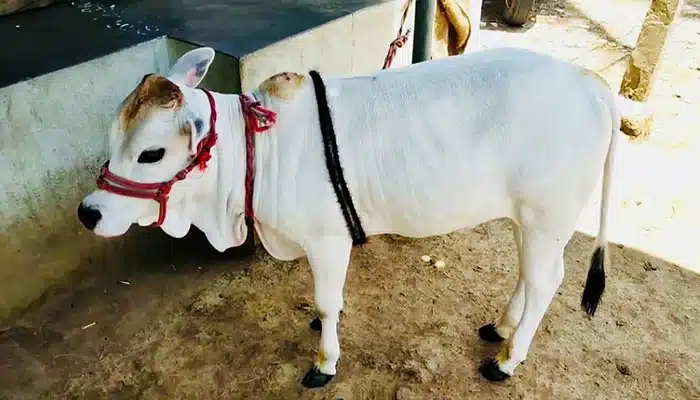
About Punganur Cow
- Standing at just around 70-90 cm tall and weighing less than 200 kg, it is among the world’s most dwarf cattle breeds.
- It is native to Punganur village in the Chittoor district of Andhra Pradesh.
- It has high resilience to drought and can adapt to low-quality feed.
- It is also prized for its milk, which boasts a higher fat content, making it ideal for producing ghee.
- A Punganur cow can give around 1 to 3 litres a day, and the milk fat content is 8 percent as compared to 3 to 4 percent in other native breeds.
- The milk is also rich in nutrients such as Omega fatty acids, calcium, potassium, and magnesium.
- Body colour: It is white, grey, or light brown to dark brown or red in colour. Sometimes, animals with white colour mixed with red, brown, or black patches are also seen.
- It has a broad forehead and short horns. The horns are crescent-shaped and often lose curving backward and forward in males and lateral and forward in females.
- Punganur cows are considered eco-friendly, requiring less water, feed, and space compared to hybrid breeds.
- Cultural Significance: Even today, many temples in Andhra Pradesh, including the famous Tirupati Thirumala Temple, use the milk of a Punganur cow for Ksheeraabhishekam (milk offering to the deity).
Q1) What are fatty acids?
Fatty acids are the building blocks of the fat in our bodies and in the food we eat. During digestion, the body breaks down fats into fatty acids, which can then be absorbed into the blood. Fatty acid molecules are usually joined together in groups of three, forming a molecule called a triglyceride. Triglycerides are also made in our bodies from the carbohydrates that we eat.
Source: PM Modi Feeds Punganur Cows On Makar Sankranti, Here’s Why You Should Adopt This ‘Golden’ Breed






 Last updated on March, 2026
→ UPSC Final Result 2025 is now out.
→ UPSC has released UPSC Toppers List 2025 with the Civil Services final result on its official website.
→ Anuj Agnihotri secured AIR 1 in the UPSC Civil Services Examination 2025.
→ UPSC Marksheet 2025 is now out.
→ UPSC Notification 2026 & UPSC IFoS Notification 2026 is now out on the official website at upsconline.nic.in.
→ UPSC Calendar 2026 has been released.
→ Check out the latest UPSC Syllabus 2026 here.
→ UPSC Prelims 2026 will be conducted on 24th May, 2026 & UPSC Mains 2026 will be conducted on 21st August 2026.
→ The UPSC Selection Process is of 3 stages-Prelims, Mains and Interview.
→ Prepare effectively with Vajiram & Ravi’s UPSC Prelims Test Series 2026 featuring full-length mock tests, detailed solutions, and performance analysis.
→ Enroll in Vajiram & Ravi’s UPSC Mains Test Series 2026 for structured answer writing practice, expert evaluation, and exam-oriented feedback.
→ Join Vajiram & Ravi’s Best UPSC Mentorship Program for personalized guidance, strategy planning, and one-to-one support from experienced mentors.
→ Shakti Dubey secures AIR 1 in UPSC CSE Exam 2024.
→ Also check Best UPSC Coaching in India