Punjab Flooding Crisis Latest News
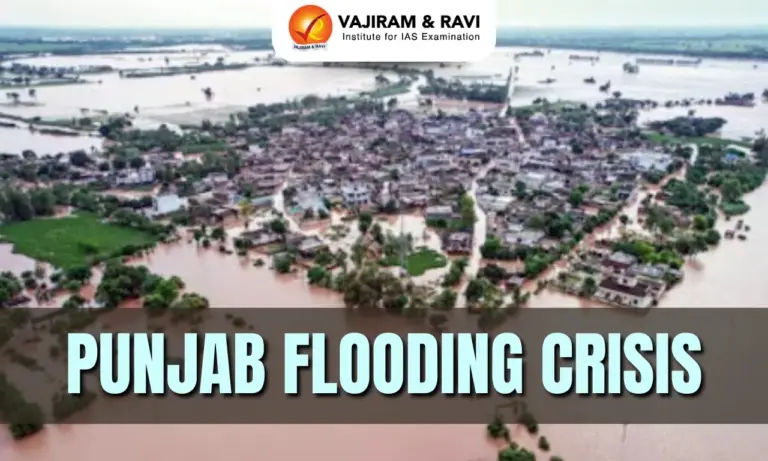
- Punjab is witnessing one of its worst floods, with all 23 districts declared flood-hit.
- Over 1,900 villages, 3.8 lakh people, and 11.7 lakh hectares of farmland have been affected, with 43 deaths reported. Gurdaspur is the worst-hit district.
- Across the border, Punjab in Pakistan has also faced severe flooding, displacing over 9 lakh people.
- While the region’s riverine geography makes it naturally flood-prone, human factors have worsened the crisis.
Rivers: Boon or Bane for Punjab
- Punjab is nourished by three perennial rivers — Ravi, Beas, and Sutlej — along with the seasonal Ghaggar and smaller hill streams (choes).
- These rivers deposit fertile alluvium, making Punjab one of the most productive agricultural regions globally.
- Despite comprising just 1.5% of India’s landmass, Punjab contributes nearly 20% of the nation’s wheat and 12% of its rice, earning it the title “food bowl of India.”
The Bane: Recurrent Flooding
- The same rivers that sustain agriculture also bring devastation during the monsoon.
- Rainfall in Punjab and upstream catchments of Himachal Pradesh and J&K causes rivers to swell.
- Though dhussi bundhs (earthen embankments) offer protection, they are often overwhelmed by heavy inflows.
Floods in 2024 and Historical Recurrence
- Punjab has witnessed major floods repeatedly in 1955, 1988, 1993, 2019, and 2023.
- This year, excessive rainfall triggered flooding once again.
- The Beas overflowed in August due to heavy rain in Himachal, inundating villages and farmland in Kapurthala, Tarn Taran, Ferozepur, Fazilka, and Hoshiarpur.
- Soon after, the Ravi swelled dangerously; the collapse of two gates of Madhopur Barrage led to catastrophic flooding in Pathankot, Gurdaspur, and Amritsar.
Widespread Impact of Excess Rainfall
- Simultaneously, incessant rainfall across Punjab worsened the crisis.
- While Sutlej embankments held, the Malwa region experienced severe waterlogging, affecting Ludhiana, Jalandhar, Ropar, Nawanshahr, and Moga.
- According to the Indian Meteorological Department, Punjab, Himachal Pradesh, and J&K have all received over 45% excess rainfall this year, far above seasonal norms.





The Role of Dams in Punjab’s Floods
- Every time Punjab faces floods, attention turns to three major dams on its perennial rivers. These are: Bhakra dam; Pong dam; Thein dam.
- The Bhakra Dam on the Sutlej (Bilaspur, Himachal Pradesh) and the Pong Dam on the Beas (Kangra, Himachal Pradesh) are run by the Bhakra Beas Management Board (BBMB).
- BBMB is a statutory body constituted under the Punjab Reorganisation Act, 1966.
- The Thein or Ranjit Sagar Dam on the Ravi (border of J&K and Punjab) is managed by Punjab’s State Power Corporation and Irrigation Department.
- These dams regulate river flow and play a critical role in flood control.
Release of Water from Dams
- When heavy rainfall fills reservoirs beyond safe levels, dam operators must release water to avoid overtopping, which can be disastrous.
- The BBMB follows a “rule curve” that guides how much water should be stored or released based on weather forecasts and hydrology.
- However, extreme rainfall events often force sudden releases. This year, inflows into the Pong Dam were about 20% higher than 2023, an unprecedented surge.
- The Bhakra Dam also saw very high inflows, though not entirely new in scale.
Punjab’s Concerns with BBMB
- Punjab has long argued that the BBMB prioritizes irrigation and power generation over flood management.
- According to state officials, BBMB keeps reservoir levels too high in July and August to secure water for winter farming and power supply, leaving little cushion for sudden heavy rains in August-September.
- Sudden water releases, often without timely warnings, worsen flooding downstream and leave local officials unprepared.
Governance Issues and Tensions
- At the core of Punjab’s problem is the structure of the BBMB.
- It is a Centre-controlled body whose main mandate is irrigation and power, not flood management.
- Punjab feels it has too little say in the Board’s decisions.
- Tensions increased after the Centre amended BBMB rules in 2022, allowing officers from across India—not just Punjab and Haryana—to hold top positions.
- Punjab criticized the BBMB, accusing it of holding back water until the last moment before suddenly releasing it.
Governance Failures Behind Punjab’s Floods
- Experts stress that poor dam management, delayed warnings, and weak infrastructure worsened Punjab’s floods this year.
- The collapse of two Madhopur barrage gates after sudden water release from the Thein dam highlighted gaps in coordination within Punjab’s own Irrigation Department.
- Environmentalists noted that reservoirs at Ranjit Sagar, Pong, and Bhakra were kept too full and then emptied abruptly, triggering severe downstream flooding.
- Weak dhussi bundhs, further damaged by illegal mining, added to the crisis.
Source: IE

 Last updated on March, 2026
→ UPSC Final Result 2025 is now out.
→ UPSC has released UPSC Toppers List 2025 with the Civil Services final result on its official website.
→ Anuj Agnihotri secured AIR 1 in the UPSC Civil Services Examination 2025.
→ UPSC Marksheet 2025 is now out.
→ UPSC Notification 2026 & UPSC IFoS Notification 2026 is now out on the official website at upsconline.nic.in.
→ UPSC Calendar 2026 has been released.
→ Check out the latest UPSC Syllabus 2026 here.
→ UPSC Prelims 2026 will be conducted on 24th May, 2026 & UPSC Mains 2026 will be conducted on 21st August 2026.
→ The UPSC Selection Process is of 3 stages-Prelims, Mains and Interview.
→ Prepare effectively with Vajiram & Ravi’s UPSC Prelims Test Series 2026 featuring full-length mock tests, detailed solutions, and performance analysis.
→ Enroll in Vajiram & Ravi’s UPSC Mains Test Series 2026 for structured answer writing practice, expert evaluation, and exam-oriented feedback.
→ Join Vajiram & Ravi’s Best UPSC Mentorship Program for personalized guidance, strategy planning, and one-to-one support from experienced mentors.
→ Shakti Dubey secures AIR 1 in UPSC CSE Exam 2024.
→ Also check Best UPSC Coaching in India
Punjab Flooding Crisis FAQs
Q1. What makes Punjab prone to recurrent floods?+
Q2. How have Punjab’s rivers contributed to both prosperity and floods?+
Q3. What role do dams play in Punjab’s flooding?+
Q4. Why does Punjab criticize the Bhakra Beas Management Board (BBMB)?+
Q5. What governance failures worsen Punjab’s flood crisis?+
Tags: mains articles Punjab flooding crisis upsc current affairs upsc mains current affairs