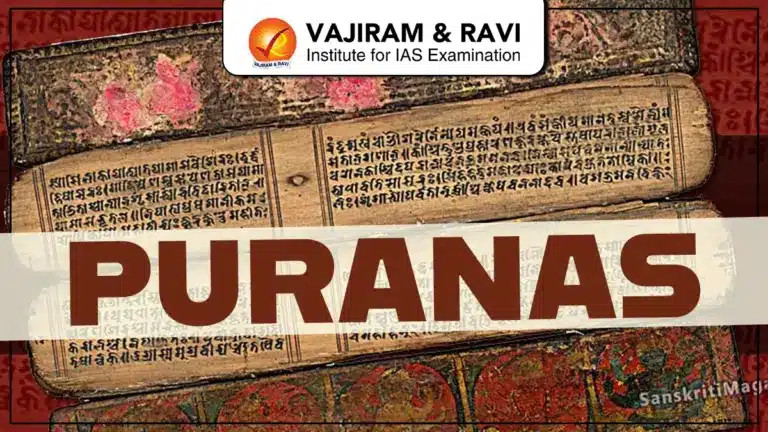
Puranas are ancient Sanskrit texts that preserve Hindu mythology, history, cosmology, and ethical teachings in an accessible form. They were traditionally compiled by Sage Veda-Vyasa, with origins tracing back to the post-Vedic period and oral transmission before being written down. Puranas are classified based on the three gunas into Sattvika (Vishnu), Rajasa (Brahma), and Tamasa (Shiva), and include 18 Mahapuranas and numerous Upapuranas. They are significant for spreading spiritual knowledge, moral values, cultural traditions, and historical information, influencing art, festivals, social cohesion, and daily life in Indian society.
Puranas Origin
The term Purana literally means “ancient” in Sanskrit. According to legend, Sage Veda-Vyasa is credited with compiling the Puranas. It is believed that originally there was only one Purana, which Vyasa passed on to his disciple Lomaharshana. Lomaharshana’s students then created their own Purana compilations, leading to the eighteen Mahapuranas we know today.
The Puranas likely originated between the 4th and 5th centuries CE, though some were composed in later centuries. While their content may overlap with the Vedas, the Puranas were largely composed during the Gupta period, with texts like the Bhagavata Purana (10th century CE) and Skanda Purana (14th century CE) being notable examples.
Classification of Puranas
The Puranas are classified based on the three Gunas (qualities), Sattva, Rajas, and Tamas, corresponding to Vishnu, Brahma, and Shiva. This classification highlights the primary deity and theme of each Purana.
1. Sattvika Puranas (Vishnu-Oriented)
These Puranas emphasize devotion to Lord Vishnu and his avatars. They focus on dharma, moral teachings, and the preservation of the universe.
Examples and Features:
- Vishnu Purana: Discusses Vishnu’s avatars, cosmology, and genealogy of kings.
- Bhagavata Purana: Highlights Krishna’s life and teachings, emphasizing bhakti (devotion).
- Padma Purana: Covers pilgrimages, festivals, and Vishnu-related rituals.
- Emphasis on righteous living and devotion to Vishnu.
2. Rajasa Puranas (Brahma-Oriented)
These texts are primarily concerned with creation, knowledge, and worldly duties. They highlight the active, dynamic aspects of the universe and human life.
Examples and Features:
- Brahma Purana: Focuses on creation myths, genealogy, and legends of sages.
- Brahmanda Purana: Discusses cosmology, historical narratives, and dharma.
- Bhavishya Purana: Contains prophecies, social rules, and historical accounts.
- Emphasis on knowledge, action, and moral responsibilities.
3. Tamasa Puranas (Shiva-Oriented)
These Puranas center around Lord Shiva and the concepts of destruction and transformation. They often describe asceticism, meditation, and the cycles of creation and dissolution.
Examples and Features:
- Linga Purana: Focuses on Shiva worship, rituals, and philosophical teachings.
- Skanda Purana: Contains extensive details of pilgrimages and Shiva-related legends.
- Markandeya Purana: Includes Devi Mahatmya, worship of Shakti, and ethical narratives.
- Emphasis on renunciation, transformation, and devotion to Shiva.






18 Puranas
The 18 Mahapuranas are the major Puranic texts that cover a wide range of themes including mythology, cosmology, genealogy of gods and kings, rituals, and philosophy. Each Purana has its unique focus, length, and contribution to Hindu religious and cultural knowledge.
| 18 Puranas | |||
| S.No | Name of Purana | Approx. Verses | Highlights |
|
1 |
Vishnu Purana |
23,000 |
Vishnu’s avatars, cosmology, genealogy of kings |
|
2 |
Bhagavata Purana |
18,000 |
Krishna’s life, bhakti, philosophical teachings |
|
3 |
Narada Purana |
25,000 |
Devotion, religious rites, pilgrimages |
|
4 |
Garuda Purana |
19,000 |
Death, afterlife, ethics, rituals |
|
5 |
Padma Purana |
55,000 |
Pilgrimages, festivals, Vishnu-related legends |
|
6 |
Varaha Purana |
24,000 |
Varaha avatar of Vishnu, cosmology, dharma |
|
7 |
Skanda Purana |
81,100 |
Shiva legends, pilgrimages, temples, rituals |
|
8 |
Agni Purana |
15,400 |
Rituals, cosmology, arts, medicine, astronomy |
|
9 |
Brahma Purana |
24,000 |
Creation myths, genealogy, legends of sages |
|
10 |
Brahmanda Purana |
12,000 |
Cosmology, history, geography, dharma |
|
11 |
Brahmavaivarta Purana |
18,000 |
Krishna-Radha stories, devotion, spiritual teachings |
|
12 |
Linga Purana |
11,000 |
Shiva worship, rituals, philosophy |
|
13 |
Markandeya Purana |
9,000 |
Devi Mahatmya, Shakti worship, ethics |
|
14 |
Bhavishya Purana |
14,500 |
Prophecies, social rules, historical events |
|
15 |
Vamana Purana |
10,000 |
Vamana avatar of Vishnu, dharma, legends |
|
16 |
Matsya Purana |
14,000 |
Matsya avatar, cosmology, genealogy, rituals |
|
17 |
Surya Purana |
10,000 |
Solar deity worship, festivals, rituals |
|
18 |
Vayu Purana |
24,000 |
History, geography, mythology, dynasties |
Puranas Significance
The Puranas play a crucial role in preserving and transmitting Hindu mythology, history, culture, and spiritual teachings in an accessible form.
- Puranas made religious and spiritual knowledge accessible to all, including women and shudras, unlike the Vedas.
- They preserved oral traditions by being recited aloud, ensuring the transmission of culture and mythology across generations.
- Puranas cover a wide range of topics such as mythology, cosmology, genealogy of gods and kings, rituals, festivals, geography, medicine, arts, astronomy, grammar, and philosophy.
- They provide historical insights on dynasties, political history, urban settlements, and administration, mentioning periods like the Mauryan, Satavahana, and Gupta dynasties.
- Through stories of gods, sages, and heroes, they teach dharma, karma, ethical conduct, and moral values for both spiritual and worldly life.
- Puranas integrated regional deities, local customs, and rituals, promoting cultural unity and a syncretic Hindu tradition.
- They influenced Indian arts, music, classical dance forms, storytelling, and drama, including Bharatanatyam and Rasa Lila.
- Many Hindu festivals such as Holi, Diwali, and Durga Puja are described and elaborated in Puranas.
Differences between Vedas and Puranas
Vedas are authoritative, ritual-focused texts, while Puranas are narrative, inclusive, and encyclopedic, making religious and cultural knowledge accessible to the general population. The Differences between Vedas and Puranas is given below.
| Differences between Vedas and Puranas | |
| Vedas | Puranas |
|
Considered Shruti texts, meaning “that which is heard,” and regarded as the most authoritative scriptures in Hinduism. |
Considered Smriti texts, meaning “that which is remembered,” respected but secondary to the Vedas in authority. |
|
Composed between 1500 BCE and 900 BCE for Rig Veda; other Vedas like Sama, Yajur, and Atharva composed between 1200–900 BCE. |
Composed mainly between 3rd century CE and 10th century CE, with some additions even later; originated largely during the Gupta period. |
|
Focus on rituals, sacrifices (yajnas), mantras, meditation, and spiritual knowledge for the priests and scholarly community. |
Focus on mythology, cosmology, genealogy of gods and kings, ethical guidance, festivals, pilgrimages, arts, and sciences for the general population. |
|
Written in highly complex Sanskrit, often requiring guidance for comprehension; primarily intended for scholars, priests, and initiates. |
Written in simpler Sanskrit, often in narrative form, making it accessible to common people including women and lower social groups. |
|
Divided into four sections: Samhitas (mantras and hymns), Brahmanas (ritual commentaries), Aranyakas (forest texts), and Upanishads (philosophy and meditation). |
Divided into 18 Mahapuranas (major) and numerous Upapuranas (minor), each focusing on specific deities, themes, and encyclopedic knowledge. |
|
Emphasizes universal truths, metaphysics, and eternal spiritual laws, forming the core of Hindu theology. |
Emphasizes practical knowledge, devotion, dharma, and cultural traditions, bridging spiritual teachings with everyday life. |
|
Traditionally compiled by Sage Veda Vyasa; transmitted orally before being documented. |
Traditionally compiled or compiled under the guidance of Sage Veda Vyasa, but many Puranas were written by multiple authors over centuries. |
|
Audience was limited to priests, scholars, and those trained in Sanskrit and rituals, making knowledge less accessible to the general population. |
Intended for all sections of society, including women, farmers, and lower castes, serving as a medium for mass education and cultural integration. |
Influence of Puranas on Indian Society
- Puranas played a central role in preserving and transmitting cultural, religious, and social knowledge across generations in ancient and medieval India.
- They encouraged cultural synthesis by integrating diverse beliefs, rituals, and practices into a coherent Hindu framework.
- Regional deities and local traditions were incorporated into Puranic narratives, promoting acceptance of local and regional faiths within mainstream Hinduism.
- Puranas contributed to the spread of literacy and oral education, as they were recited aloud in villages and towns, making knowledge accessible to people of all social strata.
- They influenced performing arts, including classical dance forms like Bharatanatyam, folk theatre, music, and storytelling traditions such as Rasa Lila.
- Many festivals and rituals, including Holi, Diwali, and Durga Puja, are described and codified in the Puranas, shaping the religious calendar of India.
- Puranas provided historical and geographical information, documenting dynasties, towns, temples, rivers, and urban planning, which is useful for studying political and cultural history.
- They reinforced moral, ethical, and social values, teaching dharma, karma, devotion, and righteous conduct through stories of gods, heroes, and sages.
- Puranas served as a medium of social cohesion, connecting diverse linguistic, cultural, and regional communities under shared myths, rituals, and traditions.
- Their encyclopedic content influenced science, medicine, astronomy, and arts, contributing to the holistic development of Indian knowledge systems.

 Last updated on March, 2026
→ UPSC Final Result 2025 is now out.
→ UPSC has released UPSC Toppers List 2025 with the Civil Services final result on its official website.
→ Anuj Agnihotri secured AIR 1 in the UPSC Civil Services Examination 2025.
→ UPSC Marksheet 2025 is now out.
→ UPSC Notification 2026 & UPSC IFoS Notification 2026 is now out on the official website at upsconline.nic.in.
→ UPSC Calendar 2026 has been released.
→ Check out the latest UPSC Syllabus 2026 here.
→ UPSC Prelims 2026 will be conducted on 24th May, 2026 & UPSC Mains 2026 will be conducted on 21st August 2026.
→ The UPSC Selection Process is of 3 stages-Prelims, Mains and Interview.
→ Prepare effectively with Vajiram & Ravi’s UPSC Prelims Test Series 2026 featuring full-length mock tests, detailed solutions, and performance analysis.
→ Enroll in Vajiram & Ravi’s UPSC Mains Test Series 2026 for structured answer writing practice, expert evaluation, and exam-oriented feedback.
→ Join Vajiram & Ravi’s Best UPSC Mentorship Program for personalized guidance, strategy planning, and one-to-one support from experienced mentors.
→ Shakti Dubey secures AIR 1 in UPSC CSE Exam 2024.
→ Also check Best UPSC Coaching in India
Puranas FAQs
Q1. What does “Purana” mean?+
Q2. Who compiled the Puranas?+
Q3. How many Puranas exist?+
Q4. Are Puranas part of the Vedas?+
Q5. What topics do the Puranas cover?+
Tags: puranas