Putin’s India Visit Latest News
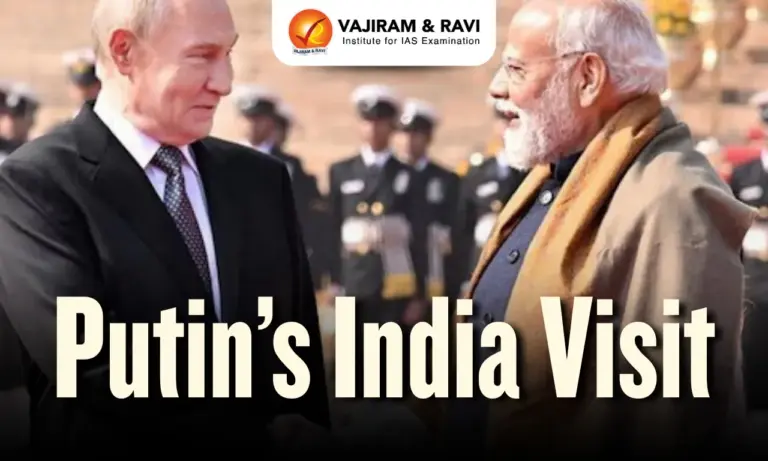
- The government extended an exceptionally warm welcome to Russian President Vladimir Putin, with PM Modi personally receiving him at the Delhi airport, hosting a private dinner, and later attending a state banquet held by President Droupadi Murmu.
- PM Modi described the India–Russia partnership as steady and reliable “like a pole star.”
Main Takeaways from Putin’s Visit: A Focus on Economics, Not Defence
- Despite the high-level protocol and symbolism, analysts believe, the tangible outcomes of the summit were modest, with limited breakthroughs announced beyond reaffirming the bilateral relationship and ongoing cooperation.
Defence Expectations Fall Flat
- Before the visit, there was widespread speculation about major defence deals involving aircraft, missiles, drones, and air-defence systems.
- However, the meeting between Defence Ministers Rajnath Singh and his counterpart from Russia ended without any announcements, signalling that defence cooperation did not move forward in any significant way.
Economic Cooperation Takes Centre Stage
- Rather than defence, both sides focused on advancing the 2030 roadmap for India–Russia economic cooperation, first launched during Modi’s 2024 Moscow visit.
- The emphasis shifted clearly toward long-term economic engagement.
Labour Mobility Agreement Announced
- A major outcome was the signing of a Labour Mobility Agreement, enabling skilled Indian workers to take up jobs in Russia.
- Russia expects a shortage of three million workers by the decade’s end, making this agreement economically and strategically important.
Investments in Fertilizer Supply Chain
- Indian and Russian fertilizer companies signed an MoU to build a urea production plant in Russia, strengthening India’s fertilizer security and supply chain stability.
Maritime and Customs Cooperation Strengthened
- Both countries inked multiple agreements on:
- Maritime collaboration
- Port connectivity
- Customs cooperation
- These aim to ease trade flows through the Chennai–Vladivostok Maritime Corridor and the International North-South Transport Corridor (INSTC).
Push for Rupee–Ruble Trade Settlement
- India and Russia agreed to further efforts to increase trade settlement in national currencies, reducing reliance on the U.S. dollar and improving resilience to sanctions.
Noticeable Gaps: No Breakthrough on Oil, Space, or Nuclear
- Despite expectations, there were no announcements on:
- Russian oil procurement (which forms the bulk of bilateral trade)
- Space cooperation
- Nuclear energy collaboration
- This contributed to the perception that the summit’s outcomes were modest compared to the ceremony and symbolism of the visit.





How the Ukraine War Shaped the Modi–Putin Talks
- Putin arrived in India just as the Ukraine war approached its fourth year and during active negotiations in Moscow over a U.S.-led peace proposal.
- Both leaders publicly expressed hope for an end to the conflict, with Modi emphasising that “India stands on the side of peace.”
War-Linked Sanctions Cast a Long Shadow
- Despite warm optics, the summit was overshadowed by the heavy impact of Western sanctions on Russia, which have increasingly affected India as well:
- European sanctions on Russian and Indian oil firms
- A 25% U.S. tariff on Indian goods
- Sharp decline in India’s Russian oil imports (38% y-o-y drop in October 2025)
- While Putin promised “uninterrupted fuel supplies,” India signalled it would base purchases solely on commercial considerations.
Caution Over Defence, Space, and Nuclear Announcements
- Both sides appeared deliberately restrained, avoiding major announcements in strategic sectors like:
- Defence procurement
- Space cooperation
- Nuclear energy
- This cautious approach may reflect concerns that the U.S. could revisit CAATSA sanctions, which target major Russian military and strategic transactions.
Subtle Western Pressure Ahead of the Summit
- Just days before the visit, ambassadors from the U.K., Germany, and France published a piece urging India to rethink its Russia stance.
- The MEA labelled this public advice “unacceptable,” but the timing likely influenced the government’s restrained posture.
The Road Ahead: Balancing Russia, the West, and Strategic Autonomy
- For New Delhi, a resolution of the Ukraine conflict would significantly reduce the strain of navigating a deeply polarised global environment.
- India has been balancing:
- Its long-standing partnership with Russia,
- Growing strategic and economic ties with Europe and the U.S., and
- Concerns over Russia’s increasing dependence on China.
- An end to the war would make this balancing act far less complicated.
High-Stakes Diplomatic Calendar With Europe and the U.S.
- Putin’s visit comes ahead of a series of crucial engagements with Western leaders:
- German Chancellor Friedrich Merz and EU leaders Ursula von der Leyen and Antonio Costa for Republic Day
- Long-awaited EU–India Summit, where the India–EU FTA may finally be signed
- French President Emmanuel Macron for the AI Summit in February
- Expected visit by Canadian PM Mark Carney
- These visits underscore the importance of India’s ties with Europe at a critical geopolitical moment.
India–U.S. Trade Deal at a Decisive Stage
- India is also pushing hard to finalise a free trade agreement with the U.S., with hopes of reversing the recent wave of excessive American tariffs.
- This adds another layer of sensitivity to how India manages public optics with Russia.
New Delhi Wanted the Putin Visit to Be ‘Win-Win’
- The ideal outcome for India was twofold:
- Reaffirm traditional ties with Russia — signalling continuity and reliability
- Avoid provoking Western partners — ensuring no backlash ahead of crucial summits and trade negotiations
- The deliberately modest outcomes of the summit reflect this delicate calibration.
Preserving Strategic Autonomy Remains the Core Principle
- Ultimately, India’s approach seeks to reinforce its long-standing doctrine of strategic autonomy — retaining the flexibility to engage major powers independently, based on national interest rather than geopolitical camps.
- Putin’s visit, carefully managed and cautiously outcome-oriented, was another step in preserving that space.

 Last updated on March, 2026
→ UPSC Final Result 2025 is now out.
→ UPSC has released UPSC Toppers List 2025 with the Civil Services final result on its official website.
→ Anuj Agnihotri secured AIR 1 in the UPSC Civil Services Examination 2025.
→ UPSC Marksheet 2025 is now out.
→ UPSC Notification 2026 & UPSC IFoS Notification 2026 is now out on the official website at upsconline.nic.in.
→ UPSC Calendar 2026 has been released.
→ Check out the latest UPSC Syllabus 2026 here.
→ UPSC Prelims 2026 will be conducted on 24th May, 2026 & UPSC Mains 2026 will be conducted on 21st August 2026.
→ The UPSC Selection Process is of 3 stages-Prelims, Mains and Interview.
→ Prepare effectively with Vajiram & Ravi’s UPSC Prelims Test Series 2026 featuring full-length mock tests, detailed solutions, and performance analysis.
→ Enroll in Vajiram & Ravi’s UPSC Mains Test Series 2026 for structured answer writing practice, expert evaluation, and exam-oriented feedback.
→ Join Vajiram & Ravi’s Best UPSC Mentorship Program for personalized guidance, strategy planning, and one-to-one support from experienced mentors.
→ Shakti Dubey secures AIR 1 in UPSC CSE Exam 2024.
→ Also check Best UPSC Coaching in India
Putin’s India Visit FAQs
Q1. What were the main outcomes of Putin’s visit to India?+
Q2. Why were defence announcements limited this time?+
Q3. What economic agreements were signed?+
Q4. How did the Ukraine war influence discussions?+
Q5. What is the strategic way forward for India?+
Tags: mains articles Putin’s India Visit upsc current affairs upsc mains current affairs