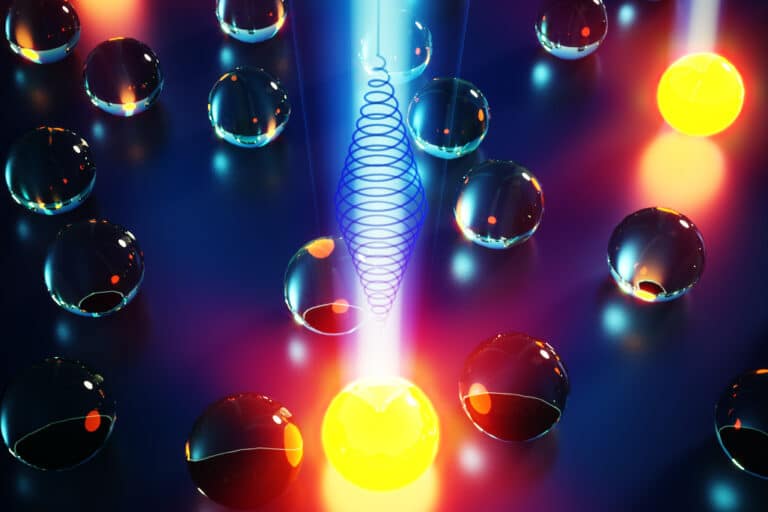
About Quantum Dots (QDs):
- Quantum dots, often referred to as “artificial atoms,” are semiconductor nanoparticles that have unique optical and electronic properties due to their small size.
- They were first theorized in the 1970s and then successfully synthesized in the early 1980s.
- Many semiconductor substances can be used as QDs, such as cadmium selenide, cadmium sulfide, or indium arsenide. Nanoparticles of these, or any other semiconductor substance, have the properties of a QD.
- The size and composition of the QDs can be controlled during synthesis, allowing scientists to tailor their properties for various applications.
- Optical Properties: One of the most notable features of QDs is their tunable emission properties.
- By controlling the size of the QD, researchers can precisely tune the wavelength of light emitted or absorbed.
- They can be engineered to emit light across the entire visible spectrum and into the infrared and ultraviolet ranges, offering a wide palette of colors for various applications.
- The smallest quantum dots emit higher energy waves and produce blue light, and the biggest dots release lower energy waves, creating red light, with the middle sizes creating the colours in between.
- Applications:
- Displays: They are used in display technology to enhance the color and efficiency of displays for TVs, monitors, and other electronic devices.
- Compared to organic luminescent materials used in organic light emitting diodes (OLEDs), QD-based materials have purer colors, a longer lifetime, lower manufacturing costs, and lower power consumption.
- Photovoltaics: QDs can be used in solar cells to enhance light absorption and energy conversion efficiency.
- Bio-medical applications: The small size of QDs allows them to go anywhere in the body, making them suitable for different bio-medical applications like medical imaging, biosensors, targeted drug delivery, etc.
- Quantum Computing: QDs are being investigated for their potential role in quantum computing, as they can serve as qubits, the fundamental units of quantum information.
- Displays: They are used in display technology to enhance the color and efficiency of displays for TVs, monitors, and other electronic devices.
Q1) What is Quantum Computing?
Quantum computing is a rapidly-emerging technology that harnesses the laws of quantum mechanics to solve problems too complex for classical computers. Unlike classical computers, which use bits to represent information as 0s and 1s, quantum computers use quantum bits or qubits, which can exist in multiple states simultaneously due to a phenomenon called superposition. This unique property enables quantum computers to process and analyze vast amounts of information simultaneously, making them potentially much more powerful for certain types of problems.






 Last updated on April, 2026
→ UPSC Final Result 2025 is now out.
→ UPSC has released UPSC Toppers List 2025 with the Civil Services final result on its official website.
→ Anuj Agnihotri secured AIR 1 in the UPSC Civil Services Examination 2025.
→ UPSC Marksheet 2025 is now out.
→ UPSC Notification 2026 & UPSC IFoS Notification 2026 is now out on the official website at upsconline.nic.in.
→ UPSC Calendar 2026 has been released.
→ Check out the latest UPSC Syllabus 2026 here.
→ UPSC Prelims 2026 will be conducted on 24th May, 2026 & UPSC Mains 2026 will be conducted on 21st August 2026.
→ The UPSC Selection Process is of 3 stages-Prelims, Mains and Interview.
→ Prepare effectively with Vajiram & Ravi’s UPSC Prelims Test Series 2026 featuring full-length mock tests, detailed solutions, and performance analysis.
→ Enroll in Vajiram & Ravi’s UPSC Mains Test Series 2026 for structured answer writing practice, expert evaluation, and exam-oriented feedback.
→ Join Vajiram & Ravi’s Best UPSC Mentorship Program for personalized guidance, strategy planning, and one-to-one support from experienced mentors.
→ Shakti Dubey secures AIR 1 in UPSC CSE Exam 2024.
→ Also check Best UPSC Coaching in India