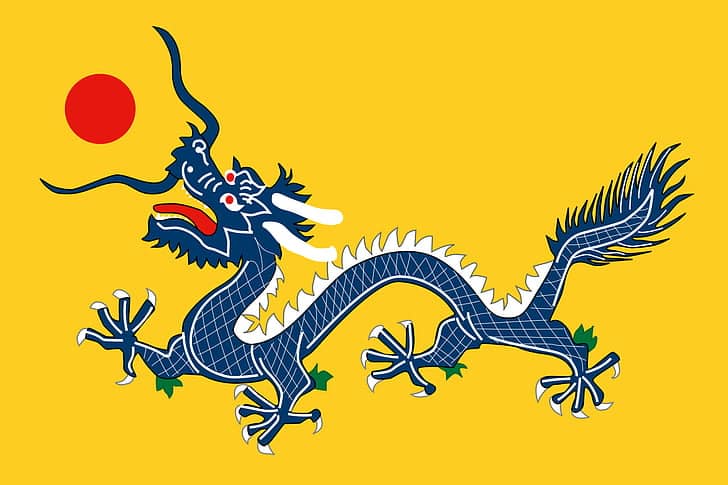
About Qing Dynasty:
- The Qing Dynasty, or Ch’ing Dynasty, or Manchu Dynasty was the final imperial dynasty in China, lasting from 1644 to 1912.
- It was preceded by the Han-led Ming Dynasty (1368–1644) and followed by the Republic of China era (1912–1949).
- Under the Qing, the territory of the empire grew to treble its size under the preceding Ming dynasty (1368–1644).
- The Qing Dynasty annexed Mongolia, Northeast China, Xinjiang, Tibet, and Taiwan, establishing a territory larger than that of today’s China — the largest China has ever been.
- History:
- In the early 1600s, the Manchu people of northern China began to unite against the Ming Dynasty.
- They formed a somewhat military society and mobilized a large army.
- In 1644, the Manchus crossed the Great Wall and invaded China.
- They soon took control of the Chinese capital city, Beijing, and declared the beginning of a new dynasty called the Qing.
- The first Qing Emperor was a five-year-old boy who became the Shunzhi Emperor.
- The Manchus continued to expand and conquer more of China.
- In 1683, under the Kangxi Emperor, the Qing Empire included all of China.
- Features:
- Model of Government: The Manchu rulers modelled many of their government practices on those of the previous Chinese Ming dynasty (1368–1644). For example, they employed a civil service examination system, much like in previous Chinese dynasties, to recruit Chinese government officials.
- Cultural attitudes were strongly conservative.
- Art: The arts flourished: literati painting was popular, novels in the vernacular developed substantially, and jingxi (Peking opera) developed.
- Trade: Qing porcelain, textiles, tea, paper, sugar, and steel were exported to all parts of the world.
- How did it end?
- Military campaigns in the latter part of the 18th century depleted government finances, and corruption grew.
- These conditions, combined with population pressures and natural disasters, led to the Opium Wars and the Taiping and Nian rebellions, which in turn so weakened the dynasty that it was unable to rebuff the demands of foreign powers.
- The dynasty ended with the republican revolution of 1911 and the abdication of the last emperor in 1912.
Q1) How did the Qing Dynasty end?
Military campaigns in the latter part of the 18th century depleted government finances, and corruption grew. These conditions, combined with population pressures and natural disasters, led to the Opium Wars and the Taiping and Nian rebellions, which in turn so weakened the dynasty that it was unable to rebuff the demands of foreign powers. The dynasty ended with the republican revolution of 1911 and the abdication of the last emperor in 1912.
Source: Qing Dynasty imperial edict found in north China






 Last updated on March, 2026
→ UPSC Final Result 2025 is now out.
→ UPSC has released UPSC Toppers List 2025 with the Civil Services final result on its official website.
→ Anuj Agnihotri secured AIR 1 in the UPSC Civil Services Examination 2025.
→ UPSC Marksheet 2025 is now out.
→ UPSC Notification 2026 & UPSC IFoS Notification 2026 is now out on the official website at upsconline.nic.in.
→ UPSC Calendar 2026 has been released.
→ Check out the latest UPSC Syllabus 2026 here.
→ UPSC Prelims 2026 will be conducted on 24th May, 2026 & UPSC Mains 2026 will be conducted on 21st August 2026.
→ The UPSC Selection Process is of 3 stages-Prelims, Mains and Interview.
→ Prepare effectively with Vajiram & Ravi’s UPSC Prelims Test Series 2026 featuring full-length mock tests, detailed solutions, and performance analysis.
→ Enroll in Vajiram & Ravi’s UPSC Mains Test Series 2026 for structured answer writing practice, expert evaluation, and exam-oriented feedback.
→ Join Vajiram & Ravi’s Best UPSC Mentorship Program for personalized guidance, strategy planning, and one-to-one support from experienced mentors.
→ Shakti Dubey secures AIR 1 in UPSC CSE Exam 2024.
→ Also check Best UPSC Coaching in India