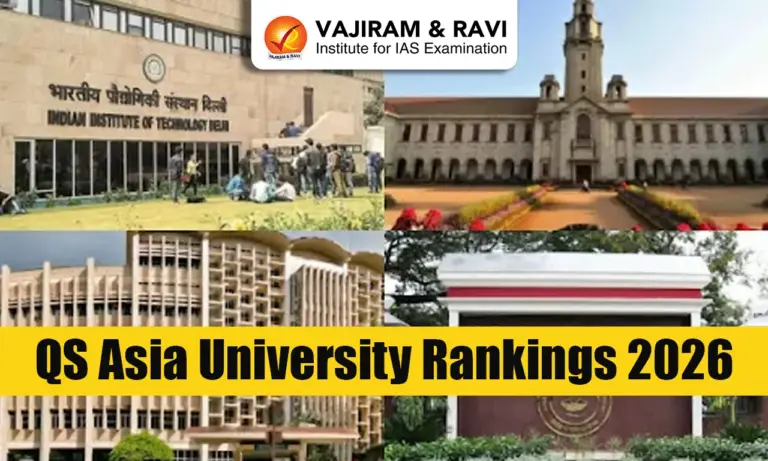
QS Asia University Rankings 2026 Latest News
- The QS World University Rankings: Asia 2026, released by global higher education analyst QS Quacquarelli Symonds, revealed a decline in the rankings of most top Indian institutions.
- Despite improvement in absolute scores, 9 out of 10 leading Indian universities—including seven IITs—fell in rank due to stronger performance by universities from China, Singapore, Hong Kong, South Korea, and Malaysia.
Key Highlights of QS Asia Rankings 2026
- Top performers in Asia:
-
- The University of Hong Kong topped the rankings, overtaking Peking University (China), which slipped to second place.
- National University of Singapore (NUS) and Nanyang Technological University (NTU) shared the third position.
- East and Southeast Asian universities—especially from China, South Korea, and Malaysia—showed consistent upward mobility, driven by investment in research collaboration and internationalisation.
- Performance of Indian institutions:
-
- Among the top Indian universities, IIT Delhi retained its position as India’s best institution but fell 15 places to 59th (from 44th in 2025).
- IIT Bombay witnessed the sharpest decline, dropping 23 places to 71st.
- Other IITs—Madras, Kanpur, and Kharagpur—also recorded their lowest ranks in recent years.
- The only Indian institution showing improvement was Chandigarh University, rising from 120 to 109.





Reasons Behind India’s Relative Decline
- Intensifying regional competition:
-
- Universities in China, Hong Kong, Singapore, South Korea, and Malaysia have significantly improved in research productivity, faculty resources, and global engagement.
- QS noted a “clear eastward concentration” of top performance in higher education.
- Expanded ranking scope and competition:
-
- The 2026 rankings included 1,529 institutions, adding 552 new entrants.
- China added 261 new institutions—more than any other country—while India added 137, bringing its total to 294.
- The expansion increased competition and volatility in the results.
Decline in Key Performance Metrics of Indian Institutes
- Citations per paper (research impact):
- IIT Delhi (31.5), IIT Bombay (20.0), and IIT Madras (20.3) scored significantly below Asian peers scoring in the high 90s.
- Indicates lower research visibility and fewer highly cited publications.
- Faculty-student ratio:
- IITs face resource constraints and large class sizes.
- Scores range from 16.5 (IIT Kharagpur) to 40.9 (IIT Delhi), compared to 80–90 among top Asian universities.
- Internationalisation metrics:
- Poor performance in International Student Ratio (ISR) and International Faculty indicators.
- IITs scored between 2.5 (IIT Kharagpur) and 12.3 (IIT Roorkee).
- Lack of foreign student or faculty participation limits global exposure and cross-border collaboration.
Positive Aspects
- Indian institutions maintained strong scores (80–90 range) in:
- Academic reputation
- Employer reputation
- Staff with PhD
- Papers per faculty
- India continues to expand its footprint with 294 universities represented in the 2026 rankings, the second highest in Asia after China.
Comparative Regional Trends
- China and Hong Kong: Sustained dominance with large-scale investment in R&D.
- South Korea: Universities like Yonsei and Korea University show upward mobility due to strategic investment in international partnerships.
- Malaysia: Institutions such as Universiti Malaya and Universiti Putra Malaysia improved rankings, aided by faculty-student ratio and international faculty/student metrics.
Way Forward for Indian Institutions
- Enhance research impact: Focus on high-quality publications and internationally co-authored research to improve citations per paper.
- Improve faculty-student ratio: Recruit more faculty and expand infrastructure to reduce student load per teacher.
- Promote internationalisation: Facilitate foreign student exchange, visiting faculty, and global academic collaborations.
- Strengthen research ecosystem: Incentivise interdisciplinary and industry-linked research, ensuring global visibility.
- Policy support: Government and institutions must align policies with National Education Policy (NEP) 2020 goals of global competitiveness and innovation.
Conclusion
- The QS Asia Rankings 2026 underscore a concerning trend for Indian higher education—while absolute performance has improved, relative standing has fallen due to stronger regional competitors.
- To climb the global ladder, India must bridge gaps in research impact, faculty resources, and internationalisation, aligning with the NEP 2020 vision of making Indian universities globally competitive and innovation-driven.
Source: IE

 Last updated on March, 2026
→ UPSC Final Result 2025 is now out.
→ UPSC has released UPSC Toppers List 2025 with the Civil Services final result on its official website.
→ Anuj Agnihotri secured AIR 1 in the UPSC Civil Services Examination 2025.
→ UPSC Marksheet 2025 is now out.
→ UPSC Notification 2026 & UPSC IFoS Notification 2026 is now out on the official website at upsconline.nic.in.
→ UPSC Calendar 2026 has been released.
→ Check out the latest UPSC Syllabus 2026 here.
→ UPSC Prelims 2026 will be conducted on 24th May, 2026 & UPSC Mains 2026 will be conducted on 21st August 2026.
→ The UPSC Selection Process is of 3 stages-Prelims, Mains and Interview.
→ Prepare effectively with Vajiram & Ravi’s UPSC Prelims Test Series 2026 featuring full-length mock tests, detailed solutions, and performance analysis.
→ Enroll in Vajiram & Ravi’s UPSC Mains Test Series 2026 for structured answer writing practice, expert evaluation, and exam-oriented feedback.
→ Join Vajiram & Ravi’s Best UPSC Mentorship Program for personalized guidance, strategy planning, and one-to-one support from experienced mentors.
→ Shakti Dubey secures AIR 1 in UPSC CSE Exam 2024.
→ Also check Best UPSC Coaching in India
QS Asia University Rankings 2026 FAQs
Q1. What is the key finding of the QS Asia University Rankings 2026?+
Q2. Which metrics have contributed most to the decline of Indian institutions in the QS Asia Rankings 2026?+
Q3. In which areas have Indian institutions performed well according to the 2026 rankings?+
Q4. What factors have led to improved performance by East and Southeast Asian universities?+
Q5. What measures can Indian institutions adopt to enhance their global competitiveness in future rankings?+
Tags: mains articles qs asia university rankings 2026 upsc current affairs upsc mains current affairs