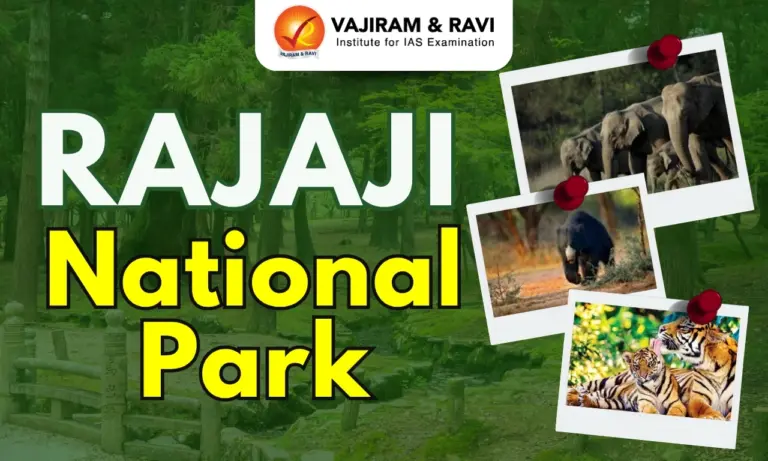
Rajaji National Park is a beautiful wildlife area located in the foothills of the Himalayas in Uttarakhand, known for its dense forests, rich biodiversity, and peaceful natural environment. It is especially famous for its population of Asian elephants and supports a wide range of animals, birds, and plant species, making it an important conservation area. The park plays a key role in maintaining the ecological balance of the region while also offering people a chance to experience the beauty of nature and connect with the wild environment.
Rajaji National Park
- Rajaji National Park is a well-known protected area in Uttarakhand, famous for its rich biodiversity, scenic beauty, and peaceful forest environment, attracting both tourists and researchers.
- It was established in 1983 by merging three wildlife sanctuaries – Rajaji, Motichur, and Chilla, to create a larger and more effective conservation area.
- The park is named after C. Rajagopalachari (Rajaji), a freedom fighter and the first Governor-General of India, giving it both ecological and historical importance.
- It covers an area of around 820.42 sq. km, making it one of the significant national parks in northern India with diverse landscapes.
- It is considered an important part of India’s protected area network, contributing to wildlife conservation at a national level.
- The park also serves as an ideal destination for eco-tourism, promoting awareness about nature and wildlife protection among visitors.
Also Read : National Parks in India 2026
Rajaji National Park Location and Physical Features
- The park lies in the Shivalik ranges of the Himalayan foothills, which provide a mix of hills, valleys, and plains, creating a unique ecological zone.
- It spreads across Dehradun, Pauri Garhwal, and Saharanpur districts, covering a large geographical area with varied landscapes.
- The Ganga River flows through the park for about 24 km, supporting rich biodiversity and dividing parts of the forest.
- Seasonal streams called “raus” flow through the park, which remain dry most of the year but become active during the monsoon season.
- The park acts as a transition zone between the Indo-Gangetic plains and the Himalayas, increasing species diversity.
- The terrain includes rocky riverbeds, dense forests, grasslands, and slopes, making it suitable for a wide range of wildlife.
- Its location near cities like Haridwar, Rishikesh, and Dehradun makes it easily accessible for tourism and research purposes.
Also Read : Siwalik Hills


Rajaji National Park Forest Types and Vegetation
- The park has a variety of forests such as semi-evergreen, moist deciduous, dry deciduous, and mixed broad-leaved forests, making it ecologically rich.
- Sal forests (Shorea robusta) dominate large parts of the park and play a key role in supporting wildlife.
- Other important trees include Shisham, Khair, Bamboo, Palash, Arjun, Amla, and Bel, which provide food and shelter to animals.
- The southern region contains alluvial grasslands and savannah-type vegetation, while higher regions may have chir pine forests.
- The vegetation is classified under the Indus-Ganga Monsoon Forest type, known for its seasonal variation.
- The undergrowth (shrubs and bushes) is often light, allowing better visibility for wildlife spotting in some areas.
- The diversity in vegetation supports different types of habitats, from dense jungle areas to open grazing lands.
Also Read : Natural Vegetation of India
Rajaji National Park Wildlife (Fauna) Diversity
-
- The park is famous for its Asian Elephant population, marking the north-western limit of their natural habitat in India.
- It is home to major predators like the Royal Bengal Tiger and Leopard, which are protected under conservation programs like Project Tiger.
- Herbivores such as Sambar, Chital (spotted deer), Barking deer, Nilgai, and Wild Boar are commonly seen grazing.
- Smaller mammals like the Indian Hare and Indian Porcupine contribute to the ecological balance of the forest.
- Carnivores like Jackal, Hyena, Jungle Cat, Civet, and Leopard Cat are also found in the park.
- Larger mammals such as Himalayan Black Bear and Sloth Bear are present in forested areas.
- The park plays an important role in maintaining the food chain and ecological balance among species.
- The park supports primates like the Rhesus Macaque and Hanuman Langur, which are commonly seen in groups.
- These animals are important for seed dispersal, helping in the natural regeneration of forests.
- They are often found near forest edges, roads, and tourist zones, making them easily visible to visitors.
- Their social behavior and adaptability make them an interesting part of the park’s wildlife.
- Bird Life (Avifauna)
-
- Rajaji National Park is home to around 300-400 bird species, making it a birdwatcher’s paradise.
- Its location between the Western Himalaya and Central Himalaya increases the variety of bird species found here.
- Important birds include Great Hornbill, Black-necked Stork, Pallas’s Fish Eagle, Northern Goshawk, and Woodpeckers.
- Many migratory birds visit during winter after crossing the Himalayas, increasing seasonal diversity.
Rajaji Tiger Reserve
- In 2015, an additional 255.63 sq. km buffer zone was added, and the park was declared a Tiger Reserve under the Wildlife Protection Act, 1972.
- The total area of the reserve increased to about 1075 sq. km, strengthening conservation efforts.
- Rajaji Tiger Reserve supports a significant population of tigers and elephants, making it ecologically important.
- The reserve acts as a green lung for nearby cities like Dehradun, Haridwar, and Rishikesh, improving air quality.
- It helps in preserving the natural habitat and migration corridors of large animals.
- Conservation programs here focus on habitat protection, wildlife monitoring, and eco-development.
Significance of Rajaji National Park
- The park plays a crucial role in maintaining the ecological balance of the Shivalik Hills by supporting diverse ecosystems like forests, grasslands, and riverine habitats, which together sustain a wide range of plant and animal life.
- It is an important center for biodiversity conservation, protecting endangered species such as the Asian Elephant and the Bengal Tiger, thereby contributing to long-term wildlife preservation.
- The park functions as a vital wildlife corridor, ensuring safe movement and genetic exchange between animal populations, especially within the Rajaji-Corbett Elephant Reserve landscape.
- It has significant hydrological importance, as it is connected with the Ganga River, helping in groundwater recharge, maintaining the water cycle, and preventing soil erosion and floods.
- Rajaji National Park promotes eco-tourism and sustainable development, generating employment opportunities for local communities and contributing to the economy of Uttarakhand.
- It serves as a center for education and research, acting as a natural laboratory for students, scientists, and conservationists studying wildlife, forestry, and environmental science.
- The park acts as a green buffer zone near urban areas like Dehradun and Haridwar, helping reduce environmental stress, control pollution, and support climate regulation.
Major Threats Faced by Rajaji National Park
- Habitat Fragmentation: The construction of roads, railways, and infrastructure projects divides the park into smaller patches, disrupting wildlife movement and weakening the Rajaji-Corbett Elephant Reserve corridor.
- Human–Wildlife Conflict: Increasing human settlements near the park boundaries lead to frequent conflicts, especially involving the Asian Elephant, resulting in crop damage, property loss, and sometimes loss of life.
- Poaching and Illegal Activities: Despite conservation efforts, threats like poaching, illegal logging, and grazing continue to endanger species such as the Bengal Tiger and other wildlife.
- Encroachment and Urbanization: Expansion of nearby cities like Dehradun and Haridwar leads to land encroachment, reducing forest cover and disturbing natural habitats.
- Tourism Pressure: Unregulated or excessive tourism causes environmental degradation, noise pollution, and disturbance to wildlife, affecting their natural behavior and habitat.
- Forest Fires: Seasonal forest fires, both natural and man-made, destroy vegetation, reduce biodiversity, and disturb the ecological balance of the park.
- Climate Change: Changes in temperature and rainfall patterns affect the park’s ecosystem stability, water availability, and the survival of sensitive species.
- Invasive Species: The spread of non-native plant species threatens native vegetation and alters the natural ecosystem dynamics of the park.
- Pollution and Resource Pressure: Pollution from nearby human activities and overuse of natural resources like water and forest products negatively impact the park’s environment.

 Last updated on Oct, 2026
→ UPSC 2027 Notification will be released on 13 January 2027 at upsconline.nic.in.
→ Asian Games 2026 are being held in Aichi-Nagoya, Japan, from 19 September to 4 October.
→ Check Nobel Prize 2026 Winners List here.
→ Download PIB PRiSM Monthly Magazine 2026 here.
→ Check UPSC Monthly Current Affairs Magazine The Recitals here.
→ Check out the latest UPSC Syllabus here.
→ Download UPSC Model Answers for Mains 2026
→ UPSC Mains Question Paper 2026 is out now for Essay & GS Paper 1, 2, 3 & 4.
→ UPSC Calendar 2027 has been released.
→ Enroll in Vajiram & Ravi’s UPSC Mains Test Series 2027 for structured answer writing practice, expert evaluation, and exam-oriented feedback.
→ Join Vajiram & Ravi’s UPSC Mentorship Program 2027 for personalized guidance, strategy planning, and one-to-one support from experienced mentors.
→ Go through the UPSC Mains Previous Year Papers to enhance your preparation.
→ UPSC has released UPSC Toppers List 2025 with the Civil Services final result on its official website.
→ Also check Best UPSC Coaching in India
Rajaji National Park FAQs
Q1. Where is Rajaji National Park located?+
Q2. What type of forests are found in Rajaji National Park?+
Q3. Is Rajaji National Park a Tiger Reserve?+
Q4. Which major animals are found in Rajaji National Park?+
Q5. What are the major threats to Rajaji National Park?+
Tags: environment environment notes rajaji national park