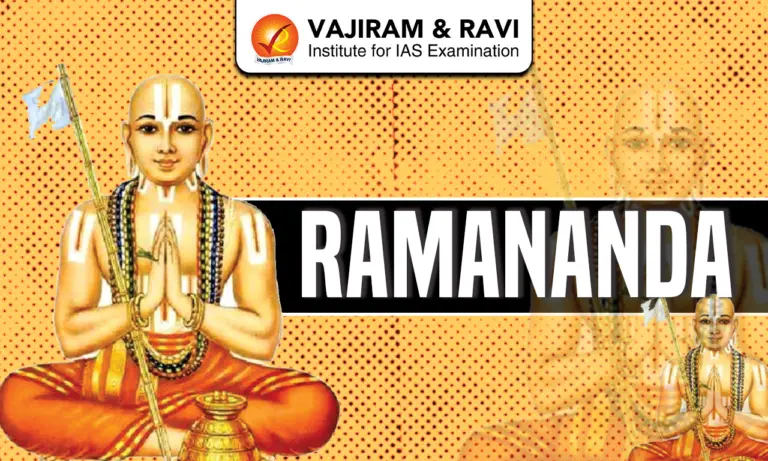
Ramananda was a 14th-15th century Vaishnava devotional saint and social reformer of North India’s Gangetic basin, associated with the Bhakti movement’s early expansion. He emphasized devotion to Rama and accessibility of religion. He is regarded as a key link between southern traditions of Ramanuja and the emerging northern Bhakti currents.
Ramananda Biography
Ramananda, also known as Ramanandacharya or Ramadatta, was born in a Kanyakubja Brahmin family and spent most of his life in Varanasi. He studied Vedic texts, yogic practices, and the philosophy of Ramanuja under teacher Raghavananda. He was influenced by both Vaishnava Vedanta and Nathpanthi traditions. He later became an ascetic teacher who preached in Hindi, rejecting caste barriers and promoting devotional equality.
Ramananda Contributions
Ramananda significantly shaped devotional practices, language use, and social inclusivity in medieval North India through his teachings and reformist approach.
- Use of Vernacular Language: Ramananda taught in Hindi instead of Sanskrit, making religious ideas accessible to common people, as Sanskrit knowledge was limited to upper castes, thereby democratizing spiritual discourse.
- Social Equality: He rejected caste restrictions in spiritual practice, allowing disciples from all backgrounds, including women and lower castes, such as Ravidas and Kabir.
- Bridge Between Bhakti Traditions: Ramananda is regarded as a connecting figure between southern Vaishnism of Ramanuja and northern Bhakti traditions, helping expand devotional movements across regions.
- Literary Contributions: He is attributed with works like Gyan-Lila, Yog-cintamani, Vaishnava Matabja Bhaskara, and Ramarchana Paddhati, though authorship remains debated among scholars.
- Philosophical Synthesis: His teachings attempted to blend Advaita Vedanta and Bhakti, accepting both Nirguna Bhakti Dhara (formless) and Saguna Bhakti Dhara (with attributes) forms of Brahman in devotional practice.
- Critique of Ritualism: Ramananda emphasized inner devotion over external rituals, rejecting mechanical practices like fasting and rote recitation without understanding spiritual meaning.
- Influence on Sikh Texts: Some of his verses appear in the Guru Granth Sahib, indicating his influence beyond Hindu traditions into Sikh devotional literature.
Also Check: Women in Bhakti Movement





Ramanandi Sampradaya
The Ramanandi Sampradaya emerged as a major Vaishnava monastic tradition centered on devotion to Rama and inclusive spiritual practices.
- Foundation and Identity: Ramananda is traditionally considered the founder of the Ramanandi Sampradaya, also called Shri Ramavat or Vairagi Sampradaya, though historical evidence suggests its expansion occurred after the 17th century.
- Largest Monastic Order: It is the largest Vaishnava ascetic order in North India and possibly the largest monastic community in the Indian subcontinent, with followers known as Ramanandis, Vairagis, or Bairagis.
- Core Beliefs: The sect emphasizes devotion to Rama and Vishnu, while also acknowledging multiple forms of divine worship, reflecting flexibility within Vaishnavism.
- Inclusive Membership: The order historically accepted members from diverse social groups, continuing Ramananda’s principle of spiritual equality beyond caste, gender, or religious identity.
- Disciplinary Lifestyle: Ramanandis follow a strict, austere, and disciplined ascetic life, marked by simplicity, renunciation, and structured monastic practices.
- Debates: Scholars and radical Ramanandis in the 20th century questioned its connection with Ramanuja and Brahmanical lineage, indicating contested historical origins.
- Cultural and Regional Spread: The sampradaya has a wide presence across North India and Nepal, with numerous monasteries and temples, maintaining strong influence in religious and social spheres.
Also Check: Sikh Reform Movements

 Last updated on April, 2026
→ UPSC Final Result 2025 is now out.
→ UPSC has released UPSC Toppers List 2025 with the Civil Services final result on its official website.
→ Anuj Agnihotri secured AIR 1 in the UPSC Civil Services Examination 2025.
→ UPSC Marksheet 2025 is now out.
→ UPSC Notification 2026 & UPSC IFoS Notification 2026 is now out on the official website at upsconline.nic.in.
→ UPSC Calendar 2026 has been released.
→ Check out the latest UPSC Syllabus 2026 here.
→ UPSC Prelims 2026 will be conducted on 24th May, 2026 & UPSC Mains 2026 will be conducted on 21st August 2026.
→ The UPSC Selection Process is of 3 stages-Prelims, Mains and Interview.
→ Prepare effectively with Vajiram & Ravi’s UPSC Prelims Test Series 2026 featuring full-length mock tests, detailed solutions, and performance analysis.
→ Enroll in Vajiram & Ravi’s UPSC Mains Test Series 2026 for structured answer writing practice, expert evaluation, and exam-oriented feedback.
→ Join Vajiram & Ravi’s Best UPSC Mentorship Program for personalized guidance, strategy planning, and one-to-one support from experienced mentors.
→ Shakti Dubey secures AIR 1 in UPSC CSE Exam 2024.
→ Also check Best UPSC Coaching in India
Ramananda FAQs
Q1. Who was Ramananda?+
Q2. What were Ramananda’s main teachings?+
Q3. Who were the disciples of Ramananda?+
Q4. What is the Ramanandi Sampradaya?+
Q5. What is the role of Ramananda in the Bhakti Movement?+
Tags: bhakti movement history medieval history ramananda