Rat-Hole Mining Latest News
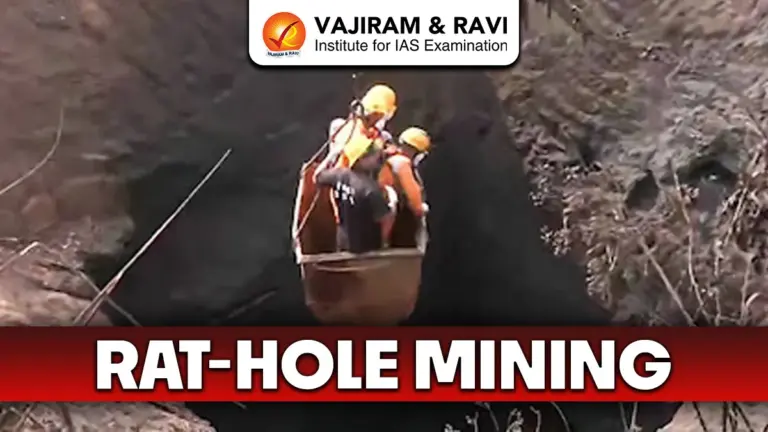
- A deadly explosion in an illegally operating rat-hole coal mine in East Jaintia Hills district, Meghalaya, has resulted in the death of 25 miners.
- The incident has once again highlighted the persistence of illegal mining in the state despite a ban by the National Green Tribunal (NGT) and the Supreme Court.
- It raises serious concerns about regulatory enforcement, governance failure, labour safety, and disaster management preparedness.
Nature of the Incident
- A dynamite explosion occurred in a rat-hole mine in the Thangkso area, a remote region with poor connectivity.
- Rescue teams comprising the NDRF, SDRF, and Special Rescue Teams retrieved multiple bodies from narrow underground tunnels.
- The mine structure included –
- Five vertical shafts (almost 100 feet deep)
- Each shaft branching into 2–3 narrow horizontal tunnels
- Tunnels measuring only 2 feet high and 3 feet wide, requiring miners to crawl
- Three bodies were found 350 feet horizontally inside a rat-hole tunnel.
- Rescue operations were hampered by –
- Water accumulation
- Mudslides due to dripping water
- Rockfall hazards
- Extremely confined working spaces





Rat-Hole Mining – Structural and Environmental Concerns
- What is rat-hole mining?
- A primitive and hazardous coal extraction method, which involves digging narrow pits and horizontal tunnels to manually extract coal.
- It is widely prevalent in Meghalaya due to unique land ownership patterns (community/private ownership).
- Why is it problematic?
-
- Because it violates the Mines and Minerals (Development and Regulation) Act, 1957 (MMDR Act).
- It was banned by the NGT (2014) and the ban was upheld by the Supreme Court.
- These violations leads to –
- Severe environmental degradation
- Acid mine drainage
- Water contamination
- Land instability
- Loss of biodiversity
- There is a complete absence of worker safety mechanisms.
Legal and Administrative Dimensions
- Criminal action: Following the incident, a case FIR registered under charges that include culpable homicide, violation of the MMDR Act and the Explosive Substances Act. Two mine owners were arrested.
- Judicial oversight:
- Justice (Retd) BP Katakey committee: Appointed by the Meghalaya High Court to monitor illegal coal-mining in the state since 2022 following a suo-motu PIL taken up by the court on the issue.
- Findings: Flagged Widespread illegal mining in Meghalaya, particularly the East Jaintia Hills.
- Meghalaya HC: “No one in the state, except the high court, is taking the issue very seriously”.
Scale of the Illegal Mining Problem
- As per Justice Katakey Committee findings, over 22,000 illegal mine openings in East Jaintia Hills alone, and over 25,000 across Meghalaya.
- East Jaintia Hills was identified as the worst-affected district.
- Past tragedies: 2018 Ksan incident – 15 miners killed in flooding, Umpleng incident – 5 miners died.
- This indicates a pattern of systemic regulatory collapse rather than isolated accidents.
Challenges Highlighted
- Governance deficit: Weak enforcement of NGT and Supreme Court orders. Lack of political and administrative will. Local complicity and informal protection networks.
- Terrain and accessibility: Remote location (25 km takes around 3 hours by road). Difficult terrain requiring 4WD vehicles. Slows both regulation and rescue.
- Informal labour exploitation: Migrant and economically vulnerable workers. Absence of safety nets or formal contracts. Occupational hazards without social security.
- Disaster management constraints: Hazardous confined spaces. Waterlogging and collapse risk. Inadequate early detection and monitoring systems.
- Constitutional and federal complexity: Meghalaya’s Sixth Schedule status. Community land ownership under Autonomous District Councils. Regulatory ambiguity exploited for illegal mining.
- Broader issues:
- Sustainable Development vs livelihood concerns
- Environmental governance and rule of law
- Judicial activism vs executive inaction
- Cooperative federalism in resource regulation
- Disaster risk reduction in informal sectors
- Internal security linkages (illegal mining networks and criminal economy)
Way Forward
- Strict enforcement and monitoring: Real-time satellite surveillance of illegal mining. Independent regulatory authority for mining oversight. Strengthened coordination between State Government, Autonomous Councils, and Centre.
- Institutional accountability: Fix responsibility of district officials. Time-bound compliance reporting to High Court. Strengthen implementation of MMDR Act provisions.
- Formalisation of the mining sector: Introduce regulated, scientific, and environmentally compliant mining models. Alternative livelihood programs for affected communities. Skill development and employment diversification.
- Environmental restoration: Mine closure plans. Rehabilitation of degraded land and water bodies. Polluter Pays Principle implementation.
- Worker safety framework: Strict compliance with labour laws. Insurance and compensation mechanisms. Community awareness regarding occupational risks.
Conclusion
- The Meghalaya rat-hole mining tragedy is not merely a mining accident—it is a stark reminder of the consequences of institutional apathy, regulatory failure, and socio-economic vulnerability.
- Despite judicial bans and repeated warnings, illegal mining continues unabated, turning preventable disasters into recurring tragedies.
- Ensuring environmental sustainability, worker safety, and accountable administration is not just a policy necessity but a constitutional obligation under Articles 21 and 48A of the Indian Constitution.
- Unless systemic reforms replace episodic reactions, such “incidents waiting to happen” will continue to claim lives.
Source: IE

 Last updated on April, 2026
→ UPSC Final Result 2025 is now out.
→ UPSC has released UPSC Toppers List 2025 with the Civil Services final result on its official website.
→ Anuj Agnihotri secured AIR 1 in the UPSC Civil Services Examination 2025.
→ UPSC Marksheet 2025 is now out.
→ UPSC Notification 2026 & UPSC IFoS Notification 2026 is now out on the official website at upsconline.nic.in.
→ UPSC Calendar 2026 has been released.
→ Check out the latest UPSC Syllabus 2026 here.
→ UPSC Prelims 2026 will be conducted on 24th May, 2026 & UPSC Mains 2026 will be conducted on 21st August 2026.
→ The UPSC Selection Process is of 3 stages-Prelims, Mains and Interview.
→ Prepare effectively with Vajiram & Ravi’s UPSC Prelims Test Series 2026 featuring full-length mock tests, detailed solutions, and performance analysis.
→ Enroll in Vajiram & Ravi’s UPSC Mains Test Series 2026 for structured answer writing practice, expert evaluation, and exam-oriented feedback.
→ Join Vajiram & Ravi’s Best UPSC Mentorship Program for personalized guidance, strategy planning, and one-to-one support from experienced mentors.
→ Shakti Dubey secures AIR 1 in UPSC CSE Exam 2024.
→ Also check Best UPSC Coaching in India
Rat-Hole Mining FAQs
Q1. What are the structural and environmental challenges associated with rat-hole mining in Meghalaya?+
Q2. Despite the NGT and SC ban, why illegal mining continues in Meghalaya?+
Q3. How does the Meghalaya mining tragedy highlight gaps in India’s disaster management framework?+
Q4. What is the role of judicial intervention in addressing illegal coal mining in Meghalaya?+
Q5. What measures are required to balance livelihood concerns with environmental sustainability?+
Tags: mains articles rat-hole mining upsc current affairs upsc mains current affairs