Goldilocks Phase Latest News
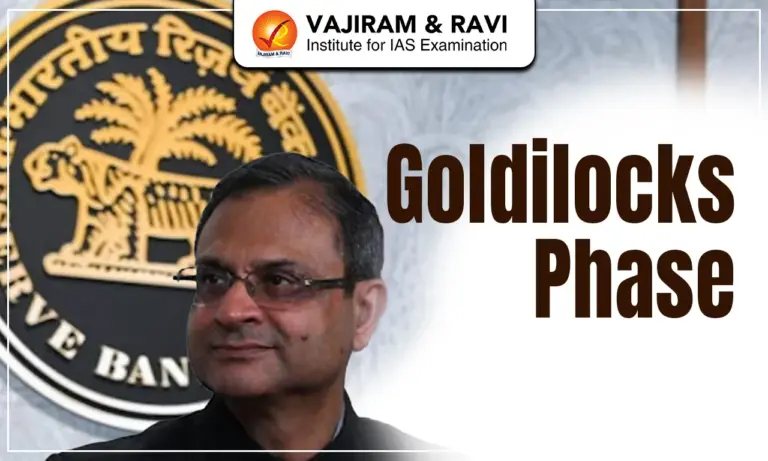
- As the current RBI Governor completes his first year, the Indian economy finds itself in an unexpectedly strong position despite global turmoil — including trade wars, steep U.S. tariffs, and geopolitical conflicts.
- The Governor described the moment as a “rare goldilocks period,” with inflation at just 2.2% and GDP growth at 8% in the first half of 2025–26.
- Reflecting this strength, the Monetary Policy Committee cut the repo rate by 25 bps to 5.25%.
- This favourable phase has been building over time: retail inflation has fallen for three consecutive years, and GDP growth has averaged 8.2% over four-and-a-half years.
- Even excluding the high-base recovery year of 2021–22, growth has averaged 7.8% between 2022–23 and Q2 of 2025–26.
Goldilocks Conditions: Low Inflation, Strong Growth, and Policy Consistency
- India’s economy is enjoying a rare goldilocks phase with falling inflation and robust growth, even though the rupee has weakened over 5% in 2025 and recently crossed the 90-per-dollar mark.
- Economists say the depreciation is not a monetary policy concern, and the RBI has rightly avoided the temptation to defend the currency.
- By cutting the repo rate by 25 bps — bringing total easing in 2025 to 125 bps — the RBI has demonstrated policy consistency.
- Analysts note that just as the central bank would tighten policy if inflation stayed above 6% for six months, it should ease when inflation remains below 2% for a similar period.
- With inflation currently well under the lower tolerance limit of the RBI’s 2–6% target band, the rate cut aligns with the central bank’s mandate to anchor inflation around 4% in the medium term.





Why Inflation Trends Created Room for Aggressive Easing
- The document shows that inflation in 2025 collapsed faster than expected, breaching the lower tolerance band for the first time under the flexible inflation-targeting framework.
- This broad-based disinflation expanded the RBI’s policy space dramatically, allowing the MPC to cut rates without risking overheating.
- The December cut was positioned as a continuation of measured easing, not the start of an open-ended cycle.
RBI’s Strategic Logic Behind the Additional Rate Cut
- Disinflation Is Durable, Not Temporary – The RBI believes the sharp decline in inflation is structural enough to justify further easing.
- Support Domestic Demand Amid Global Weakness – With global trade slowing, financial volatility rising, and geopolitical tensions persisting, the RBI used its policy room to buffer the economy.
- Maintain Policy Consistency – After pausing in October to confirm the durability of disinflation, the December cut aligns cumulative easing with evolving macro data.
More Rate Cuts Likely as Inflation Eases and Growth Set to Slow
- Despite stronger-than-expected 8.2% GDP growth in July–September, the RBI delivered a unanimous rate cut, lowered its 2025–26 inflation forecast to 2%, and signalled flexibility in its forward guidance.
- This prompted economists to expect another rate cut in February.
- RBI Governor Malhotra noted that underlying price pressures are even weaker than headline inflation suggests.
- Economists anticipate growth moderation in the second half of 2025–26 due to factors such as reduced government spending and the impact of the 50% U.S. tariff on Indian exports.
- RBI also acknowledged that growth will “soften somewhat”. It now projects GDP growth to drop to 7% in Q3 and 6.5% in Q4 of 2025–26.
RBI’s New Approach to the Rupee: More Flexibility, Less Intervention
- While growth and inflation have been favourable, the rupee’s sharp depreciation remains a challenge.
- RBI Governor avoided commenting directly on the currency’s slide during his policy statement, insisting that market fluctuations are normal and the RBI intervenes only to curb “abnormal” volatility.
- Despite his remarks, India’s exchange rate management has shifted significantly under his tenure.
- The IMF recently reclassified India’s regime from “stabilised” to a “crawl-like arrangement,” noting that increased flexibility will help the economy absorb external shocks.
- Economists broadly agree that the RBI need not aggressively defend the rupee.
- However, whether the current growth–inflation goldilocks phase will persist once India unveils its new GDP and inflation series in February 2026 remains an open question.
Balancing Growth Momentum and Future Risks
- The document emphasises that the RBI’s move is best understood against a backdrop of:
- Tariff-related risks from the U.S.
- Ongoing geopolitical tensions
- Volatile global markets
- Potential balance-of-payments pressures
- By cutting rates now, the RBI strengthened domestic demand while acknowledging uncertain global headwinds.

 Last updated on April, 2026
→ UPSC Final Result 2025 is now out.
→ UPSC has released UPSC Toppers List 2025 with the Civil Services final result on its official website.
→ Anuj Agnihotri secured AIR 1 in the UPSC Civil Services Examination 2025.
→ UPSC Marksheet 2025 is now out.
→ UPSC Notification 2026 & UPSC IFoS Notification 2026 is now out on the official website at upsconline.nic.in.
→ UPSC Calendar 2026 has been released.
→ Check out the latest UPSC Syllabus 2026 here.
→ UPSC Prelims 2026 will be conducted on 24th May, 2026 & UPSC Mains 2026 will be conducted on 21st August 2026.
→ The UPSC Selection Process is of 3 stages-Prelims, Mains and Interview.
→ Prepare effectively with Vajiram & Ravi’s UPSC Prelims Test Series 2026 featuring full-length mock tests, detailed solutions, and performance analysis.
→ Enroll in Vajiram & Ravi’s UPSC Mains Test Series 2026 for structured answer writing practice, expert evaluation, and exam-oriented feedback.
→ Join Vajiram & Ravi’s Best UPSC Mentorship Program for personalized guidance, strategy planning, and one-to-one support from experienced mentors.
→ Shakti Dubey secures AIR 1 in UPSC CSE Exam 2024.
→ Also check Best UPSC Coaching in India
Goldilocks Phase FAQs
Q1. Why does the RBI call this a ‘goldilocks’ period?+
Q2. Why did the RBI cut rates despite strong GDP data?+
Q3. What is the logic behind further rate cuts?+
Q4. How has RBI’s approach to the rupee changed?+
Q5. What risks still weigh on RBI policy?+
Tags: Goldilocks phase mains articles upsc current affairs upsc mains current affairs