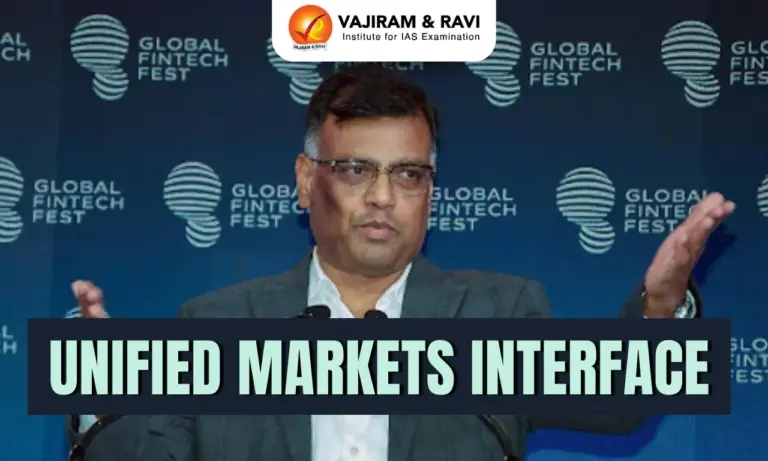
Unified Markets Interface Latest News
- The Reserve Bank of India has launched the Unified Markets Interface (UMI) to enable tokenisation and settlement of financial assets using wholesale CBDC.
About the Unified Markets Interface
- The Reserve Bank of India (RBI) has unveiled the Unified Markets Interface (UMI), a ground-breaking initiative that aims to transform India’s financial infrastructure by introducing asset tokenisation and settlements using wholesale Central Bank Digital Currency (CBDC).
- The announcement was made by the RBI Governor at the Global Fintech Fest 2025, emphasising UMI as a “next-generation financial market infrastructure.”
- The initiative is expected to enhance market efficiency, transparency, and liquidity, while also reinforcing India’s leadership in fintech innovation.





Understanding Asset Tokenisation
- Asset tokenisation is the process of converting real-world assets, such as government securities, bonds, or commodities, into digital tokens recorded on a blockchain or distributed ledger. Each token represents a share of ownership in the underlying asset.
- This approach allows for:
- Fractional ownership, enabling small investors to participate in large-value assets.
- Improved liquidity, as tokens can be traded globally and instantly.
- Enhanced transparency, since all transactions are recorded on an immutable blockchain.
- Faster settlements, reducing intermediaries through smart contracts.
- Globally, tokenisation has emerged as a major innovation in financial systems.
- Countries like Singapore, Switzerland, and the UK are piloting tokenised securities, while India’s RBI is among the first major central banks to explore tokenisation via wholesale CBDC.
Integration with Wholesale Central Bank Digital Currency
- The UMI will leverage the wholesale CBDC, a digital form of central bank money, for settlements.
- Unlike the retail CBDC, which targets individual users, the wholesale CBDC is designed for institutional financial transactions, offering secure, real-time settlements without intermediary banks.
- Early pilot results of the wholesale CBDC under the RBI’s Digital Rupee project have shown promising outcomes in reducing settlement risks and improving market efficiency.
- With UMI, the RBI plans to integrate CBDC into the broader market ecosystem, enabling tokenised trading of financial assets such as corporate bonds, Treasury bills, and derivatives.
Enhancing Data Integration and Financial Inclusion
- The Governor highlighted the need for a robust digital public infrastructure (DPI) to ensure seamless data integration across financial entities.
- The RBI aims to strengthen frameworks like the Account Aggregator (AA) system, which empowers individuals to safely share financial data with regulated entities.
- As of 2025, the Account Aggregator ecosystem includes:
- 17 registered aggregators,
- 650 Financial Information Users (FIUs) such as banks and NBFCs,
- 150 Financial Information Providers (FIPs), and
- Over 160 million linked accounts, processing 3.66 billion data-sharing requests.
- The RBI is now developing new standards to:
- Enhance data security and transparency,
- Improve customer onboarding processes,
- Refine consent management and user interfaces, and
- Ensure greater interoperability among AAs.
- These efforts complement the introduction of UMI by ensuring that digital market systems remain secure, efficient, and inclusive.
Broader Fintech Innovations Announced
- Alongside UMI, the RBI also launched four new digital payment innovations to strengthen India’s fintech landscape:
- UPI HELP – An AI-based Small Language Model (SLM) developed in-house, capable of assisting users with transaction queries, complaint tracking, and mandate management. Currently available in English, it will soon expand to Indian languages.
- IoT Payments with UPI – A feature enabling machine-to-machine payments using the Internet of Things (IoT), allowing devices like cars, appliances, and smart meters to make automatic payments.
- Banking Connect – An interoperable net banking platform designed to resolve challenges like slow navigation, inconsistent merchant integration, and complex dispute resolution.
- UPI Reserve Pay – A service that lets users block or reserve part of their credit card or credit line limit for recurring payments across e-commerce and service platforms, enhancing convenience and credit control.
Significance of the Unified Markets Interface
- Modernisation of Financial Markets: By integrating blockchain and CBDC, UMI will help move toward a fully digital market infrastructure.
- Transparency and Traceability: Tokenisation ensures every transaction is verifiable and tamper-proof.
- Global Integration: Enables cross-border trading and interoperability with international digital financial systems.
- Operational Efficiency: Reduces transaction times, costs, and settlement risks.
- Inclusion and Accessibility: Smaller investors can access traditionally high-entry financial assets through fractional tokenised units.

 Last updated on March, 2026
→ UPSC Final Result 2025 is now out.
→ UPSC has released UPSC Toppers List 2025 with the Civil Services final result on its official website.
→ Anuj Agnihotri secured AIR 1 in the UPSC Civil Services Examination 2025.
→ UPSC Marksheet 2025 is now out.
→ UPSC Notification 2026 & UPSC IFoS Notification 2026 is now out on the official website at upsconline.nic.in.
→ UPSC Calendar 2026 has been released.
→ Check out the latest UPSC Syllabus 2026 here.
→ UPSC Prelims 2026 will be conducted on 24th May, 2026 & UPSC Mains 2026 will be conducted on 21st August 2026.
→ The UPSC Selection Process is of 3 stages-Prelims, Mains and Interview.
→ Prepare effectively with Vajiram & Ravi’s UPSC Prelims Test Series 2026 featuring full-length mock tests, detailed solutions, and performance analysis.
→ Enroll in Vajiram & Ravi’s UPSC Mains Test Series 2026 for structured answer writing practice, expert evaluation, and exam-oriented feedback.
→ Join Vajiram & Ravi’s Best UPSC Mentorship Program for personalized guidance, strategy planning, and one-to-one support from experienced mentors.
→ Shakti Dubey secures AIR 1 in UPSC CSE Exam 2024.
→ Also check Best UPSC Coaching in India
Unified Markets Interface FAQs
Q1. What is the Unified Markets Interface (UMI)?+
Q2. What is asset tokenization?+
Q3. How does UMI use wholesale CBDC?+
Q4. What role does the Account Aggregator framework play?+
Q5. What other fintech innovations did RBI launch along with UMI?+
Tags: mains articles Unified Markets Interface upsc current affairs upsc mains current affairs