Key Updates on REER:
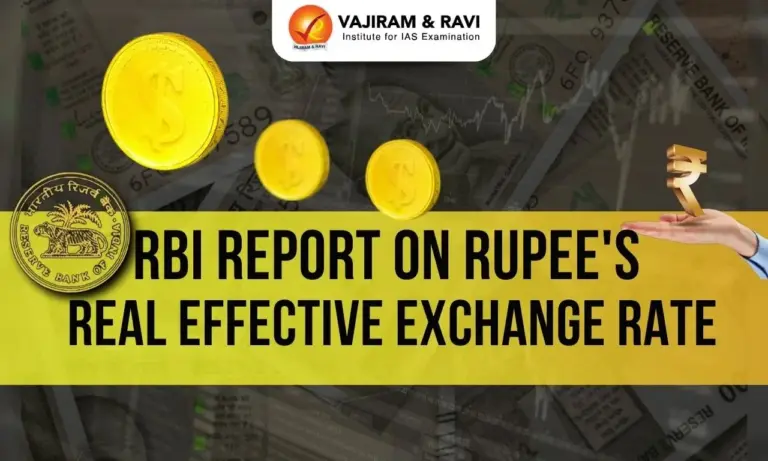
- Record High REER: The Reserve Bank of India (RBI) has reported that the rupee’s Real Effective Exchange Rate (REER) reached 108.14 in November 2024, increasing from 107.20 in October 2024. This marks its highest level this year.
- Implications of Overvaluation: A REER value above 100 signifies that the rupee is overvalued relative to the base year (2015-16), leading to reduced export competitiveness while making imports cheaper.
About NEER and REER
- NEER (Nominal Effective Exchange Rate): It is the weighted average of a currency’s bilateral exchange rates with multiple trading partner currencies.
- NEER reflects the nominal strength of a currency but does not adjust for inflation or price level differences.
- A rise in NEER indicates nominal appreciation, while a decline signals depreciation.
- REER (Real Effective Exchange Rate): An improvement over NEER, it adjusts for relative price levels (inflation) between domestic and foreign economies.
- Calculated as: NEER × (Domestic Price Index ÷ Foreign Price Index).
- It is a purchasing power parity (PPP)-adjusted measure of competitiveness.
- Currency basket for India’s Indices: Earlier, the NEER and REER indices included six major currencies: US Dollar (USD), Euro (EUR), Japanese Yen (JPY), British Pound (GBP), Chinese Yuan (CNY), and Singapore Dollar (SGD).
- The indices now encompass a broader basket of 36 currencies, reflecting India’s diverse trade relations.
- Factors influencing NEER and REER:
- Productivity differences: Affect competitiveness and influence REER values.
- Terms of Trade: The balance of exports and imports can impact both indices.
- Inflation: Higher inflation erodes currency value, affecting REER.
- Fiscal spending: Impacts economic stability and demand, influencing exchange rate dynamics.
Q1. What is a Bank Rate?
The bank rate is the rate at which the Reserve Bank of India (RBI) provides the loans to commercial banks without keeping any security. No agreement on repurchase will be drawn up or agreed upon with no collateral as well. The RBI allows short-term loans with the presence of collateral.
Source: IE





 Last updated on March, 2026
→ UPSC Final Result 2025 is now out.
→ UPSC has released UPSC Toppers List 2025 with the Civil Services final result on its official website.
→ Anuj Agnihotri secured AIR 1 in the UPSC Civil Services Examination 2025.
→ UPSC Marksheet 2025 is now out.
→ UPSC Notification 2026 & UPSC IFoS Notification 2026 is now out on the official website at upsconline.nic.in.
→ UPSC Calendar 2026 has been released.
→ Check out the latest UPSC Syllabus 2026 here.
→ UPSC Prelims 2026 will be conducted on 24th May, 2026 & UPSC Mains 2026 will be conducted on 21st August 2026.
→ The UPSC Selection Process is of 3 stages-Prelims, Mains and Interview.
→ Prepare effectively with Vajiram & Ravi’s UPSC Prelims Test Series 2026 featuring full-length mock tests, detailed solutions, and performance analysis.
→ Enroll in Vajiram & Ravi’s UPSC Mains Test Series 2026 for structured answer writing practice, expert evaluation, and exam-oriented feedback.
→ Join Vajiram & Ravi’s Best UPSC Mentorship Program for personalized guidance, strategy planning, and one-to-one support from experienced mentors.
→ Shakti Dubey secures AIR 1 in UPSC CSE Exam 2024.
→ Also check Best UPSC Coaching in India