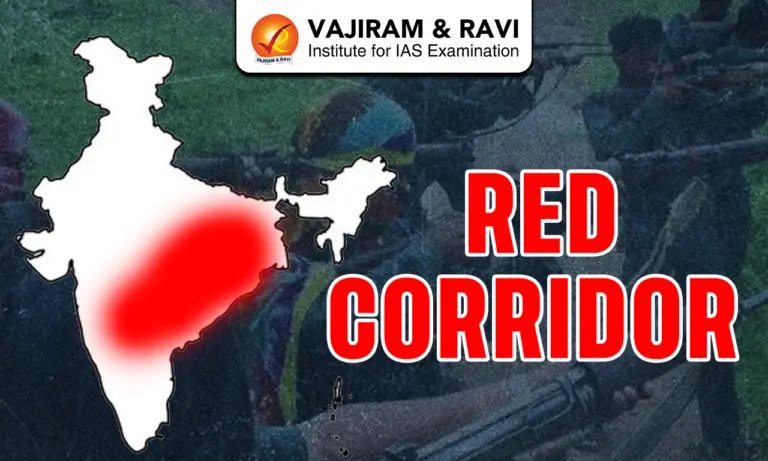
The Red Corridor refers to the regions in India affected by the Naxalite-Maoist insurgency, representing one of the most significant internal security challenges. It includes areas historically marked by poverty, underdevelopment and weak governance. Over decades, it witnessed violence, parallel authority structures and socio-economic disruption, but recent years have seen a sharp decline due to coordinated security and development strategies.
Red Corridor
The Red Corridor is the geographical zone where Naxalite influence exists, primarily in central, eastern and southern India. As of April 2026, it has significantly contracted and now includes only two districts across Chhattisgarh and Jharkhand, reflecting a major reduction from its earlier vast spread across multiple states and hundreds of districts.
Red Corridor Historical Background
The Red Corridor emerged from the Naxalite-Maoist insurgency that began in 1967 after the Naxalbari uprising.
- It developed as a conflict between left wing extremist groups and the Indian state, rooted in agrarian distress and tribal discontent.
- The insurgency started after the 1967 Naxalbari uprising and split in Communist Party of India (Marxist), leading to a Marxist-Leninist faction promoting armed struggle and rural revolution.
- Naxalite organisations were declared terrorist organisations under the Unlawful Activities (Prevention) Act 1967, due to their violent activities against security forces and governance structures.
- The movement emerged due to land inequality, lack of tribal rights over natural resources and absence of development in forested and mineral rich regions.





Red Corridor Districts
The categorisation of affected districts under Red Corridor has evolved to better reflect ground realities and improve targeted intervention strategies by the government.
- As of 2026, Bijapur in Chhattisgarh and West Singhbhum in Jharkhand are classified as LWE affected districts, representing the highest intensity of remaining Maoist activity.
- Kanker in Chhattisgarh falls under Districts of Concern category, indicating moderate influence where focused interventions are still required to prevent resurgence of extremist activities.
Red Corridor Government Initiatives
The government adopted a multi dimensional approach combining security, development, infrastructure and rehabilitation to eliminate Left Wing Extremism from the Red Corridor.
- National Policy and Action Plan 2015: This policy integrates security measures, development interventions and rights based governance to comprehensively address extremism in affected areas.
- Security Related Expenditure (SRE) Scheme: Under this scheme, ₹1,685 crore released up to 2023-24 reimburses states for security operations, rehabilitation, ex-gratia payments and community policing efforts.
- Special Central Assistance (SCA): Funds provided to fill critical infrastructure gaps in most affected districts, ensuring development reaches remote and vulnerable populations.
- Special Infrastructure Scheme (SIS): Funds exceeding ₹371 crore and extended allocations strengthen state police, intelligence branches and fortified police stations to improve operational capacity.
- Fortified Police Stations: The number increased from 66 before 2014 to over 586, significantly enhancing security presence in remote and insurgency prone areas.
- Road Connectivity: More than 12,000 km roads constructed, with 17,589 km approved, improving mobility, governance reach and socio-economic integration in previously inaccessible regions.
- Telecom Connectivity: Over 10,000 mobile towers planned, with thousands operational, ensuring digital connectivity and improved intelligence gathering in remote regions.
- Financial Inclusion Measures: Establishment of 1,804 bank branches, 1,321 ATMs and 37,850 banking correspondents brought formal banking to previously excluded populations.
- Skill Development Initiatives: 48 Industrial Training Institutes and 61 Skill Development Centres established, creating employment opportunities and reducing recruitment into extremist groups.
- NIA Anti Naxal Operations: Dedicated vertical investigated 108 cases and filed charge sheets in 87, weakening organisational networks and financial channels of Maoist groups.
Red Corridor Decline
The Red Corridor has witnessed a sharp decline due to sustained security operations, development initiatives and improved governance mechanisms across affected regions.
- Reduction in Districts: The number of affected districts declined from nearly 180 in late 2000s to 38 in 2024, 18 in 2025 and only 2 districts by April 2026.
- Decline in Violence: Violent incidents reduced by 53% from 16,463 (2004-2014) to 7,744 (2014-2024), showing a significant weakening of insurgent capabilities.
- Casualty Reduction: Security force deaths declined by 73% and civilian deaths by 70%, indicating improved operational success and reduced impact on local populations.
Red Corridor Achievements
Significant achievements highlight the success of coordinated efforts in dismantling the Red Corridor and restoring governance and development.
- Security Success: In 2025, 317 Naxals were neutralised, over 800 arrested and nearly 2,000 surrendered, indicating high attrition within insurgent ranks.
- Infrastructure Expansion: Construction of 586 fortified police stations, 361 camps and 68 helipads strengthened security reach in remote and forested areas.
- Surrender and Rehabilitation: Attractive policies offering ₹2.5-5 lakh incentives and monthly stipends led to large scale surrender and reintegration of cadres into society.
- Liberation of Strongholds: Areas like Budha Pahad, Parasnath and Abujhmad were freed from decades long Maoist control, marking a major strategic breakthrough.
- Decline in Police Incidents: Police stations reporting Naxal incidents reduced from 330 in 2013 to 52 by 2025, showing improved law and order conditions.

 Last updated on April, 2026
→ UPSC Final Result 2025 is now out.
→ UPSC has released UPSC Toppers List 2025 with the Civil Services final result on its official website.
→ Anuj Agnihotri secured AIR 1 in the UPSC Civil Services Examination 2025.
→ UPSC Marksheet 2025 is now out.
→ UPSC Notification 2026 & UPSC IFoS Notification 2026 is now out on the official website at upsconline.nic.in.
→ UPSC Calendar 2026 has been released.
→ Check out the latest UPSC Syllabus 2026 here.
→ UPSC Prelims 2026 will be conducted on 24th May, 2026 & UPSC Mains 2026 will be conducted on 21st August 2026.
→ The UPSC Selection Process is of 3 stages-Prelims, Mains and Interview.
→ Prepare effectively with Vajiram & Ravi’s UPSC Prelims Test Series 2026 featuring full-length mock tests, detailed solutions, and performance analysis.
→ Enroll in Vajiram & Ravi’s UPSC Mains Test Series 2026 for structured answer writing practice, expert evaluation, and exam-oriented feedback.
→ Join Vajiram & Ravi’s Best UPSC Mentorship Program for personalized guidance, strategy planning, and one-to-one support from experienced mentors.
→ Shakti Dubey secures AIR 1 in UPSC CSE Exam 2024.
→ Also check Best UPSC Coaching in India
Red Corridor FAQs
Q1. What is the Red Corridor?+
Q2. How many districts are affected by the Red Corridor in 2026?+
Q3. What caused the emergence of the Red Corridor?+
Q4. Which are the most affected districts in 2026?+
Q5. What is the government’s target regarding the Red Corridor?+
Tags: geography geography notes red corridor