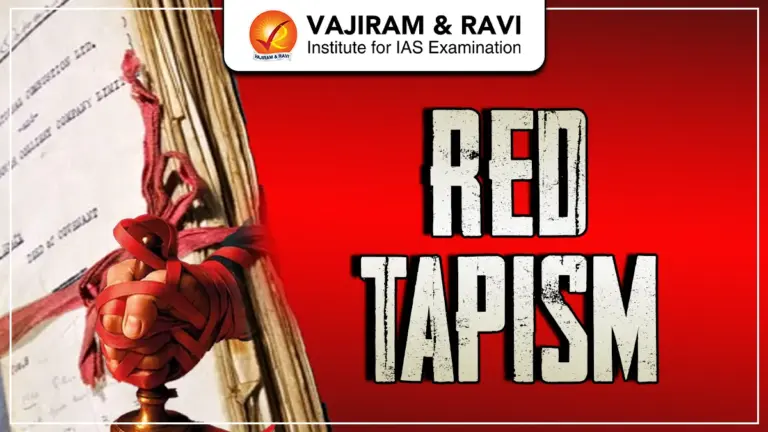
Red Tapism refers to the excessive adherence to formal rules, procedures, and bureaucratic requirements that delay decision making without adding real administrative value. It is commonly associated with public administration but is also observed in private organisations. Red Tapism increases compliance costs in terms of time, money, and human effort, reducing efficiency, accountability, and public trust in governance systems across countries.
Red Tapism
Red Tapism is the manifestation of red tape in administrative functioning, where procedures become ends in themselves rather than means to effective governance. It represents unnecessary, duplicative, outdated, or poorly designed regulations that impose avoidable compliance burdens. Unlike essential safeguards, Red Tapism generates administrative costs beyond what is required to achieve policy objectives, thereby slowing service delivery and economic activity.
Red Tapism Historical Background
Red Tapism evolved alongside expanding bureaucratic states and complex governance systems, historically emerging from administrative control mechanisms rather than service oriented governance.
- Early Administrative Origins: The term originated in the 16th century Spanish administration under Charles V, where red ribbons bound urgent state files, symbolising procedural formalism over outcomes.
- British Institutionalisation: In Britain, red tape became synonymous with bureaucratic inertia during the 19th century, highlighted in literary critiques by Charles Dickens and Thomas Carlyle.
- Colonial Administrative Legacy: Colonial administrations used rigid procedures to enforce control, prioritising rule compliance over responsiveness, shaping bureaucratic cultures in many post colonial states.
- United States Expansion: Early 20th century America associated red tape with military procurement delays and veterans’ record management, reflecting procedural overload.
- Post War Governance Growth: After World War II, expanding welfare states and regulatory regimes increased paperwork and layered approvals, deepening Red Tapism.
- Modern Regulatory Proliferation: Late 20th century governance saw rapid regulatory growth, often without sunset clauses, converting useful rules into persistent administrative burdens.





Red Tapism Causes
Red Tapism arises from structural, institutional, behavioural, and technological factors that reinforce procedural rigidity.
- Over Regulation: Excessive rules created without adequate problem analysis lead to compliance requirements that exceed policy necessity.
- Rules Becoming Obsolete: Regulations designed for older technologies or conditions persist even after their relevance ends, increasing procedural redundancy.
- Layered Decision Making: Multiple approval levels create delays as files move sequentially rather than concurrently.
- Risk Averse Bureaucracy: Fear of accountability encourages officials to rely excessively on rules rather than professional judgment.
- Lack of Accountability Mechanisms: Weak performance evaluation allows inefficient procedures to continue unchecked.
- Colonial Administrative Structures: Legacy systems prioritise control, documentation, and hierarchy over service delivery.
- Discretionary Power Concentration: Officials controlling approvals may maintain complexity to preserve authority.
- Inconsistent Rule Interpretation: Ambiguity across departments results in repetitive documentation and procedural duplication.
- Poor Digital Integration: Fragmented IT systems replicate paperwork instead of eliminating it.
- Cultural Formalism: Organisational cultures equate compliance with effectiveness, discouraging innovation.
Read About: Judicial Reforms in India
Red Tapism Impact
Red Tapism produces measurable economic, administrative, social, and ethical consequences across governance systems.
- Economic Growth Constraint: Studies across 68 countries show excessive bureaucracy discourages investment and slows technological diffusion.
- Business Compliance Costs: In Canada, regulatory red tape cost businesses approximately USD 11 billion in 2020, representing nearly 28% of total regulatory burden.
- Reduced Job Creation: Research links red tape with lower firm growth, reduced competitiveness, and weaker employment generation.
- Public Sector Inefficiency: Surveys of public servants reveal that unnecessary documentation reduces operational effectiveness and internal service quality.
- Employee Burnout: Studies in Korea, Belgium, Chile, and New Zealand link red tape to emotional exhaustion and declining job satisfaction.
- Risk Averse Governance: Officials prioritise procedural safety over problem solving, delaying critical decisions.
- Delayed Public Services: Welfare schemes and infrastructure projects experience prolonged implementation timelines due to layered approvals.
- Erosion of Public Trust: Persistent delays weaken citizen confidence in institutions.
- Increased Informality: Complex procedures push citizens and firms toward informal or illegal alternatives.
- Policy Ineffectiveness: Administrative overload dilutes the intended impact of welfare and development programs.
Red Tapism Prevention Measures
Reducing Red Tapism requires structural reforms, political commitment, ethical governance, and digital transformation.
- Regulatory Simplification: Periodic review and repeal of obsolete rules prevent accumulation of unnecessary procedures.
- Sunset Clauses: Automatic expiration of regulations ensures continued relevance and accountability.
- Digital Governance: Integrated online platforms reduce paperwork, duplication, and discretionary delays.
- Single Window Systems: Unified clearance mechanisms minimise inter departmental procedural overlaps.
- Decriminalisation of Minor Offences: Shifting technical violations from criminal prosecution to administrative adjudication reduces procedural congestion.
- Faceless Administration: Electronic assessment and appeals limit discretion and procedural bias.
- Performance Audits: Regular evaluation of administrative efficiency discourages procedural formalism.
- Capacity Building: Training officials in ethical decision making and problem solving reduces rule bound inertia.
- Citizen Feedback Mechanisms: Direct reporting of procedural bottlenecks helps prioritise reforms.
- Strong Political Leadership: Evidence shows successful red tape reduction depends on sustained executive commitment.
Red Tapism International Aspects
Red Tapism is a global governance challenge addressed through varied reform strategies across countries.
- European Union: The EU has pursued administrative burden reduction since the 1990s, focusing on regulatory simplification and harmonisation across the single market.
- United Kingdom: Regulatory reform initiatives estimated potential GDP gains exceeding 1% through red tape reduction.
- Canada: The federal one-for-one rule mandates removal of an existing regulation for every new administrative burden introduced.
- British Columbia Model: A 37% regulatory reduction achieved between 2001 and 2004 through strong political leadership and ministerial accountability.
- United States: Red tape reduction featured in the National Performance Review and later initiatives to limit regulatory expansion.
- South Korea: Institutionalised regulatory impact assessments, sunset clauses, and digital complaint platforms reduced redundant procedures.
- New Zealand: Creation of a Ministry for Regulation in 2023 institutionalised the principle that regulation should be a last resort.
- Latin America: Countries like Mexico and Spain have faced persistent red tape challenges, affecting business formation and innovation.
- Global Trade Impact: Misaligned regulations across jurisdictions increase transaction costs and restrict cross border commerce.
- Governance Rankings: Ease of Doing Business indicators historically highlight red tape as a major development barrier.

 Last updated on March, 2026
→ UPSC Final Result 2025 is now out.
→ UPSC has released UPSC Toppers List 2025 with the Civil Services final result on its official website.
→ Anuj Agnihotri secured AIR 1 in the UPSC Civil Services Examination 2025.
→ UPSC Marksheet 2025 is now out.
→ UPSC Notification 2026 & UPSC IFoS Notification 2026 is now out on the official website at upsconline.nic.in.
→ UPSC Calendar 2026 has been released.
→ Check out the latest UPSC Syllabus 2026 here.
→ UPSC Prelims 2026 will be conducted on 24th May, 2026 & UPSC Mains 2026 will be conducted on 21st August 2026.
→ The UPSC Selection Process is of 3 stages-Prelims, Mains and Interview.
→ Prepare effectively with Vajiram & Ravi’s UPSC Prelims Test Series 2026 featuring full-length mock tests, detailed solutions, and performance analysis.
→ Enroll in Vajiram & Ravi’s UPSC Mains Test Series 2026 for structured answer writing practice, expert evaluation, and exam-oriented feedback.
→ Join Vajiram & Ravi’s Best UPSC Mentorship Program for personalized guidance, strategy planning, and one-to-one support from experienced mentors.
→ Shakti Dubey secures AIR 1 in UPSC CSE Exam 2024.
→ Also check Best UPSC Coaching in India
Red Tapism FAQs
Q1. What is Red Tapism?+
Q2. Why is Red Tapism considered harmful?+
Q3. Is Red Tapism limited to government offices?+
Q4. How does Red Tapism affect economic growth?+
Q5. How can Red Tapism be reduced?+
Tags: red tapism