Aravallis Latest News
- Amid criticism over the government’s new definition of the Aravalli Hills, the Environment Ministry said there was no immediate ecological threat and that the range remains protected, with mining allowed in only 0.19% of its total area.
- While the government has paused new mining leases pending further study, critics argue that official assurances do not address disputed court submissions or broader environmental threats beyond mining.
New Aravalli Definition: What Changes and Why It Matters
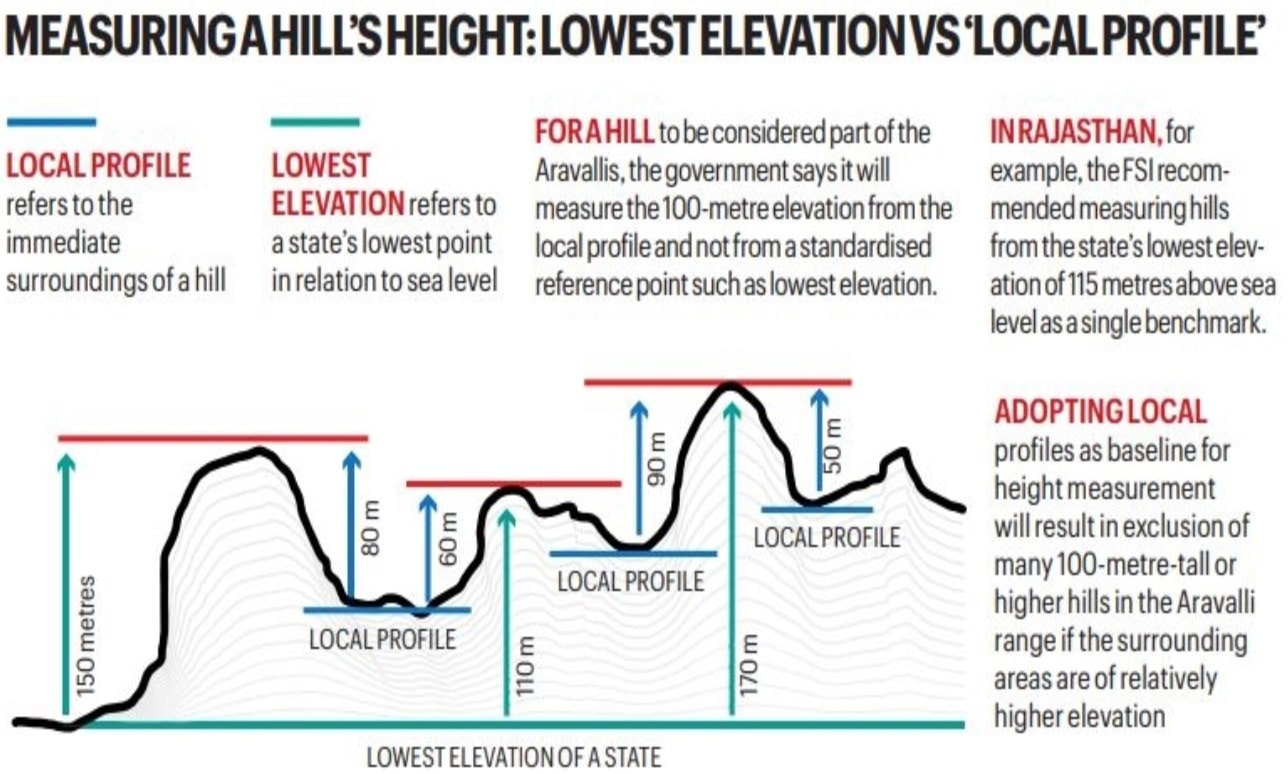
- A new definition of the Aravalli Hills, approved by the Supreme Court in November 2025, classifies only landforms rising 100 metres or more above local relief—along with their slopes and adjoining areas—as part of the range.
- Critics argue that using local profile instead of a standard baseline could exclude large stretches of the Aravallis from protection.
- The Environment Ministry has said that no new mining leases will be granted until a detailed study is completed under the court’s order.





What Remains Protected in the Aravallis
- Several parts of the Aravallis continue to enjoy strong legal protection, including tiger reserves, national parks, wildlife sanctuaries, eco-sensitive zones, notified wetlands, and compensatory afforestation plantations.
- These areas remain closed to mining or development unless explicitly permitted under wildlife or forest laws, regardless of whether they fall within the revised Aravalli definition.
Protection Is Not Always Permanent
- However, such safeguards can be revised or diluted.
- A recent attempt by the Centre and Rajasthan to redefine the boundaries of the Sariska tiger reserve—which could have opened nearby areas to mining—was halted only after intervention by the Supreme Court, highlighting the fragility of regulatory protection.
How the New Benchmark Still Includes Some Areas
- The new benchmark does not exclude all landforms below 100 metres.
- Any landform rising at least 100 metres above its local profile qualifies as part of the Aravalli Hills.
- Moreover, if two such hills are within 500 metres, the intervening land—regardless of its elevation—will also be treated as part of the Aravalli range.
What the New Aravalli Definition Excludes
- The new parameters exclude large areas earlier identified as Aravalli under the Forest Survey of India (FSI) 3-degree slope formula, which classifies land as Aravalli if it lies above a state’s minimum elevation (115 m in Rajasthan) and has a slope of at least 3 degrees.
- Rajasthan—home to nearly two-thirds of the Aravalli range—faces the biggest exclusions.
Entire Districts Dropped from the Aravalli List
- Several districts earlier counted among the 34 Aravalli districts across Gujarat, Rajasthan, Haryana, and Delhi are now excluded. Notably:
- Sawai Madhopur (Ranthambhore Tiger Reserve; Aravalli–Vindhya convergence),
- Chittorgarh (UNESCO World Heritage fort on an Aravalli outcrop),
- Nagaur (where FSI mapped 1,110 sq km as Aravalli),
- are missing from the updated list submitted to the Supreme Court.
Overstated Extent and the Mining Claim
- While the government cited mining as limited to 0.19% of a 1.44 lakh sq km Aravalli expanse, this figure effectively covers the entire landmass of the 34 listed districts, not the actual hill range.
- Under the FSI method, the Aravallis span 40,483 sq km across 15 districts of Rajasthan—about 33% of those districts’ area.
Scale of Exclusion Under the 100-Metre Benchmark
- Applying the new 100-metre local relief definition would exclude 99.12%—1,17,527 of 1,18,575—of the Aravalli hills (including slopes and surroundings) identified by the FSI in these 15 districts, dramatically shrinking the range’s officially recognised footprint.
What the Centre Told the Supreme Court
- The Environment Ministry informed the Supreme Court that the 100-metre definition would include a larger area of the Aravallis than the 3-degree slope formula used by the Forest Survey of India (FSI).
- This was despite the FSI flagging concerns that the new benchmark would exclude vast tracts earlier identified as Aravalli.
Argument Based on District Averages
- The Ministry argued that in 12 of the 34 Aravalli districts, the average slope is below 3 degrees—implying these districts would be excluded under the FSI method.
- Critics note this averages plains with hills, understating the slopes of actual hilly areas and thereby weakening the comparison.
Local Profile as the Baseline
- The Ministry told the court that elevation would be measured from the local profile rather than a standardised reference point (such as Rajasthan’s lowest elevation of 115 m used by the FSI).
- Using local profiles can exclude even 100-metre-high hills if surrounding terrain is already elevated (saddles), potentially shrinking the officially recognised Aravalli footprint despite claims to the contrary.
Inclusion vs Exclusion: The Core of the Aravalli Debate
- Limits of the Mining Argument
- The government has highlighted that only a small fraction of the Aravallis would be legally open to mining.
- However, concerns persist about illegal mining, the future expansion of mining in areas excluded by the 100-metre definition, and the cumulative ecological impact of individual mining blocks on surrounding landscapes.
- Environmental Risks Beyond Mining
- Mining is not the only threat.
- By de-recognising large hilly tracts, especially in the Delhi NCR, where Aravalli ranges taper in height, the new definition could open vast areas to real estate and infrastructure development, posing serious environmental risks.
- Committee’s Rationale: Avoiding ‘Over-Inclusion’
- The ministry-led committee told the Supreme Court that not every hill is Aravalli and not every part of Aravalli is hilly, warning against “inclusion errors” if slope alone is used to define boundaries.
- It argued for caution in wrongly categorising non-Aravalli land.
- Critics’ Concern: Exclusion Takes Priority
- While acknowledging non-hilly stretches, the submission places greater emphasis on preventing inclusion of extra areas rather than on the risk of excluding genuine Aravalli landscapes, raising concerns that environmental protection may be weakened in the process.
Source: IE

 Last updated on April, 2026
→ UPSC Final Result 2025 is now out.
→ UPSC has released UPSC Toppers List 2025 with the Civil Services final result on its official website.
→ Anuj Agnihotri secured AIR 1 in the UPSC Civil Services Examination 2025.
→ UPSC Marksheet 2025 is now out.
→ UPSC Notification 2026 & UPSC IFoS Notification 2026 is now out on the official website at upsconline.nic.in.
→ UPSC Calendar 2026 has been released.
→ Check out the latest UPSC Syllabus 2026 here.
→ UPSC Prelims 2026 will be conducted on 24th May, 2026 & UPSC Mains 2026 will be conducted on 21st August 2026.
→ The UPSC Selection Process is of 3 stages-Prelims, Mains and Interview.
→ Prepare effectively with Vajiram & Ravi’s UPSC Prelims Test Series 2026 featuring full-length mock tests, detailed solutions, and performance analysis.
→ Enroll in Vajiram & Ravi’s UPSC Mains Test Series 2026 for structured answer writing practice, expert evaluation, and exam-oriented feedback.
→ Join Vajiram & Ravi’s Best UPSC Mentorship Program for personalized guidance, strategy planning, and one-to-one support from experienced mentors.
→ Shakti Dubey secures AIR 1 in UPSC CSE Exam 2024.
→ Also check Best UPSC Coaching in India
Aravallis FAQs
Q1. What is the new Aravalli Hills definition?+
Q2. Why is the new Aravalli definition controversial?+
Q3. What areas remain protected despite the new definition?+
Q4. What does the new definition exclude from Aravalli protection?+
Q5. Why does the inclusion–exclusion debate matter?+
Tags: Aravallis mains articles upsc current affairs upsc mains current affairs