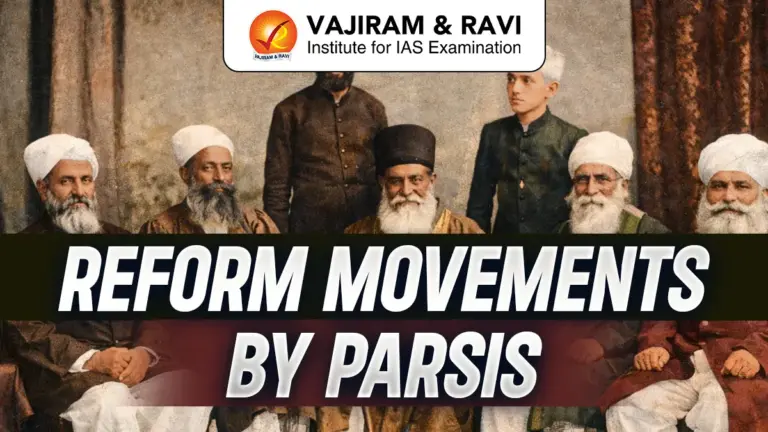
The Reform Movements by Parsis emerged in the mid nineteenth century as a powerful response to internal social stagnation and external pressures such as Christian missionary influence and Western education. The movement was concentrated mainly in Bombay. The Parsis used education, print media and organized associations to modernize Zoroastrian beliefs and social practices. These reforms focused on rational religion, women’s education, opposition to orthodoxy and simplification of rituals. Over time, these efforts transformed the Parsis into one of the most socially progressive and westernised communities in Indian society, while still preserving their religious identity.
Reform Movements by Parsis Historical Timeline
The Reform Movements by Parsis developed gradually during the nineteenth century, shaped by education, print culture and leadership from within the community.
- Early Intellectual Awakening (1840s): Reformist thinking began with journals like Fam-i-Famshid, edited by Nauroji Furdonji, which defended Zoroastrianism while encouraging rational interpretation of religious texts and customs.
- Emergence of Print Culture (1850-1851): Reform leaders used journals such as Jagat Mitra, Jagat Premi and Rast Goftar to reach the Parsi public, spreading ideas on social reform, women’s education and religious rationalism.
- Organised Reform Phase (1851 onwards): The formation of reform associations institutionalised debates on marriage customs, rituals and women’s status, marking a shift from individual critique to collective action.
- Consolidation of Social Change (Late 19th Century): Continuous campaigns against infant marriage, ritual excesses and superstition gradually reshaped Parsi social life and strengthened modern education within the community.
Rahnumai Mazdayasnan Sabha
The Rahnumai Mazdayasnan Sabha played a central role in directing and popularising Reform Movements by Parsis through organised debate and sustained public outreach.
- The Sabha was created in 1851 by educated Parsis with financial backing from K.N. Kama, reflecting internal community support for reform rather than external pressure.
- The organisation opposed rigid orthodoxy and promoted rational understanding of Zoroastrian doctrines, arguing that religion should adapt to reason and social needs.
- Rast Goftar, edited by Dadabhai Naoroji, served as the Sabha’s main voice, publishing articles in Anglo-Gujarati to reach both traditional and modern educated Parsis.
- The Sabha strongly criticised social attitudes that restricted girls’ education, highlighting education as essential for moral, social and economic progress.
- Reformers condemned infant marriage, elaborate ceremonies, astrology and excessive rituals at marriages and funerals, calling them unscientific and socially harmful.
- The Sabha’s radical approach led to divisions, with conservative groups like Raherastnumi Mazdayasnan advocating limited ritual change instead of deep reforms.





Parsi Socio-Religious Reforms
Reform Movements by Parsis addressed multiple aspects of religion and society, aiming for ethical clarity, gender justice and social efficiency as highlighted below:
- Religious Rationalisation: Reformers argued for interpreting Zoroastrian scriptures through reason, rejecting blind ritualism and stressing moral conduct over ceremonial excess.
- Opposition to Orthodoxy: Campaigns challenged priestly dominance and rigid customs, promoting individual understanding of faith rather than unquestioned adherence to tradition.
- Women’s Education: Reform leaders actively supported female education, leading to higher literacy rates among Parsi women compared to most Indian communities of the time.
- Marriage Reforms: The movement opposed infant marriage and encouraged more rational, consent based marital practices aligned with health and social well being.
- Simplification of Rituals: Excessive spending and elaborate rituals at betrothals, marriages and funerals were criticised as economically wasteful and socially regressive.
- Social Position of Women: Reform discourse emphasised improving women’s legal, educational and social status, recognising them as equal moral agents within the community.
- Defence of Zoroastrian Identity: Reformers like Furdonji Naoroji defended the faith against missionary criticism while modernising its internal practices to remain relevant.
- Codification of Religion: Intellectual efforts sought to systematise Zoroastrian beliefs, making them accessible to educated youth influenced by Western rationalism.
Reform Movements by Parsis Leaders
Individual leaders provided intellectual direction, organisational strength and public legitimacy to the Reform Movements by Parsis. List of various leaders involved in the socio-religious reforms were:
- Nauroji Furdonji: A central reformer who edited Fam-i-Famshid, published Tarika Farthest in 1850 and defended Zoroastrianism while advocating internal reform of customs.
- Dadabhai Naoroji: As editor of Rast Goftar, he articulated reformist ideas on religion, education and social ethics, linking Parsi reforms with broader intellectual modernity.
- S.S. Bengalee: A key organiser and secretary of reform associations, he published Jagat Mitra and Jagat Premi, using journalism to spread reformist awareness.
- K.N. Kama: A prominent patron who provided financial support to reform organisations, enabling sustained activities, publications and outreach within the community.
- Behramji Malabari: Though later in period, he extended reformist concerns to women’s rights and social ethics, reinforcing earlier Parsi efforts for gender reform and education.

 Last updated on March, 2026
→ UPSC Final Result 2025 is now out.
→ UPSC has released UPSC Toppers List 2025 with the Civil Services final result on its official website.
→ Anuj Agnihotri secured AIR 1 in the UPSC Civil Services Examination 2025.
→ UPSC Marksheet 2025 is now out.
→ UPSC Notification 2026 & UPSC IFoS Notification 2026 is now out on the official website at upsconline.nic.in.
→ UPSC Calendar 2026 has been released.
→ Check out the latest UPSC Syllabus 2026 here.
→ UPSC Prelims 2026 will be conducted on 24th May, 2026 & UPSC Mains 2026 will be conducted on 21st August 2026.
→ The UPSC Selection Process is of 3 stages-Prelims, Mains and Interview.
→ Prepare effectively with Vajiram & Ravi’s UPSC Prelims Test Series 2026 featuring full-length mock tests, detailed solutions, and performance analysis.
→ Enroll in Vajiram & Ravi’s UPSC Mains Test Series 2026 for structured answer writing practice, expert evaluation, and exam-oriented feedback.
→ Join Vajiram & Ravi’s Best UPSC Mentorship Program for personalized guidance, strategy planning, and one-to-one support from experienced mentors.
→ Shakti Dubey secures AIR 1 in UPSC CSE Exam 2024.
→ Also check Best UPSC Coaching in India
Reform Movements by Parsis FAQs
Q1. When did the Reform Movements by Parsis begin?+
Q2. What was the main aim of Parsi Socio-Religious Reforms?+
Q3. Which organisation played a key role in Reform Movements by Parsis?+
Q4. How did Reform Movements by Parsis impact women?+
Q5. What were the major Journals used in the Parsi Reform Movements?+
Tags: reform movements by parsis