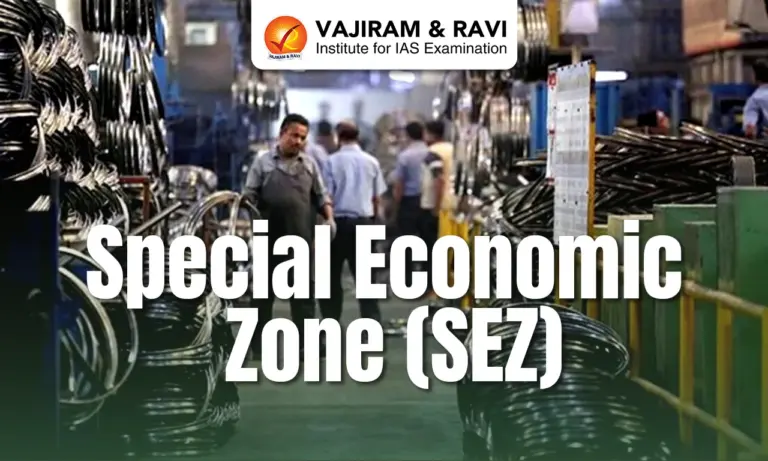
Special Economic Zone (SEZ) Latest News
- A government panel comprising officials from the Commerce and Industry Ministry, NITI Aayog, and exporters is formulating new Special Economic Zone (SEZ) norms to revive manufacturing and support exporters adversely affected by steep US tariffs.
- The move comes amid rising requests for de-notification of SEZ units and demands for a reverse job work policy to enable better domestic market integration.
SEZs in India
- Meaning: SEZs in India are geographically delineated, duty-free enclaves that are treated as foreign territory for the purposes of trade operations, duties, and tariffs.
- Objectives: They are industrial areas designed to promote exports, attract domestic and foreign investment, generate employment, and develop robust infrastructure by offering a more stable and business-friendly regulatory environment with a variety of incentives.
- History:
- 1965 – India’s first Export Processing Zone (EPZ) was set up in Kandla, Gujarat.
- 2000 – India introduced SEZ policy to increase exports and attract Foreign Direct Investment (FDI).
- 2005 – The SEZ Act was passed, formalising SEZ regulation in India.
- 2006 – SEZ rules were notified, leading to rapid growth in SEZ approvals.
- Administration: SEZs are managed through a three-tier structure –
- The Board of Approval (BoA) for approving SEZ establishments,
- The Unit Approval Committee (UAC) at the zone level for unit approvals, and
- The Development Commissioner (DC) who oversees daily operations.
- Operations:
- Operational flexibility is provided through aspects like allowing 100% FDI in most sectors via the automatic route and the requirement for units to be a “Net Foreign Exchange Earner” over a five-year period.
- India currently has nearly 276 operational SEZs across different states, focusing on a wide array of industries including IT, pharmaceuticals, and engineering.





SEZs and Their Challenges
- Export performance: India’s SEZ exports in FY25 stood at $172 billion from nearly 276 units, with only 2% of production catering to the domestic market.
- Comparative lag: Indian SEZs have underperformed compared to China’s SEZ model, which transformed its industrial base through large-scale manufacturing, logistics integration, and export-led growth.
- Current crisis: Several SEZ units catering primarily to the US market face reduced competitiveness due to tariff hikes, leading to production losses and job risks.
Key Policy Demand – Reverse Job Work
- What is reverse job work? A proposed policy allowing SEZ units to perform production or processing work for the domestic tariff area (DTA) instead of exclusively for exports.
- Rationale behind the demand:
-
- Optimal utilisation: SEZ units face seasonal export demand, resulting in underused labour and equipment capacity.
- Efficiency boost: Integration with the domestic market could enhance productivity and resource utilisation.
- Fair competition: The challenge lies in ensuring parity in duty exemptions between SEZ and domestic units so that domestic producers are not disadvantaged.
Sectoral Focus – Gems and Jewellery Industry
- Dominant share: Nearly 65% of India’s studded jewellery exports originate from SEZ units.
- Tariff impact: The US, being the largest destination, has severely affected this sector.
- Industry demands:
-
- Allow reverse job work and DTA sales.
- Extend export obligation periods.
- Grant interest moratorium on packing credit and working capital loans.
- Keep factories and artisans engaged and safeguard employment.
- Trade imbalance concern: Rising imports of raw materials and marginal growth in exports are leading to a negative trade balance within SEZs.
Structural Challenges in SEZs
- Declining unit numbers: For example, before 2019 there were 500 gems and jewellery units, which reduced to around 360 units in 2021-22, reflecting policy uncertainty and reduced fiscal incentives.
- Low R&D investment: Only 4 of 14 surveyed SEZ units invested in R&D, revealing minimal innovation focus.
- Skill and technology gaps: Lack of modern training, inadequate funds, and poor quality of upskilling programmes.
- Weak FDI:
-
- FDI inflows remain low due to –
- Absence of investment protection agreements (unlike Vietnam).
- Negative perception of Indian SEZs.
- Weak brand promotion and marketing efforts.
- FDI is crucial for technology transfer, brand building, and global networking.
- FDI inflows remain low due to –
Institutional and Policy Response
- Instead of waiting for a comprehensive SEZ Bill, the government is considering faster administrative measures.
- However, the Finance Ministry’s reservations on potential revenue loss have delayed immediate implementation.
- The ICRIER has recommended a review of trade balance mechanisms after the removal of the Net Foreign Exchange (NFE) earnings criteria.
Way Forward
- Adopt reverse job work policy: Allow limited DTA access under transparent norms ensuring fairness with domestic manufacturers.
- Promote R&D and skill development: Establish dedicated innovation funds and training centres within SEZs.
- Enhance FDI attractiveness: Introduce investment protection agreements and marketing initiatives to improve SEZ image.
- Streamline SEZ governance: Simplify compliance and integrate SEZs within the logistics and industrial corridors.
- Sectoral support measures: Particularly for gems and jewellery, offer credit relief, export extensions, and infrastructure upgrades.
Conclusion
- India’s SEZ policy is at a crossroads. While global trade disruptions and US tariffs have exposed structural weaknesses, they also present an opportunity to restructure SEZs for long-term competitiveness.
- It is essential to revitalise SEZs as engines of export-led industrial growth, ensuring both resilience and job preservation in key manufacturing sectors.
Source: IE

 Last updated on March, 2026
→ UPSC Final Result 2025 is now out.
→ UPSC has released UPSC Toppers List 2025 with the Civil Services final result on its official website.
→ Anuj Agnihotri secured AIR 1 in the UPSC Civil Services Examination 2025.
→ UPSC Marksheet 2025 is now out.
→ UPSC Notification 2026 & UPSC IFoS Notification 2026 is now out on the official website at upsconline.nic.in.
→ UPSC Calendar 2026 has been released.
→ Check out the latest UPSC Syllabus 2026 here.
→ UPSC Prelims 2026 will be conducted on 24th May, 2026 & UPSC Mains 2026 will be conducted on 21st August 2026.
→ The UPSC Selection Process is of 3 stages-Prelims, Mains and Interview.
→ Prepare effectively with Vajiram & Ravi’s UPSC Prelims Test Series 2026 featuring full-length mock tests, detailed solutions, and performance analysis.
→ Enroll in Vajiram & Ravi’s UPSC Mains Test Series 2026 for structured answer writing practice, expert evaluation, and exam-oriented feedback.
→ Join Vajiram & Ravi’s Best UPSC Mentorship Program for personalized guidance, strategy planning, and one-to-one support from experienced mentors.
→ Shakti Dubey secures AIR 1 in UPSC CSE Exam 2024.
→ Also check Best UPSC Coaching in India
Special Economic Zone (SEZ) FAQs
Q1. What is the objective behind the government’s ongoing reform of Special Economic Zone (SEZ) norms?+
Q2. What is the concept of ‘reverse job work’ policy proposed for SEZs?+
Q3. Why is the gems and jewellery sector particularly affected by the recent US tariff hike?+
Q4. What are the key structural challenges faced by Indian SEZs?+
Q5. What measures are needed to revitalise India’s SEZs?+
Tags: mains articles special economic zones upsc current affairs upsc mains current affairs