What’s in today’s article?
- Why in News?
- What is a RLV?
- What is the RLV LEX?
- What is the History of ISRO’s RLV Missions?
Why in News?
- Recently, the Indian Space Research Organisation (ISRO) successfully conducted an experiment under the Reusable Launch Vehicle Autonomous Landing Mission (RLV LEX).
- It would propel the country forward in its goal to send reusable rockets into space.





What is a RLV?
- The RLV is essentially a space plane with a low lift-to-drag (L/D) ratio, requiring an approach at high glide angles that necessitates a landing at high velocities of 350 kmph.
- In aerodynamics, the L/D ratio is the lift generated by an aerodynamic body such as an aerofoil or aircraft, divided by the aerodynamic drag caused by moving through air.
What is the RLV LEX?
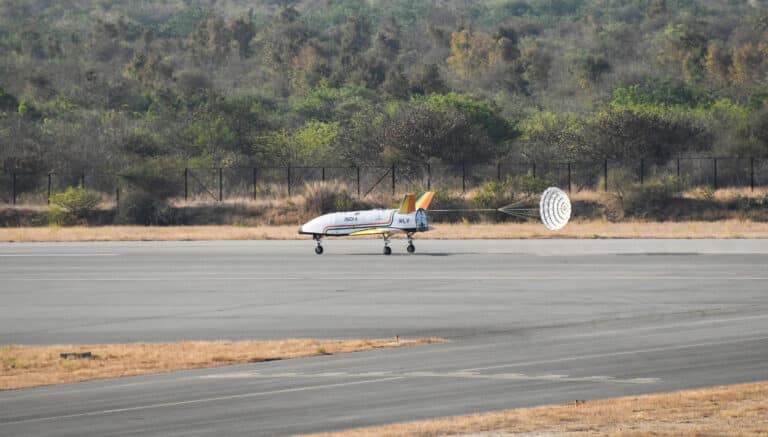
- The test was conducted at the Aeronautical Test Range (ATR), Chitradurga, Karnataka, and with LEX the dream of an Indian RLV arrives one step closer to reality
- In a first in the world, a winged body has been carried to an altitude of 4.5 km by a helicopter and released for carrying out an autonomous landing on a runway.
- The autonomous landing was carried out under the exact conditions of a Space Re-entry vehicle’s landing – high speed, unmanned, precise from the same return path as if the vehicle arrived from space.
What is the History of ISRO’s RLV Missions?
- ISRO had demonstrated the re-entry of its winged vehicle RLV-TD in the HEX (Hypersonic Flight Experiment) mission in 2016.
- The re-entry of a hypersonic sub-orbital vehicle marked a major accomplishment in developing Reusable Launch Vehicles.
- In HEX, the vehicle landed on a hypothetical runway over the Bay of Bengal. Precise landing on a runway was an aspect not included in the HEX mission.
- The LEX mission achieved the final approach phase that coincided with the re-entry return flight path exhibiting an autonomous, high speed (350 kmph) landing.
- The LEX began with an Integrated Navigation test in 2019 and followed multiple Engineering Model Trials and Captive Phase tests in subsequent years.
- More experiments are in the pipeline to ensure that the RLV succeeds in payload delivery to low earth orbit, as ISRO plans to reduce the cost of the process by 80%.
Q1) What are the advantages of Reusable Rocket?
Cost for launching becomes much cheaper as it reduces material cost due to reusability. Some of the reusable rockets use kerosene (of rocket grade type) as fuel which does not generate harmful chlorine as exhaust.
Q2) What are the disadvantages of Reusable Rocket?
Fuel cannot be reused in the rocket as it is released in the atmosphere. Due to cheaper flight costs, more flights are launched at frequent intervals. This leads to more exhaust and more harm to the atmosphere.
Source: ‘India achieved it’: ISRO succeeds in landing Reusable Launch Vehicle | TH | ISRO

 Last updated on March, 2026
→ UPSC Final Result 2025 is now out.
→ UPSC has released UPSC Toppers List 2025 with the Civil Services final result on its official website.
→ Anuj Agnihotri secured AIR 1 in the UPSC Civil Services Examination 2025.
→ UPSC Marksheet 2025 is now out.
→ UPSC Notification 2026 & UPSC IFoS Notification 2026 is now out on the official website at upsconline.nic.in.
→ UPSC Calendar 2026 has been released.
→ Check out the latest UPSC Syllabus 2026 here.
→ UPSC Prelims 2026 will be conducted on 24th May, 2026 & UPSC Mains 2026 will be conducted on 21st August 2026.
→ The UPSC Selection Process is of 3 stages-Prelims, Mains and Interview.
→ Prepare effectively with Vajiram & Ravi’s UPSC Prelims Test Series 2026 featuring full-length mock tests, detailed solutions, and performance analysis.
→ Enroll in Vajiram & Ravi’s UPSC Mains Test Series 2026 for structured answer writing practice, expert evaluation, and exam-oriented feedback.
→ Join Vajiram & Ravi’s Best UPSC Mentorship Program for personalized guidance, strategy planning, and one-to-one support from experienced mentors.
→ Shakti Dubey secures AIR 1 in UPSC CSE Exam 2024.
→ Also check Best UPSC Coaching in India