Royalty Rates Latest News
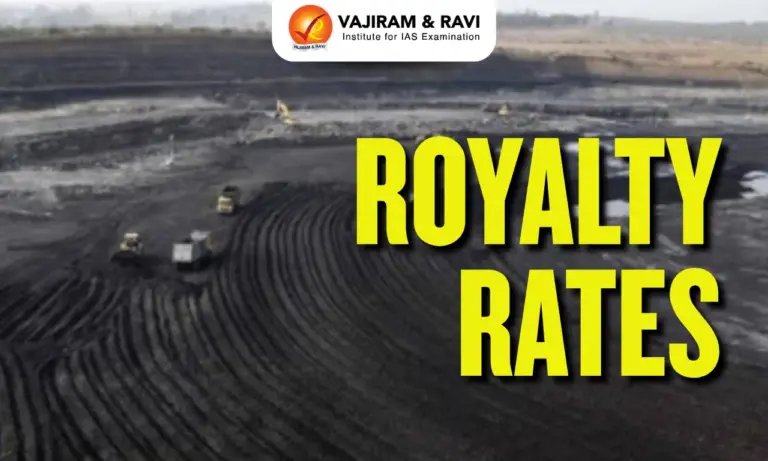
- The Union Government has revised royalty rates for four key critical minerals — graphite, caesium, rubidium, and zirconium — essential for green energy technologies.
- The move aims to boost domestic exploration, reduce import dependence, and strengthen supply-chain security.
- Graphite has shifted from a fixed per-tonne royalty to an ad valorem system. High-grade graphite (80%+ fixed carbon) will now incur a 2% royalty on the Average Sale Price (ASP), while lower-grade graphite attracts 4%.
- Caesium and rubidium will each have a 2% royalty, and zirconium’s rate has been sharply reduced to 1% from the previous 12% uniform levy.
Why India Shifted to Ad Valorem Royalty for Critical Minerals
- ASP (Average Sale Price) reflects the weighted average ex-mine price of minerals from non-captive mines, published monthly by the Indian Bureau of Mines (IBM).
- For minerals lacking domestic pricing, IBM relies on United States Geological Survey (USGS) data converted into INR.
- Experts say shifting to ad valorem royalties makes the system market-responsive and attractive to investors.
- As sale prices rise with global demand, state revenues increase proportionally, ensuring fair value.
- The reform also comes amid China’s prolonged export restrictions on key minerals.
- With China controlling 90% of global critical mineral processing, supply-chain disruptions have pushed India and other countries to diversify sources and stabilise domestic production.





Rising Demand and India’s Critical Mineral Dependency
- India’s renewable energy and EV ambitions will sharply raise demand for critical minerals, many of which the country imports entirely.
- India remains 100% import-dependent for cobalt, lithium, nickel, REEs and silicon — all vital for batteries, solar, semiconductors and advanced electronics.
- The government expects revised royalty rates to attract more bidders and unlock associated minerals such as lithium, tungsten, REEs and niobium.
- However, progress has been limited: since auctions began in 2023, only 34 of 81 critical mineral blocks have received successful bids.
- Despite having sizable reserves, India’s mining and processing capacity remains restricted by policy gaps, technical limitations and insufficient investments.
Revised Royalty Rates: What They Mean for India’s Critical Mineral Push
- India classifies 30 minerals as “critical,” though caesium and rubidium — included in the latest royalty revision — are not part of India’s list, even though countries like the US, Canada and South Korea consider them critical.
- The revised rates are part of a continuing series of royalty reforms, following earlier revisions in 2022, 2023 and early 2024 covering minerals such as cobalt, indium, titanium, tungsten, molybdenum, and REEs.
- Under the MMDR Act’s Second Schedule, most minerals follow an ad valorem royalty structure linked to ASP, while only six, including graphite, previously followed per-tonne rates.
Why the Shift Was Needed
- Earlier, graphite’s per-tonne royalty system made mining unviable during price falls or for lower-grade deposits.
- Moving to ad valorem rates aligns royalties with real market prices, improving commercial viability.
- Caesium, rubidium and zirconium were previously subject to the default 12% ASP rate, despite lacking defined ASPs or domestic production.
- This discouraged bidders and limited exploration.
Expected Impact
- The newly lowered and transparent ad valorem rates are expected to:
- Provide predictable royalty obligations for bidders
- Improve auction participation
- Encourage domestic mining and production of key minerals
- Reduce import dependence and strengthen India’s supply-chain resilience
India’s Critical Mineral Bottleneck: Mining More Isn’t Enough
- India’s critical mineral ecosystem faces structural weaknesses that cannot be solved by royalty revisions alone.
- A study identified regulatory gaps, low private-sector incentives, limited technical expertise, and inadequate financial capacity as major barriers to mining, explaining the modest response to critical mineral auctions.
Weak Processing Capacity: The Core Constraint
- A far deeper challenge lies in mineral processing, where India remains heavily import-dependent.
- The analysis highlights three connected limitations:
- Low processing scale,
- Difficulty securing raw materials, and
- Relatively small domestic demand.
- Even in minerals like copper — where India has significant smelting capacity — the country contributes just 3% of global processed output.
- For rare earth elements, private participation was historically restricted because they were categorised as atomic minerals.
The Way Forward
- Expanding mining alone will not bring self-reliance unless India also builds the ability to convert raw minerals into high-purity materials needed for batteries, semiconductors, optics and advanced manufacturing.
- For true strategic autonomy in EVs, electronics and green technologies, India must develop a full domestic value chain — mining and processing — to reduce import dependence and strengthen supply-chain security.

 Last updated on March, 2026
→ UPSC Final Result 2025 is now out.
→ UPSC has released UPSC Toppers List 2025 with the Civil Services final result on its official website.
→ Anuj Agnihotri secured AIR 1 in the UPSC Civil Services Examination 2025.
→ UPSC Marksheet 2025 is now out.
→ UPSC Notification 2026 & UPSC IFoS Notification 2026 is now out on the official website at upsconline.nic.in.
→ UPSC Calendar 2026 has been released.
→ Check out the latest UPSC Syllabus 2026 here.
→ UPSC Prelims 2026 will be conducted on 24th May, 2026 & UPSC Mains 2026 will be conducted on 21st August 2026.
→ The UPSC Selection Process is of 3 stages-Prelims, Mains and Interview.
→ Prepare effectively with Vajiram & Ravi’s UPSC Prelims Test Series 2026 featuring full-length mock tests, detailed solutions, and performance analysis.
→ Enroll in Vajiram & Ravi’s UPSC Mains Test Series 2026 for structured answer writing practice, expert evaluation, and exam-oriented feedback.
→ Join Vajiram & Ravi’s Best UPSC Mentorship Program for personalized guidance, strategy planning, and one-to-one support from experienced mentors.
→ Shakti Dubey secures AIR 1 in UPSC CSE Exam 2024.
→ Also check Best UPSC Coaching in India
Royalty Rates FAQs
Q1. Why did India revise royalty rates for critical minerals?+
Q2. What major changes were introduced in the royalty structure?+
Q3. How will lower royalty rates help critical mineral mining?+
Q4. What challenges still constrain India’s critical mineral sector?+
Q5. Why is processing capacity a major bottleneck?+
Tags: mains articles royalty rates upsc current affairs upsc mains current affairs