Eco-Sensitive Zone (ESZ) Latest News
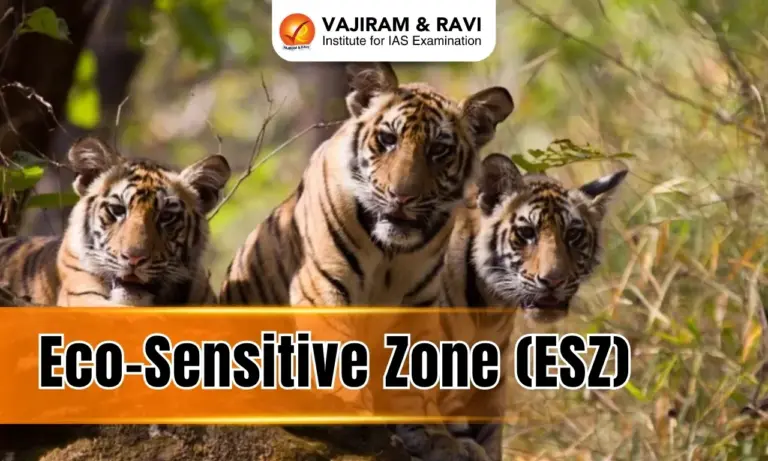
- The recent meeting of the Standing Committee of the National Board for Wildlife (SC-NBWL), chaired by the Union Environment Minister, resolved to revisit the 2011 guidelines on Eco-Sensitive Zones (ESZs).
- The move comes amid concerns about the need for more region-specific, flexible, and balanced ecological governance around India’s protected areas.
Eco-Sensitive Zones (ESZs)
- Meaning:
- Also known as Ecologically Fragile Areas (EFAs), these are areas notified and regulated by the Union Ministry of Environment, Forest and Climate Change (MoEFCC) around Protected Areas, National Parks and Wildlife Sanctuaries.
- The purpose of declaring ESZs:
- To create some kind of shock absorbers to the protected areas by regulating and managing the activities around such areas.
- To act as a transition zone from areas of high protection to areas involving lesser protection.
- Statutory backing: The Environment (Protection) Act 1986 does not mention the word “Eco-Sensitive Zones”, however, the government of India effectively uses the act to declare ESZs.
- The 2011 guidelines: Issued by the MoEF & CC, it provides a framework for declaring ESZs.
- Extent of ESZ: An ESZ could extend up to 10 km around a protected area.





Revision of ESZ Guidelines
- Objective: Make ESZ norms site-specific and aligned with ecological and socio-economic conditions.
- Current status: 2011 guidelines offer an indicative framework on land-use classification and activity regulation (permitted, regulated, prohibited).
- SC directive: Union Environment Ministry to –
- Draft a revised note on ESZs,
- Hold international consultations with relevant divisions (impact assessment, forest conservation, wetlands),
- Conduct multi-stakeholder consultations, and
- Submit findings for further deliberation.
Need for Site-Specific ESZ Framework
- Blanket 10-km norm ineffective: Uniform 10-km ESZ rule is ecologically irrational and developmentally restrictive in varied regions.
- Examples:
- Urban parks: Sanjay Gandhi National Park (Mumbai), Asola Bhatti Sanctuary (Delhi).
- Hill states: Himachal Pradesh has 65% area under forests or protection — strict ESZs may obstruct development.
State-wise Concerns and Inputs
- Himachal Pradesh: Commercial activity regulations affect livelihoods of local people.
- Kerala: Fear of additional restrictions in ESZs discouraged declaration of new sanctuaries.
- Tamil Nadu and Karnataka: Expressed the need for more pragmatic ESZ implementation frameworks.
Gaps in Compliance Monitoring
- SC-NBWL directive:
- Chief Wildlife Wardens of all states must submit compliance reports on cleared infrastructure projects (mining, railways, highways).
- Non-compliance penalty: Proposals from defaulting states won’t be considered.
- Concern raised:
- Implementation of terms and conditions not monitored adequately.
- The committee urged stricter scrutiny and accountability.
Emerging Ecological Concerns
- Large renewable energy projects:
- Concerns: Solar/wind plants near protected areas (PAs) threaten wildlife migration routes and habitats.
- Recommendation: Reclassify/promote regulated activity status even for green projects based on their scale.
- Marine ecosystem oversight:
- Current land-centric ESZ norms unsuited for marine sanctuaries.
- Call for marine-specific regulatory principles.
Critical Reflections on 2011 Guidelines
- Guidelines were already flexible and allowed for region-specific customization.
- Question raised on whether further dilution could undermine core ecological safeguards.
Role of SC-NBWL
- Functions as an advisory body for wildlife policy, conservation strategy, and project appraisals within and around protected areas.
- As of last year, 347 final ESZ notifications were published by the ministry.
Source: IE

 Last updated on March, 2026
→ UPSC Final Result 2025 is now out.
→ UPSC has released UPSC Toppers List 2025 with the Civil Services final result on its official website.
→ Anuj Agnihotri secured AIR 1 in the UPSC Civil Services Examination 2025.
→ UPSC Marksheet 2025 is now out.
→ UPSC Notification 2026 & UPSC IFoS Notification 2026 is now out on the official website at upsconline.nic.in.
→ UPSC Calendar 2026 has been released.
→ Check out the latest UPSC Syllabus 2026 here.
→ UPSC Prelims 2026 will be conducted on 24th May, 2026 & UPSC Mains 2026 will be conducted on 21st August 2026.
→ The UPSC Selection Process is of 3 stages-Prelims, Mains and Interview.
→ Prepare effectively with Vajiram & Ravi’s UPSC Prelims Test Series 2026 featuring full-length mock tests, detailed solutions, and performance analysis.
→ Enroll in Vajiram & Ravi’s UPSC Mains Test Series 2026 for structured answer writing practice, expert evaluation, and exam-oriented feedback.
→ Join Vajiram & Ravi’s Best UPSC Mentorship Program for personalized guidance, strategy planning, and one-to-one support from experienced mentors.
→ Shakti Dubey secures AIR 1 in UPSC CSE Exam 2024.
→ Also check Best UPSC Coaching in India
Eco-Sensitive Zone (ESZ) FAQs
Q1. Why is SC-NBWL revising the 2011 ESZ guidelines?+
Q2. Why is a uniform 10-km ESZ not suitable for all areas?+
Q3. What concerns have states raised on ESZ implementation?+
Q4. What compliance step has SC-NBWL mandated for states?+
Q5. What is the conflict in ESZ demarcation?+
Tags: eco-sensitive zone (esz) mains articles upsc current affairs upsc mains current affairs