What’s in today’s article?
- Why in News?
- Problems of Urban Self-Governance in India
- Key Challenges in Municipal Financing
- Strategies for Strengthening Urban Local Bodies (ULBs)
- Strategic Recommendations for Financial Improvement in MCs
- Some Government Initiatives to Promote Urban Governance in India
- Conclusion
Why in News?
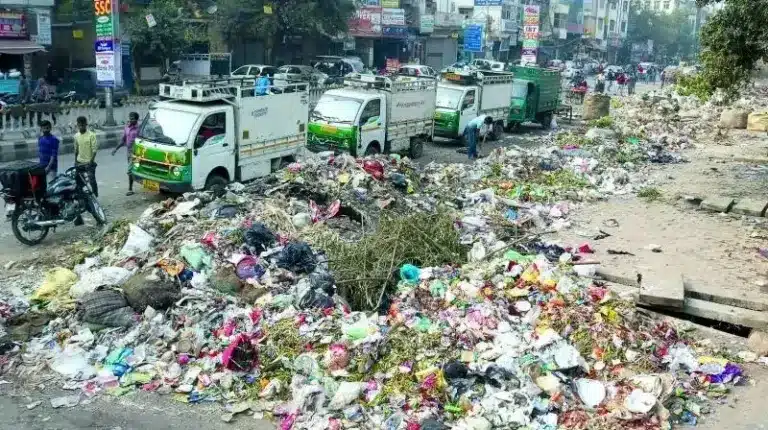
- Urban India, contributing nearly 60% to the nation’s economic output, relies heavily on municipal corporations (MCs) for essential services like road maintenance and sanitation.
- However, the financial constraints faced by the MCs impede their capacity to deliver efficiently.





Problems of Urban Self-Governance in India:

Key Challenges in Municipal Financing:
- Limited revenue generation:
- With revenue receipts constituting a mere 0.6% of GDP in 2023-24, MCs rely significantly on state and central government transfers, curtailing their financial autonomy and developmental capabilities.
- The low revenue receipts of the MCs are mainly because of the poor property tax revenues, a critical revenue source, which remains abysmally low at 0.12% of GDP.
- Revenue concentration: Over 58% of municipal revenue is generated by the top 10 municipal corporations, highlighting fiscal disparity among urban areas.
- Inefficiency in tax and fee collection:
- Ineffective property tax systems fail to reflect actual property valuations.
- User fees for essential services like water supply and sanitation are inadequately adjusted, affecting cost recovery.
Strategies for Strengthening Urban Local Bodies (ULBs):
- Enhancing participatory governance: Encourage direct citizen involvement in policy-making through forums like resident welfare associations, NGOs, and citizen forums.
- Building capacity of municipal personnel: Implement comprehensive training programs that include administrative and management skills. Continuously calibrate training outcomes using measurable indicators.
- Legislative and institutional reforms: Strong institutional arrangements are essential to empower ULBs as self-governing entities. Therefore, states must enact legislative reforms for fiscal and functional devolution.
Strategic Recommendations for Financial Improvement in MCs:
- Enhancing own-source revenues:
- Implement GIS-based property tax mapping for better compliance. Use valuation-linked property tax formulae to improve revenue elasticity.
- Periodic adjustments for cost recovery. Better service delivery to increase public willingness to pay.
- Boosting non-tax revenues:
- Increase income from services like waste management and urban transport through public-private partnerships (PPPs).
- Enhance revenue from investments and user charges via technology integration and monitoring systems.
- Reducing dependence on transfers: Clearly defined, rule-based frameworks for state and central transfers to ensure predictable compensation. Adjust transfer amounts for inflation and economic growth potential.
- Strengthening fiscal management: Digitalisation and automation to streamline expenditures and free resources for capital projects. Pooling resources across MCs to fund large-scale infrastructure projects.
- Exploring innovative financing options:
- Utilise municipal bonds to finance infrastructure development, as adopted by larger MCs.
- Introduce diverse financing instruments to attract private investments in renewable energy and urban transport.
Some Government Initiatives to Promote Urban Governance in India:
- Citizen-centric programs:
- Swachh Sarvekshan (2017) promotes citizen participation to enhance urban hygiene.
- ‘Swachh Bharat Idea Book’ empowers citizens to contribute innovative solutions at the grassroots level.
- Performance-based indexes:
- Ease of Living Index (2017) evaluates urban living quality across three parameters: quality of life, economic ability, and sustainability.
- Municipal Performance Index (2019) assesses ULB performance in service delivery, financial management, planning, technology, and governance.
Conclusion:
- Since empowering ULBs is a national priority, cooperation between the government, academia, and civil society is essential to reaching this objective.
- Through collaborative efforts, MCs can overcome fiscal constraints and deliver sustainable urban development outcomes.
Q.1. What are municipal bonds?
Municipal bonds are debt securities issued by local governments and municipal corporations. The funds raised through municipal bonds are used to finance various public works projects, such as building schools, highways, bridges, and other municipal infrastructure.
Q.2. What is the Municipal Performance Index (MPI)?
The MPI is developed by the Institute of Competitiveness and rolled out by the Ministry of Housing and Urban Affairs (MoHUA) to assess the performance of Indian municipalities.
News: Civic woes: Why municipal corporations’ struggle for revenues mirrors India’s faltering urban development agenda | IIPA

 Last updated on March, 2026
→ UPSC Final Result 2025 is now out.
→ UPSC has released UPSC Toppers List 2025 with the Civil Services final result on its official website.
→ Anuj Agnihotri secured AIR 1 in the UPSC Civil Services Examination 2025.
→ UPSC Marksheet 2025 is now out.
→ UPSC Notification 2026 & UPSC IFoS Notification 2026 is now out on the official website at upsconline.nic.in.
→ UPSC Calendar 2026 has been released.
→ Check out the latest UPSC Syllabus 2026 here.
→ UPSC Prelims 2026 will be conducted on 24th May, 2026 & UPSC Mains 2026 will be conducted on 21st August 2026.
→ The UPSC Selection Process is of 3 stages-Prelims, Mains and Interview.
→ Prepare effectively with Vajiram & Ravi’s UPSC Prelims Test Series 2026 featuring full-length mock tests, detailed solutions, and performance analysis.
→ Enroll in Vajiram & Ravi’s UPSC Mains Test Series 2026 for structured answer writing practice, expert evaluation, and exam-oriented feedback.
→ Join Vajiram & Ravi’s Best UPSC Mentorship Program for personalized guidance, strategy planning, and one-to-one support from experienced mentors.
→ Shakti Dubey secures AIR 1 in UPSC CSE Exam 2024.
→ Also check Best UPSC Coaching in India