Rice Fortification Latest News
- The Centre has temporarily discontinued the Rice Fortification Scheme under PMGKAY and allied schemes, citing findings from an IIT Kharagpur study on nutrient stability.
Background of the Rice Fortification Scheme
- Rice fortification was introduced as a nutritional intervention to address widespread anaemia and micronutrient deficiencies in India.
- Under this initiative, Fortified Rice Kernels (FRK), enriched with iron, folic acid, and vitamin B12, were blended with regular rice and distributed through welfare schemes.
- The scheme was implemented under the Pradhan Mantri Garib Kalyan Anna Yojana (PMGKAY), as well as through the Public Distribution System (PDS), Integrated Child Development Services (ICDS), and the Mid-Day Meal Scheme.
- The objective was to provide essential micronutrients to vulnerable populations, particularly women and children, by leveraging the existing foodgrain distribution network.





Government Decision to Suspend Fortification
- The Union Food Ministry announced that the process of rice fortification would be temporarily discontinued “until a more effective mechanism for delivery of nutrients to beneficiaries is identified.”
- The decision followed a review of the implementation of rice fortification under PMGKAY and allied schemes.
- The Ministry clarified that this suspension does not reduce foodgrain entitlements and will not affect operations under PDS, ICDS, or the Mid-Day Meal Scheme.
- Thus, beneficiaries will continue to receive their allocated foodgrains, albeit without fortification.
Findings of the IIT Kharagpur Study
- The government had commissioned IIT Kharagpur to assess the shelf life of Fortified Rice Kernels (FRK) and fortified rice under actual storage conditions across diverse agro-climatic zones.
- The study concluded that factors such as Moisture content, Storage condition, Temperature, Relative Humidity and Packaging Material critically influence the stability and shelf life of fortified rice.
- The report found that FRK and fortified rice are susceptible to micronutrient reduction during prolonged storage and routine handling.
- Since rice in the central pool may remain in storage for two to three years, the effective shelf life of fortified rice was found to be shorter than expected, thereby limiting the intended nutritional outcomes.
- These findings raised concerns about whether beneficiaries were actually receiving the expected nutritional benefits.
Supply and Storage Context
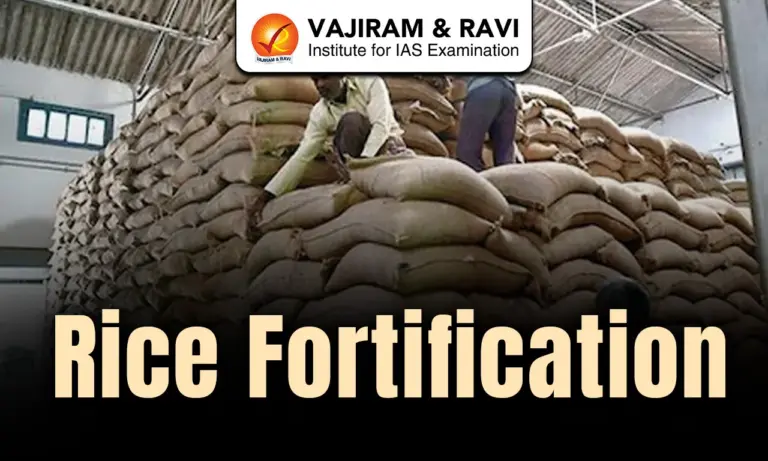
- According to official data, against an annual allocation of 372 lakh metric tonnes (LMT) under PMGKAY and other welfare schemes, total availability in the central pool is projected at 674 LMT, including receipts from the Kharif Marketing Season (KMS) 2025-26.
- Large procurement volumes and extended storage duration increase the challenges associated with maintaining nutrient stability in fortified rice.
- The suspension reflects the difficulty of implementing nutrient-sensitive interventions within large-scale foodgrain logistics systems.
Activist and Public Health Perspectives
- Activists who had challenged the scheme in the Supreme Court welcomed the move.
- They argued that fortification is not a scientific method to curb anaemia and that not all anaemia is linked to iron deficiency.
- Critics have raised concerns about the safety, cost-effectiveness, and regulatory oversight of large-scale fortification. They argue that addressing anaemia requires a more comprehensive approach that includes dietary diversity, improved public health measures, and targeted supplementation rather than blanket fortification.
- This debate highlights the tension between population-wide interventions and targeted nutritional strategies.
Broader Policy Implications
- India continues to face high levels of anaemia, particularly among women and children, as reflected in National Family Health Survey (NFHS) data.
- The rice fortification initiative was seen as a scalable solution leveraging the PDS network.
- However, the IIT study underscores the importance of:
- Ensuring scientific validation of large-scale interventions
- Accounting for storage and climatic variations
- Monitoring nutrient retention over time
- Aligning food policy with logistical realities
- The government has stated that fortification will remain suspended until a more robust and effective nutrient delivery mechanism is developed and operationalised.
- This suggests a possible redesign rather than complete abandonment of micronutrient strategies.

 Last updated on April, 2026
→ UPSC Final Result 2025 is now out.
→ UPSC has released UPSC Toppers List 2025 with the Civil Services final result on its official website.
→ Anuj Agnihotri secured AIR 1 in the UPSC Civil Services Examination 2025.
→ UPSC Marksheet 2025 is now out.
→ UPSC Notification 2026 & UPSC IFoS Notification 2026 is now out on the official website at upsconline.nic.in.
→ UPSC Calendar 2026 has been released.
→ Check out the latest UPSC Syllabus 2026 here.
→ UPSC Prelims 2026 will be conducted on 24th May, 2026 & UPSC Mains 2026 will be conducted on 21st August 2026.
→ The UPSC Selection Process is of 3 stages-Prelims, Mains and Interview.
→ Prepare effectively with Vajiram & Ravi’s UPSC Prelims Test Series 2026 featuring full-length mock tests, detailed solutions, and performance analysis.
→ Enroll in Vajiram & Ravi’s UPSC Mains Test Series 2026 for structured answer writing practice, expert evaluation, and exam-oriented feedback.
→ Join Vajiram & Ravi’s Best UPSC Mentorship Program for personalized guidance, strategy planning, and one-to-one support from experienced mentors.
→ Shakti Dubey secures AIR 1 in UPSC CSE Exam 2024.
→ Also check Best UPSC Coaching in India
Rice Fortification FAQs
Q1. Why has the Rice Fortification Scheme been suspended?+
Q2. What is fortified rice?+
Q3. Will beneficiaries lose foodgrain entitlements?+
Q4. What major concern did the IIT study highlight?+
Q5. What is the broader objective of rice fortification?+
Tags: mains articles rice fortification upsc current affairs upsc mains current affairs