What’s in today’s article?
- Why in News?
- Growing Agricultural Households in India
- How the COVID-19 Impacted this Trend of Rising Agricultural Households and Income?
- Rising Agricultural Dependency Amid Economic Growth
- Way Ahead to Address the Rising Dependence on Agriculture for Livelihoods in India
Why in News?
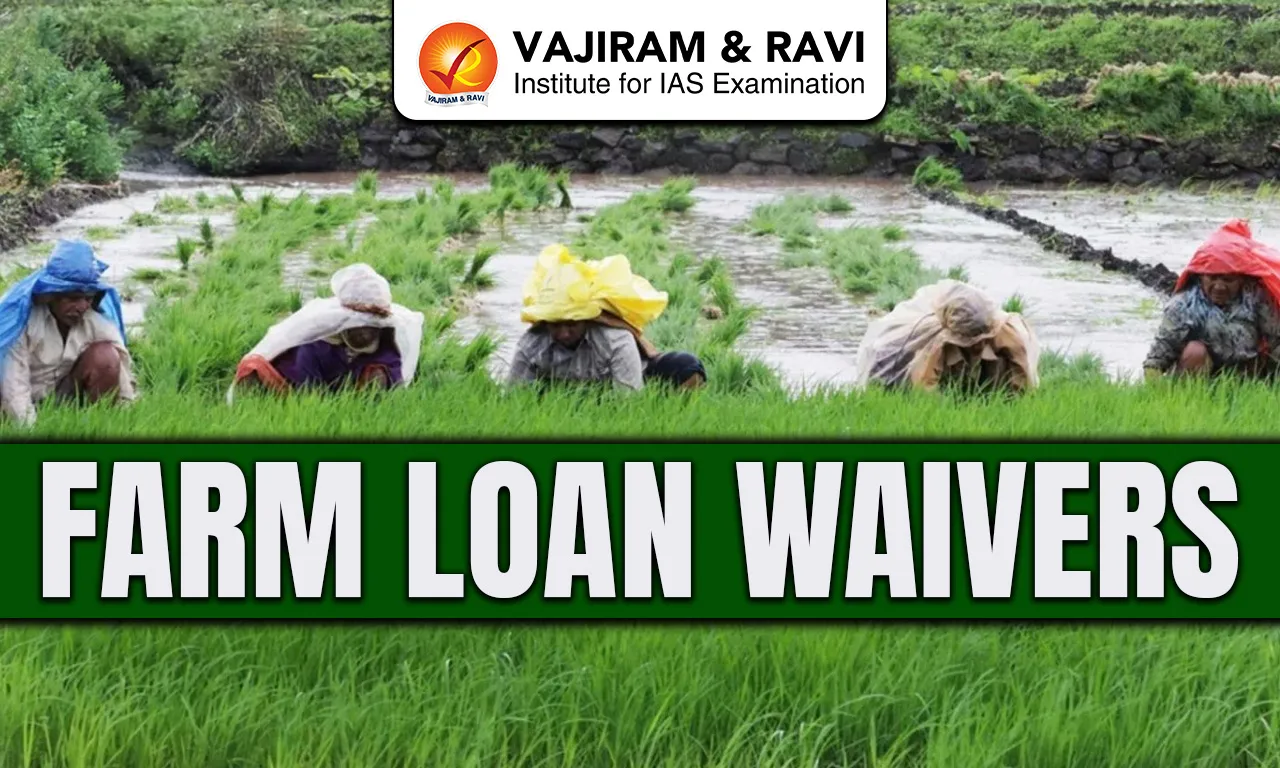
- The landscape of rural India is undergoing a significant transformation, as indicated by the recent All India Rural Financial Inclusion Survey for 2021-22.
- This survey (commissioned by NABARD) reveals a noteworthy increase in the proportion of rural households reliant on agriculture for their livelihoods, signifying a break from a decades-long pattern of dwindling rural agricultural links.




Growing Agricultural Households in India:
- Statistical insights:
- According to the survey, 57% of rural households were classified as “agricultural” in 2021-22, a considerable rise from 48% in 2016-17.
- The survey defines an agricultural household as one that produces crops or livestock worth more than Rs 6,500 (Rs 5,000 in the earlier survey) and has at least one member engaged in self-employment in agricultural activities.
- Income comparison:
- The average monthly income for agricultural households stood at Rs 13,661 in 2021-22, surpassing the Rs 11,438 for non-agricultural rural households.
- Notably, agricultural households have seen their income from farming rise to over 45% of their total income, an increase from 43.1% in 2016-17.
- This trend spans across various land sizes, illustrating a broad-based rise in agricultural income.
How the COVID-19 Impacted this Trend of Rising Agricultural Households and Income?
- Lockdown effects:
- The survey period coincided with the aftermath of COVID-19 lockdowns, which significantly impacted economic activities across sectors.
- Agriculture was exempt from many restrictions, potentially leading to an overestimation of its share in rural livelihoods.
- The favourable monsoon seasons from 2019 further supported agricultural productivity, suggesting a complex interplay between external factors and survey results.
- Labour force dynamics:
- According to the National Sample Survey Office’s (NSSO) Periodic Labour Force Surveys (PLFS), agriculture engaged 64.6% of the country’s workforce in 1993-94.
- That share fell to 58.5% in 2004-05, 48.9% in 2011-12, and a low of 42.5% in 2018-19.
- However, post-2019, the farm sector’s share of the employed labour force rebounded, with figures rising to 45.6% and 46.5% in the pandemic years.
Rising Agricultural Dependency Amid Economic Growth:
- The paradox:
- Despite the Indian economy experiencing robust growth, with an annual GDP increase of 8.3% in recent years, agricultural dependency has persisted.
- The proportion of the rural workforce engaged in agriculture rose from 57.8% in 2018-19 to 59.8% in 2023-24.
- This trend presents a paradox: why is a growing economy relying more on agriculture?
- Structural employment issues:
- This paradox can be partly explained by the stagnation in manufacturing employment, which accounted for only 11.4% of the workforce in 2023-24, down from previous years.
- The movement of surplus labour does not appear to be transitioning from agriculture to manufacturing; instead, it is shifting to informal sectors with similar low productivity and wage characteristics.
- Regional disparities in agricultural employment:
- According to the PLFS data for 2023-24, States like Chhattisgarh (63.8%), MP (61.6%), and UP (55.9%) have high agricultural workforce shares, while states like Goa (8.1%) and Kerala (27%) exhibit much lower dependence on agriculture.
- These variations highlight regional economic conditions and the effectiveness of rural development initiatives.
Way Ahead to Address the Rising Dependence on Agriculture for Livelihoods in India:
- The rising dependence on agriculture for livelihoods in India necessitates a thorough examination of underlying causes.
- As the economy grows, the challenge remains to create sustainable employment opportunities outside of agriculture.
- Policymakers need to focus on strengthening the agricultural sector while simultaneously promoting diversification into higher productivity sectors.
- Understanding this paradox is crucial for crafting effective strategies that ensure balanced economic growth and improved livelihoods in rural India.
Q.1. What is the All-India Rural Financial Inclusion Survey (NAFIS)?
The NAFIS is a survey conducted by the National Bank for Agriculture and Rural Development (NABARD) to assess the financial inclusion and livelihoods of rural households in India. Its 1st edition (NAFIS 2016-17) was released in 2018, while its 2nd edition (NAFIS 2021-22) was recently released.
Q.2. What is Periodic Labour Force Surveys (PLFS)?
The PLFS is a survey conducted by the National Statistical Office (NSO) under the Ministry of Statistics and Programme Implementation (MoSPI) to measure the employment and unemployment situation in India.
News: Comeback of krishi in Bharat

 Last updated on March, 2026
→ UPSC Final Result 2025 is now out.
→ UPSC has released UPSC Toppers List 2025 with the Civil Services final result on its official website.
→ Anuj Agnihotri secured AIR 1 in the UPSC Civil Services Examination 2025.
→ UPSC Marksheet 2025 Will be out soon.
→ UPSC Notification 2026 & UPSC IFoS Notification 2026 is now out on the official website at upsconline.nic.in.
→ UPSC Calendar 2026 has been released.
→ Check out the latest UPSC Syllabus 2026 here.
→ UPSC Prelims 2026 will be conducted on 24th May, 2026 & UPSC Mains 2026 will be conducted on 21st August 2026.
→ The UPSC Selection Process is of 3 stages-Prelims, Mains and Interview.
→ Prepare effectively with Vajiram & Ravi’s UPSC Prelims Test Series 2026 featuring full-length mock tests, detailed solutions, and performance analysis.
→ Enroll in Vajiram & Ravi’s UPSC Mains Test Series 2026 for structured answer writing practice, expert evaluation, and exam-oriented feedback.
→ Join Vajiram & Ravi’s Best UPSC Mentorship Program for personalized guidance, strategy planning, and one-to-one support from experienced mentors.
→ Shakti Dubey secures AIR 1 in UPSC CSE Exam 2024.
→ Also check Best UPSC Coaching in India