Rising Disposable Income in India 2025 Latest News
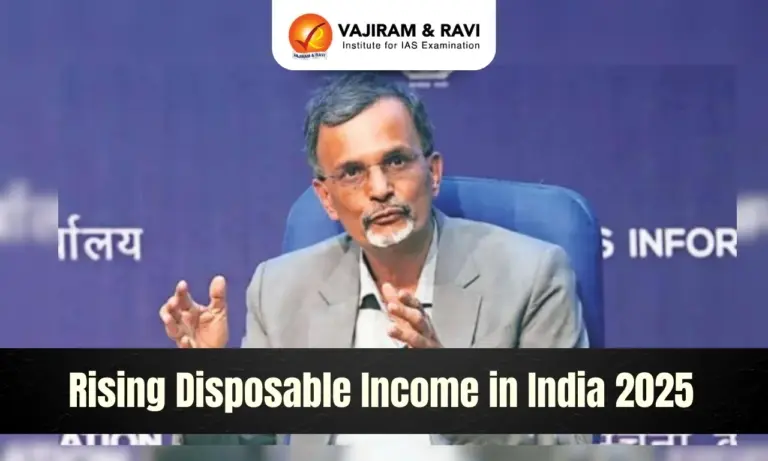
- Chief Economic Advisor V. Anantha Nageswaran said that Indian households’ disposable income will be significantly higher this year compared to last year.
- This increase is mainly driven by easing inflation and the tax cuts already announced, along with potential further reductions expected soon.
- The rise in disposable income is seen as a positive factor for household spending and economic growth.
Understanding Disposable Income
- Disposable income is the money that households have left after paying taxes. It is the net income available for spending and saving.
- In simple words, it’s the money in one’s hand after the payment of one’s taxes.
- People can use it for daily expenses like food, rent, healthcare, education, or save and invest it for the future.
- Formula: Disposable Income = Total Income – Taxes
Role of Inflation in Disposable Income
- Even if disposable income (after-tax income) remains the same in numbers, high inflation reduces its real value.
- E.g., If disposable income is ₹50,000, and inflation rises, the same ₹50,000 buys fewer goods and services.
- High Inflation → Lower real disposable income → People cut down on non-essential spending, which slows down demand and growth.
- Also, when inflation is high, households may struggle to save because a larger share of disposable income goes toward basic expenses (food, fuel, rent). This reduces long-term investments and weakens financial security.
Importance of Higher Disposable Income
- Boosts Consumption: When people have more money left after taxes and inflation, they can spend more on goods and services, which drives economic growth.
- Improves Standard of Living: Higher disposable income allows households to afford better food, healthcare, education, and housing, improving overall quality of life.
- Supports Savings & Investments: Families with more money left after expenses can save and invest, which builds financial security and contributes to capital formation.
- Encourages Business Growth: Increased consumer spending raises demand, helping businesses grow, expand production, and create more jobs.
- Enhances Economic Resilience: Higher disposable income cushions families against inflation or economic shocks, reducing poverty and vulnerability.
- Economic Growth: Higher disposable income boosts consumer spending on goods and services, which drives demand, stimulates economic activity, and creates more jobs—making it a key driver of growth.





Higher Disposable Income in 2025
- Chief Economic Advisor (CEA) V. Anantha Nageswaran announced that Indian households’ disposable income will be significantly higher this year compared to 2024.
- This improvement is attributed to lower inflation, the direct tax cuts announced in the 2025 Union Budget, and the expected GST rate rationalisation.
- These measures are expected to boost household spending and support economic growth.
- India’s GDP growth for April–June 2025 reached 7.8%, the highest in five quarters, surpassing expectations.
Urban vs Rural Demand Trends
- Despite concerns raised in the RBI’s August MPC meeting about weak urban demand, CEA argued that urban consumption was underestimated due to reliance on traditional surveys.
- He cited UPI merchant payment data, which showed strong growth in digital transactions across categories.
- Rural demand has remained resilient, supported by a good monsoon, while urban consumption displayed mixed trends—robust in services like hospitality and trade but muted in housing and consumer durable loans.
Countering US Tariffs
- From August 27, 2025, tariffs on Indian goods entering the US market doubled to 50% (25% duty + 25% penalty linked to India’s Russian oil imports).
- This raises risks for labour-intensive export sectors such as textiles, potentially impacting jobs, wages, and consumption, and dampening private investment.
- Economists caution of a possible negative domino effect on growth.
Government’s Policy Response
- The government is pursuing a two-pronged strategy:
- Boosting domestic consumption through income tax cuts (₹1 lakh crore revenue loss estimated) and GST rationalisation to lower inflation.
- Exploring alternatives to US markets and enhancing domestic resilience to reduce vulnerability to external shocks.

 Last updated on March, 2026
→ UPSC Final Result 2025 is now out.
→ UPSC has released UPSC Toppers List 2025 with the Civil Services final result on its official website.
→ Anuj Agnihotri secured AIR 1 in the UPSC Civil Services Examination 2025.
→ UPSC Marksheet 2025 is now out.
→ UPSC Notification 2026 & UPSC IFoS Notification 2026 is now out on the official website at upsconline.nic.in.
→ UPSC Calendar 2026 has been released.
→ Check out the latest UPSC Syllabus 2026 here.
→ UPSC Prelims 2026 will be conducted on 24th May, 2026 & UPSC Mains 2026 will be conducted on 21st August 2026.
→ The UPSC Selection Process is of 3 stages-Prelims, Mains and Interview.
→ Prepare effectively with Vajiram & Ravi’s UPSC Prelims Test Series 2026 featuring full-length mock tests, detailed solutions, and performance analysis.
→ Enroll in Vajiram & Ravi’s UPSC Mains Test Series 2026 for structured answer writing practice, expert evaluation, and exam-oriented feedback.
→ Join Vajiram & Ravi’s Best UPSC Mentorship Program for personalized guidance, strategy planning, and one-to-one support from experienced mentors.
→ Shakti Dubey secures AIR 1 in UPSC CSE Exam 2024.
→ Also check Best UPSC Coaching in India
Rising Disposable Income in India 2025 FAQs
Q1. What is disposable income and why is it important?+
Q2. Why is disposable income higher in India in 2025?+
Q3. How does inflation affect disposable income?+
Q4. What role does digital spending data play in tracking urban demand?+
Q5. How do US tariffs affect India’s economy in 2025?+
Tags: mains articles rising disposable income in India 2025 upsc current affairs upsc mains current affairs