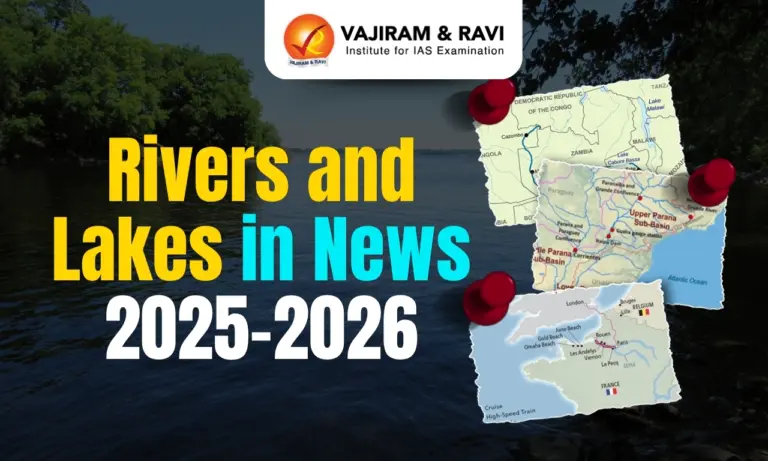
Rivers and Lakes in News 2025-2026 were highlighted globally because of climate change, pollution, dam construction, droughts, floods, ecological decline and water management concerns. These water bodies are important for biodiversity, agriculture, trade, transport, hydropower and human settlements. Many of them also highlight the growing impact of human activities on fragile freshwater ecosystems.
Rivers and Lakes in News 2025-2026
Many important Rivers and Lakes in News 2025-2026 are due to environmental stress, geographical importance, floods, droughts, conservation concerns and strategic infrastructure developments worldwide.
Kunar River
India supported Afghanistan’s proposed dam project on the transboundary Kunar River flowing through eastern Afghanistan and northern Pakistan.
- The river originates from the Chiantar Glacier in the Hindu Kush Mountains near Gilgit-Baltistan and Chitral region of Pakistan.
- Kunar River joins the Kabul River in Afghanistan and the combined waters later merge with the Indus River in Pakistan.
- Major tributaries include Lutkho, Landai Sin, Shishi and Pech River, making it part of the larger Indus Drainage System.
Seine River
The Seine River became globally important after public swimming was permitted again for the first time since 1923.
- The river flows completely within France and passes through Paris, where it is joined by the Marne River near the city.
- Seine River empties into the English Channel at Le Havre and stretches nearly 775 kilometres across northern France.
- Its drainage basin covers around 79,000-80,000 square kilometres, making it France’s second longest river after the Loire.
Zambezi River
The Zambezi River remained in news because of water concerns and its importance for hydropower generation in southern Africa.
- It originates from the Kalene Hills in Zambia and flows through or borders Zambia, Angola, Botswana, Zimbabwe, Mozambique and DR Congo.
- Victoria Falls lies on the Zambia-Zimbabwe border, while Kariba Dam forms one of the world’s largest reservoirs by volume.
- Cahora Bassa Dam and Cahora Bassa Lake are important features located in Mozambique before the river drains into the Mozambique Channel.
Potomac River
The Potomac River gained attention due to rising pollution levels and high E. coli contamination from untreated wastewater discharge.
- The river originates from Green Spring in West Virginia and drains into Chesapeake Bay along the Atlantic coast of the USA.
- Washington D.C., the capital city of the United States, is situated along the banks of the Potomac River.
- Potomac River was officially designated as the “Sister River” of Japan’s Arakawa River because both flow through national capital regions.
Arakawa River
Japan’s Arakawa River remained in discussions because of its ecological and cultural relationship with the Potomac River of the USA.
- The river originates from Mount Kobushi in Japan and drains into Tokyo Bay near the Japanese capital region.
- Tokyo is situated along the Arakawa River, similar to Washington D.C. being located on the Potomac River banks.
- Cherry blossom landscapes along both rivers strengthened cultural exchange under the international “Sister River” partnership initiative.
Tapajós River
Brazil’s Tapajós River entered news due to historic drought conditions and severe decline in water levels linked to climate change.
- The river is entirely located within Brazil and forms an important part of the Amazon River Basin system.
- It originates in Mato Grosso and later joins the Amazon River before draining into the Atlantic Ocean.
- Dredging plans and water scarcity emergency declarations in lower stretches triggered concerns among indigenous communities and environmental groups.
Mekong River
The Mekong River remained in focus because of sand mining, dam construction and ecological threats affecting Southeast Asia.
- The river originates in China’s Tangula Mountains and flows through China, Myanmar, Laos, Thailand, Cambodia and Vietnam.
- Intensive sand mining in the Vietnamese Mekong Delta disrupted natural sediment replenishment and damaged local ecosystems.
- Tonlé Sap Lake in Cambodia, Southeast Asia’s largest freshwater lake, is also facing ecological stress due to upstream developments.
Paraná River
The Paraná River witnessed ecological and economic concerns because of declining water levels affecting transportation and trade activities.
- The river basin spreads across Brazil, Paraguay, Argentina and Uruguay before draining into the Atlantic Ocean.
- Falling water levels disrupted soybean oil transportation routes in Argentina and affected regional commercial navigation systems.
- Important cities associated with the basin include Brasília, São Paulo, Asunción and Buenos Aires across South America.
Great Ruaha River
The Great Ruaha River in Tanzania faced severe environmental stress due to climate change and poor water management practices.
- The river originates in the Kipengere Mountains and flows through wetlands of the Usangu Valley and Ruaha National Park.
- Reports highlighted drying conditions in several stretches, threatening wildlife habitats and freshwater availability in the region.
- It later joins the Kisigo and Kilombero Rivers before becoming part of the Rufiji River system draining into the Indian Ocean.
Colorado River
The Colorado River remained important because of major water loss linked to climate crisis, glacier melt and prolonged drought conditions.
- The river originates in the Rocky Mountains of Colorado and drains into the Gulf of California near Mexico.
- Over 10 trillion gallons of water have reportedly been lost from the basin during the past two decades.
- Major American cities such as Las Vegas, Los Angeles and San Diego depend heavily on Colorado River water resources.
Yangtze River
China’s Yangtze River remained in international news because of flooding events and rising water levels near the Three Gorges Dam.
- The river originates from the Tangula Mountains and flows eastward entirely within China before entering the East China Sea.
- It is Asia’s longest river at nearly 6,300 kilometres and the third longest river in the world after the Nile and Amazon.
- Fishing restrictions introduced on the river helped revive fish populations after years of ecological degradation and overexploitation.
Flint River
The Flint River in the United States witnessed environmental concern due to climate related stress, floods, droughts and human pressures.
- The river originates in Georgia, USA and ultimately drains into the Apalachicola River through Lake Seminole.
- It is recognised for rich biodiversity and ecological importance within the southeastern region of the United States.
- Increasing climate variability and expanding human activities are placing growing pressure on freshwater ecosystems of the river basin.
Herbert River
Australia’s Herbert River became significant after severe flooding in North Queensland caused record rise in river water levels.
- The river originates from the Great Dividing Range and later drains into the Coral Sea connected to the Pacific Ocean.
- Extreme rainfall and flood events highlighted the growing frequency of climate linked hydrological disasters in Australia.
- Floodwaters affected settlements, transportation networks and agricultural regions dependent on the river basin for livelihoods.
Lohit River
The Lohit River remained important because of proposed hydroelectric projects and ecological sensitivity in the eastern Himalayan region.
- Lohit River is a major tributary of the Brahmaputra River and flows through Arunachal Pradesh and Assam.
- It is sometimes called the “River of Blood” because of the reddish coloration observed in its waters.
- The river basin supports habitats of the endangered White Bellied Heron and forms part of the eastern Himalayan river system.
Litani River
Lebanon’s Litani River gained geopolitical importance because of security concerns and defence activities near the river region.
- Litani River is the longest river in Lebanon with an estimated length of nearly 170 kilometres.
- The river has an annual water carrying capacity of around 750 million cubic metres supporting irrigation and water supply.
- Israel’s defence measures near the river area increased attention on the strategic importance of southern Lebanon’s river systems.
Lake Sapanca
Lake Sapanca entered news due to water stress concerns and discussions over freshwater management in Türkiye.
- It is a tectonic freshwater lake situated in Sakarya Province between the Gulf of İzmit and Adapazarı Meadow.
- The lake lies parallel to Lake İznik and is surrounded by mountains in the south and smaller hills in the north.
- Small streams from nearby mountains feed the lake, which serves as an important domestic and industrial freshwater source.
Lake Turkana
Lake Turkana remained in news because of climate change, falling water levels and geological activity associated with tectonic movements.
- The lake lies mainly in Kenya’s Great Rift Valley, while its northern extension reaches southwestern Ethiopia.
- It is the world’s largest permanent desert lake and largest alkaline lake, popularly called the “Jade Sea” due to turquoise waters.
- Omo River contributes nearly 90 percent of total inflow, while Turkwel and Kerio Rivers are other important sources.
- Lake Turkana gained conservation importance because of its ecological and anthropological significance in East Africa.
- The Turkana Basin became a UNESCO World Heritage Site in 1997 because of exceptional natural and archaeological importance.
- The region is known as the “Cradle of Humankind” because numerous hominin fossils have been discovered there.
- Lake Turkana also supports the world’s largest breeding colony of Nile crocodiles within its fragile desert ecosystem.
Great Bitter Lake
Great Bitter Lake remained important because of its strategic location within Egypt’s globally significant Suez Canal system.
- The lake is a saltwater body located between the Mediterranean Sea and Red Sea through canal connectivity.
- It originally existed as a dry salt valley before construction activities transformed it into a navigable water body.
- The Suez Canal route shortened maritime trade distance between Europe and Asia by nearly 7,000 kilometres.
Aral Sea
The Aral Sea continued to symbolise one of the world’s worst environmental disasters caused by excessive human intervention.
- It is an endorheic saltwater lake situated between Kazakhstan in the north and Uzbekistan in the south.
- The lake lost nearly three-fourths of its volume and almost half its surface area due to irrigation overuse and dam projects.
- Diversion of Amu Darya and Syr Darya rivers for agriculture became the primary reason behind rapid shrinkage of the Aral Sea.
Lake Tulare
Lake Tulare in California returned to news after reappearing more than a century after its disappearance.
- The lake revived during 2023 because of intense atmospheric river events and large inflows from nearby river systems.
- Kings, Tule and Kern Rivers originating from Sierra Nevada Mountains contributed to the lake’s re-emergence.
- Historically, it was considered the largest freshwater lake west of the Mississippi River in the United States.
Lake Chad
Lake Chad remained important because of rapid shrinkage linked to climate change, irrigation demand and prolonged drought conditions.
- The lake is shared by Nigeria, Niger, Chad and Cameroon in the Sahel region of Africa.
- Nearly 90 percent of the lake’s area has disappeared over past decades because of water overuse and declining rainfall.
- Shrinking water availability increased migration pressures, socio-economic instability and competition over land and water resources.
Lake Kariba
Lake Kariba gained attention due to falling water levels affecting hydropower generation and regional energy security.
- It is a large man made reservoir created on the Zambezi River during dam construction in the 1950s.
- The reservoir is shared between Zambia and Zimbabwe and remains important for electricity generation in southern Africa.
- Reduced inflows and drought conditions negatively impacted aquatic ecosystems and hydroelectric power production capacity.
Lake Retba
Lake Retba in Senegal remained significant because of environmental changes affecting its famous pink coloration and water levels.
- The lake is popularly known as the “Pink Lake” because of halophilic algae thriving in highly saline conditions.
- Rising temperatures and milder winters contributed to shrinking water levels and ecological stress within the lake.
- Lake Retba demonstrates how climate change can threaten even unique natural phenomena dependent on delicate environmental balance.
Prespa Lakes
Prespa Lakes remained environmentally important because of shrinking water levels, pollution and transboundary conservation challenges.
- These freshwater lakes are located between Greece, Albania and North Macedonia in southeastern Europe.
- The lakes are recognised as Ramsar Sites because of their ecological significance and biodiversity importance.
- Climate change and pollution pressures increased concerns regarding long term sustainability of the fragile freshwater ecosystem.
Lake Urmia
Lake Urmia in Iran continued to attract global concern because of severe shrinkage caused by drought and river diversion projects.
- It is an endorheic salt lake and was once the largest saltwater lake in the Middle East.
- Zarrineh and Simineh Rivers feed the lake, while high evaporation levels increase overall salinity concentration.
- Nearly 95 percent of its water has disappeared because of dam construction, water diversion and prolonged climate stress.
- Lake Urmia remained ecologically important because of its wetland ecosystem and biodiversity despite severe environmental decline.
- The lake is recognised as a Ramsar type wetland ecosystem with important ecological and conservation value.
- High salinity conditions support specialised organisms and migratory bird species including flamingos.
- Drying conditions increased dust storms and environmental health risks for nearby settlements in Iran.


 Last updated on Oct, 2026
→ UPSC 2027 Notification will be released on 13 January 2027 at upsconline.nic.in.
→ Check Nobel Prize 2026 Winners List here.
→ Download PIB PRiSM Monthly Magazine 2026 here.
→ Check UPSC Monthly Current Affairs Magazine The Recitals here.
→ Check out the latest UPSC Syllabus here.
→ Download UPSC Model Answers for Mains 2026
→ UPSC Mains Question Paper 2026 is out now for Essay & GS Paper 1, 2, 3 & 4.
→ UPSC Calendar 2027 has been released.
→ Enroll in Vajiram & Ravi’s UPSC Mains Test Series 2027 for structured answer writing practice, expert evaluation, and exam-oriented feedback.
→ Join Vajiram & Ravi’s UPSC Mentorship Program 2027 for personalized guidance, strategy planning, and one-to-one support from experienced mentors.
→ Go through the UPSC Mains Previous Year Papers to enhance your preparation.
→ UPSC has released UPSC Toppers List 2025 with the Civil Services final result on its official website.
→ Also check Best UPSC Coaching in India
Rivers and Lakes in News 2025-2026 FAQs
Q1. Why is the Aral Sea called an environmental disaster?+
Q2. Which lake is known as the Pink Lake?+
Q3. Which river is called the River of Blood in India?+
Q4. Why is Lake Chad shrinking rapidly?+
Q5. Which river is associated with Victoria Falls?+
Tags: current affairs rivers and lakes in news 2025-2026