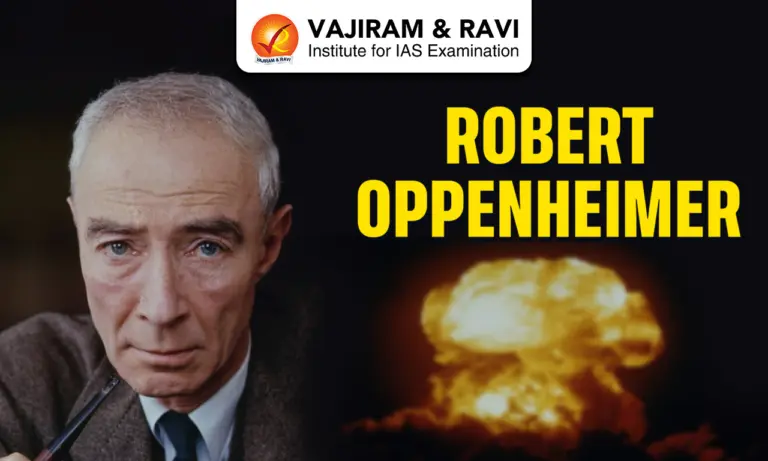
Robert Oppenheimer was an American theoretical physicist and science administrator who played a decisive role in shaping modern nuclear science. He became widely known as the director of the Los Alamos Laboratory during the development of the atomic bomb. His life reflects the complex interaction between scientific innovation, political authority and moral responsibility in the twentieth century.
Robert Oppenheimer Biography
Robert Oppenheimer was born on April 22nd, 1904 in New York into a wealthy German immigrant family in New York City and showed exceptional academic brilliance from an early age. He studied at Harvard University, excelling in physics, chemistry and classical languages and later pursued doctoral research at the University of Göttingen under Max Born, receiving his PhD in 1927. He worked with leading physicists like Niels Bohr and P.A.M. Dirac, later teaching at the University of California, Berkeley and the California Institute of Technology. He died on February 18th, 1967, in New Jersey, at the age of 62 due to throat cancer.
Robert Oppenheimer Contributions
Oppenheimer made major contributions to theoretical physics, particularly in quantum theory, astrophysics and nuclear science during the early twentieth century. Some of his major contributions are:
- Quantum Theory Research: Oppenheimer worked extensively on quantum mechanics and relativity during the 1920s and 1930s, focusing on energy interactions of subatomic particles like electrons, positrons and cosmic rays, contributing to foundational theoretical developments.
- Astrophysical Discoveries: He conducted pioneering research on neutron stars and black holes, helping establish early theoretical understanding of gravitational collapse and dense stellar objects long before observational confirmation became possible.
- Scientific Integration: Oppenheimer played a key role in linking quantum mechanics with astrophysics, encouraging interdisciplinary applications and expanding the scope of theoretical physics beyond traditional boundaries during a transformative scientific era.
- Institutional Role: He served as director of the Institute for Advanced Study, Princeton (1947-1966), where he guided research across disciplines and influenced leading scientists, including future Nobel Prize winners.
- Advisory Influence: As chairman of the General Advisory Committee of the Atomic Energy Commission (1947-1952), he advised on nuclear policy, including opposition to hydrogen bomb development due to ethical and strategic concerns.





Manhattan Project
The Manhattan Project marked Oppenheimer’s most significant contribution, where he led efforts to develop the world’s first atomic bomb during World War II.
- Appointment and Leadership: In 1942, he was appointed scientific director of the Manhattan Project and tasked with establishing a secret laboratory at Los Alamos, New Mexico, coordinating thousands of scientists, engineers and military personnel.
- Trinity Test (July 16, 1945): The first atomic bomb test occurred at Alamogordo, New Mexico, producing an explosion equivalent to 15,000 20,000 tons of TNT, marking the beginning of the nuclear age.
- Hiroshima Bombing: On August 6, 1945, the Uranium based bomb “Little Boy” destroyed Hiroshima, killing about 70,000 instantly and over 100,000 by year end, demonstrating unprecedented destructive capability.
- Nagasaki Bombing: On August 9, 1945, the Plutonium bomb “Fat Man” devastated Nagasaki with a force of 21,000 tons of TNT, killing about 40,000 instantly and causing widespread destruction.
- World War II: The atomic bombings contributed to Japan’s surrender on September 2, 1945, effectively ending World War II and establishing nuclear weapons as decisive strategic tools.
- Ethical Realisation: Oppenheimer later reflected on the moral consequences of nuclear weapons, famously recalling a line from the Shreemad Bhagavad Gita, highlighting the ethical dilemma faced by scientists involved in destructive innovations.
- Post War Influence: After the war, he became a key adviser on nuclear policy and advocated for international control of atomic energy to prevent nuclear arms race and global destruction.
- Recognition and Legacy: In 1963, he received the Enrico Fermi Award for contributions to theoretical physics and leadership, symbolizing partial rehabilitation after years of political exclusion.

 Last updated on April, 2026
→ UPSC Final Result 2025 is now out.
→ UPSC has released UPSC Toppers List 2025 with the Civil Services final result on its official website.
→ Anuj Agnihotri secured AIR 1 in the UPSC Civil Services Examination 2025.
→ UPSC Marksheet 2025 is now out.
→ UPSC Notification 2026 & UPSC IFoS Notification 2026 is now out on the official website at upsconline.nic.in.
→ UPSC Calendar 2026 has been released.
→ Check out the latest UPSC Syllabus 2026 here.
→ UPSC Prelims 2026 will be conducted on 24th May, 2026 & UPSC Mains 2026 will be conducted on 21st August 2026.
→ The UPSC Selection Process is of 3 stages-Prelims, Mains and Interview.
→ Prepare effectively with Vajiram & Ravi’s UPSC Prelims Test Series 2026 featuring full-length mock tests, detailed solutions, and performance analysis.
→ Enroll in Vajiram & Ravi’s UPSC Mains Test Series 2026 for structured answer writing practice, expert evaluation, and exam-oriented feedback.
→ Join Vajiram & Ravi’s Best UPSC Mentorship Program for personalized guidance, strategy planning, and one-to-one support from experienced mentors.
→ Shakti Dubey secures AIR 1 in UPSC CSE Exam 2024.
→ Also check Best UPSC Coaching in India
Robert Oppenheimer FAQs
Q1. Who was J. Robert Oppenheimer?+
Q2. What was Oppenheimer’s role in the Manhattan Project?+
Q3. When was the first atomic bomb tested?+
Q4. What position did Oppenheimer hold after World War II?+
Q5. When did J. Robert Oppenheimer die?+
Tags: history physics robert oppenheimer