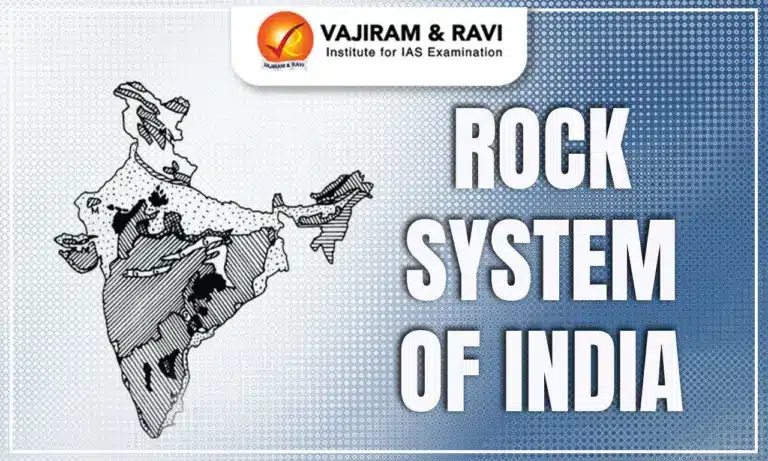
The Rock System of India showcases the geological history of India. From the Archaean rock system to the modern Quaternary, the diverse rock system helps in understanding the rock system. In this article, we are going to cover the rock system in India, its formation, significance and location in the Indian landscape.
Rock System in India
The rock system in India is very diverse and consists of a series of rocks that belong to different ages and periods. The rock system in India is divided into four categories:
- Archaean Rock System
- The Purana Rock System
- Dravidian Rock System
- The Aryan Rock System
1. Archaean Rock System in India
The Archaean Rock System in India represents the oldest rock system in Indian geological history. These rocks are some of the oldest in the world and date back to four billion years. These rocks are formed when molten magma gets solidified into the earth’s crust.
Archaean rock system in India features:
- Azoic (devoid of fossils)
- Crystalline due to volcanic origin
- Foliated, appearing in thin sheets
- Extremely contorted, faulted, and often occurring as plutonic intrusions
Archaean Rock System in India Subdivisions
Archaean Rock System in India can be sub-divided into two: Gneisses & Schists and Dharwar System
(a) The Archaean System – Gneisses & Schists
- Rocks: Gneisses (banded structure, granite to gabbro composition) and Schists (crystalline).
- Locations: Himalayas, Central & Southern Peninsula, Odisha, Jharkhand (Chotanagpur Plateau), Madhya Pradesh, Bundelkhand.
- Significance: Rich in mica, talc, hornblende, and chlorite.
(b) The Dharwar System
- Formation Period: Between 3100 to 1000 million years ago, formed in three cycles.
- Features: Ancient metamorphosed sedimentary rocks derived from Archaean gneisses and schists.
- Rocks: Hornblende, Quartzites, Phyllites, Slates, Crystalline Limestones, Dolomites.
- Locations: Dharwar-Bellary-Mysore belt (Karnataka), Jharkhand, Chhattisgarh, Odisha, parts of Himalayas.
- Significance: Economically vital with rich deposits of iron ore, manganese, copper, lead, and gold.




2. Purana Rock System in India (Proterozoic Rocks)
The Purana Rock System was formed between 1400-600 million years ago and was sedimentary- metamorphic in nature. These rocks are largely unfossiliferous in nature and are important for their economic value.
Purana Rock System in India Subdivisions
The Purana Rock System in India can be sub-divided into two: cuddapah and the vindhyan system
(a) Cuddapah System
- Location: Cuddapah & Kurnool (Andhra Pradesh), parts of Chhattisgarh and Aravalli range.
- Rocks: Clay, slates, sandstones, limestones.
- Minerals: Iron, manganese, copper, cobalt, nickel.
(b) Vindhyan System
- Location: Stretch from Sasaram (Bihar) to Chittorgarh (Rajasthan), covering ~1,00,000 sq. km.
- Rocks: Ancient sedimentary deposits, ~4000 m thick.
- Features: Devoid of fossils; important diamond-bearing regions (Panna & Golconda).
- Minerals: Limestone, ornamental stones, glass-making sand.
3. Dravidian Rock System in India (Palaeozoic Era)
The Dravidian rock system in India spans 600-300 million years ago, representing the palaeozoic age. These rocks are fossiliferous in nature and marks the beginning of coal formation. Contain shale, talc, dolomite, marble, and limited but valuable coal resources.
Dravidian Rock System in India Features
- Presence of fossil remains.
- Initial coal deposits (Carboniferous period).
- Rock types include shales, sandstones, quartzites, clays, salts, and slates.
Locations of Dravidian Rock System in India
- Predominantly in Extra-Peninsular regions: Kashmir (Anantnag, Lider Valley), Himachal Pradesh (Spiti, Kangra, Shimla), Uttarakhand (Garhwal, Kumaon), Pir Panjal.
Dravidian Rock System in India Subdivisions
Dravidian Rock System in India can be subdivided into the following types:
- Cambrian Rocks: NW Himalayas.
- Ordovician Rocks: Quartzites, sandstones.
- Silurian Rocks: Lahaul & Spiti (limestones, shales).
- Devonian Rocks: Lacking fossil fuels.
- Carboniferous Rocks: Coal-bearing, limestone, quartzite, and shales.
4. Aryan Rock System in India
The Aryan Rock System in India
The Aryan rock system in India ranges from the upper carboniferous to the recent period and has many sub-divisions.
(a) Gondwana System
- Formation: 250 million years ago (Permian).
- Location: Damodar Valley (Jharkhand), Mahanadi Valley (Odisha, Chhattisgarh), parts of Madhya Pradesh.
- Features: Continental origin, laid down in synclinal troughs.
- Significance: Contains 98% of India’s coal reserves, along with iron ore, copper, and uranium.
(b) Jurassic System
- Formation: 201–145 million years ago.
- Location: Rajasthan, Kachchh, Ladakh, Spiti, Nepal, Bhutan.
- Rocks: Coral limestone, sandstones, conglomerates.
- Significance: Yields coal, petroleum, and gold.
(c) Deccan Traps
- Formation: End of Cretaceous to early Eocene (volcanic eruptions).
- Extent: ~5 lakh sq. km across Maharashtra, Madhya Pradesh, Karnataka, Gujarat.
- Rocks: Basalt; weathering produces regur (black cotton soil).
- Significance: Fertile soil for cotton cultivation.
(d) Tertiary System
- Formation: 60–7 million years ago.
- Features: Period of Himalayan orogeny; known as the “Age of Mammals”.
- Rocks: Karewas of Kashmir, Bhangar & Khadar of Great Plains, coastal rocks of Konkan, Malabar, Nilgiris.
- Significance: Petroleum and coal deposits.
(e) Shivalik System
- Location: Shiwalik Hills (between Ganga & Yamuna).
- Rocks: Sandstones, conglomerates, clays, silts.
- Significance: Contains lignite, oil, bauxite, and clays.
(f) Quaternary System (Pleistocene & Recent)
- Formation: Last 1 million years.
- Features: Fossiliferous clays, sands, gravels, and extensive alluvium deposits in Indo-Gangetic Plains.
- Classification:
- Bhangar: Older alluvium.
- Khadar: Younger alluvium, fertile and suitable for agriculture.

 Last updated on March, 2026
→ UPSC Final Result 2025 is now out.
→ UPSC has released UPSC Toppers List 2025 with the Civil Services final result on its official website.
→ Anuj Agnihotri secured AIR 1 in the UPSC Civil Services Examination 2025.
→ UPSC Marksheet 2025 is now out.
→ UPSC Notification 2026 & UPSC IFoS Notification 2026 is now out on the official website at upsconline.nic.in.
→ UPSC Calendar 2026 has been released.
→ Check out the latest UPSC Syllabus 2026 here.
→ UPSC Prelims 2026 will be conducted on 24th May, 2026 & UPSC Mains 2026 will be conducted on 21st August 2026.
→ The UPSC Selection Process is of 3 stages-Prelims, Mains and Interview.
→ Prepare effectively with Vajiram & Ravi’s UPSC Prelims Test Series 2026 featuring full-length mock tests, detailed solutions, and performance analysis.
→ Enroll in Vajiram & Ravi’s UPSC Mains Test Series 2026 for structured answer writing practice, expert evaluation, and exam-oriented feedback.
→ Join Vajiram & Ravi’s Best UPSC Mentorship Program for personalized guidance, strategy planning, and one-to-one support from experienced mentors.
→ Shakti Dubey secures AIR 1 in UPSC CSE Exam 2024.
→ Also check Best UPSC Coaching in India
Rock Systems of India FAQs
Q1. What is the rock system of India?+
Q2. What are rock systems?+
Q3. Which is the oldest rock system of India?+
Q4. How many types can the Deccan Trap get subdivided?+
Q5. The Aryan Rock System can be subdivided into how many types?+
Tags: rock systems of india