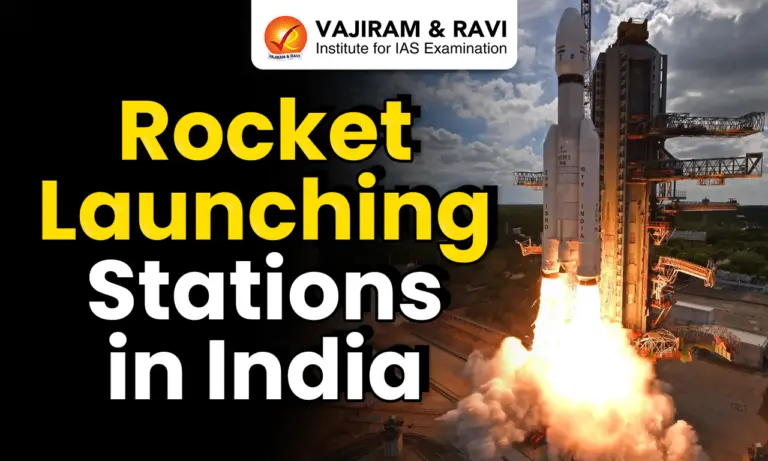
Rocket Launching Stations in India are important facilities used for sending satellites and space missions into space. These centers are developed and managed mainly by the Indian Space Research Organisation, which plays a key role in the country’s space program. They are usually located in coastal or remote areas to ensure safety and to make launches more efficient. These stations are equipped with advanced technology, launch pads, control centers, and tracking systems that help in successful rocket launches.
Satellite Launch Sites in India
- Vikram Sarabhai Space Centre (VSSC)
- Located in Thiruvananthapuram, Kerala, this centre is one of the main research and development hubs of ISRO.
- It was earlier known as Thumba Equatorial Rocket Launching Station (TERLS) when it started in 1962.
- Later, it was renamed after Dr. Vikram Sarabhai, who is known as the father of India’s space program.
- VSSC mainly focuses on the design and development of launch vehicles and rockets.
- It has contributed to major rockets like PSLV, GSLV, and GSLV Mk III, which are used for launching satellites.
- The location near the equator is helpful for efficient rocket launches, especially for certain types of missions.
- Satish Dhawan Space Centre (SDSC-SHAR)
- Situated in Sriharikota, Andhra Pradesh, it is India’s main rocket launch centre.
- Established in 1969, it is also known as Sriharikota Range (SHAR).
- Most of India’s satellite launches take place from this centre.
- Its location is ideal because it is close to the equator and surrounded by the sea, ensuring safety and better launch efficiency.
- It has multiple launch pads, control centres, and tracking systems for handling missions.
- It will play a key role in India’s human spaceflight missions (like Gaganyaan), with new launch facilities being developed.
- Kulasekarapattinam Rocket Launching Site
- The new rocket launchport is being developed by the Indian Space Research Organisation (ISRO) at Kulasekarapattinam in Tamil Nadu (Thoothukudi district). It will be India’s second major space launch facility.
- This new launch site is needed because India’s space activities are increasing rapidly, especially after opening the sector to private companies, which will lead to more commercial satellite launches in the coming years.
- At present, most launches take place from the Satish Dhawan Space Centre (SDSC), which is already handling many missions. The new launchport will reduce pressure on SDSC and allow better management of different types of launches.
- The Kulasekarapattinam facility will mainly focus on small satellite launches, especially using the Small Satellite Launch Vehicle (SSLV), while SDSC will continue to handle heavy and important missions like human spaceflight and large satellites.
- The launchport will also support on-demand launches, which are important for commercial customers who need quick and flexible launch services.
- It will encourage private sector participation, allowing companies to build satellites, develop technologies, and use the launch facility, thereby boosting innovation and investment in India’s space sector.
- The location of Kulasekarapattinam provides a geographical advantage because it is close to the equator, where the Earth’s rotation gives rockets extra speed, helping them save fuel and carry more payload.
- Rockets launched from this site can follow a straight southward path over the sea, unlike Sriharikota launches which require turning (dog-leg movement). This makes launches more efficient and cost-effective.
- Due to this efficient trajectory, rockets, especially SSLVs can carry more weight into orbit, which is beneficial for small satellite missions.
- Military Rocket Testing Site in India
- Dr. Abdul Kalam Island (formerly Wheeler Island)
- Located off the coast of Odisha, this island is used for missile testing and defence-related activities.
- It hosts the Integrated Test Range (ITR), operated by the Defence Research and Development Organisation (DRDO).
- The facility has multiple launch complexes, including sites on the island and at Chandipur.
- It is used to test various ballistic and cruise missiles, which are important for India’s defence system.
- The remote island location ensures high safety and security during testing operations.
Location of Rocket Launch Sites
- Rocket launch sites are generally built near the Equator because this location provides a natural advantage due to the Earth’s rotation. Since the Earth rotates from west to east, rockets launched in this direction get an extra push (speed), helping them save fuel and carry more payload.
- Areas close to the Equator move faster than regions near the poles, so rockets launched from here already have some initial velocity. This makes launches more efficient, cost-effective, and suitable for placing satellites into orbit, especially geostationary and low Earth orbits.
- Most launch sites are also located on the eastern coast so rockets can be launched over the sea. This ensures that in case of any failure, debris falls into the ocean rather than populated areas, making launches safer for people and infrastructure.
- Coastal and isolated locations also provide large safety zones and flexible launch paths, which are essential for smooth and secure space missions.


 Last updated on Oct, 2026
→ UPSC 2027 Notification will be released on 13 January 2027 at upsconline.nic.in.
→ Asian Games 2026 are being held in Aichi-Nagoya, Japan, from 19 September to 4 October.
→ Check Nobel Prize 2026 Winners List here.
→ Download PIB PRiSM Monthly Magazine 2026 here.
→ Check UPSC Monthly Current Affairs Magazine The Recitals here.
→ Check out the latest UPSC Syllabus here.
→ Download UPSC Model Answers for Mains 2026
→ UPSC Mains Question Paper 2026 is out now for Essay & GS Paper 1, 2, 3 & 4.
→ UPSC Calendar 2027 has been released.
→ Enroll in Vajiram & Ravi’s UPSC Mains Test Series 2027 for structured answer writing practice, expert evaluation, and exam-oriented feedback.
→ Join Vajiram & Ravi’s UPSC Mentorship Program 2027 for personalized guidance, strategy planning, and one-to-one support from experienced mentors.
→ Go through the UPSC Mains Previous Year Papers to enhance your preparation.
→ UPSC has released UPSC Toppers List 2025 with the Civil Services final result on its official website.
→ Also check Best UPSC Coaching in India
Rocket Launching Stations in India FAQs
Q1. What are Rocket Launching Stations in India?+
Q2. Which is the main rocket launch centre in India?+
Q3. What is the role of Vikram Sarabhai Space Centre (VSSC)?+
Q4. What is Dr. Abdul Kalam Island used for?+
Q5. Why is a new launch site being developed at Kulasekarapattinam?+
Tags: rocket launching stations in india science and technology