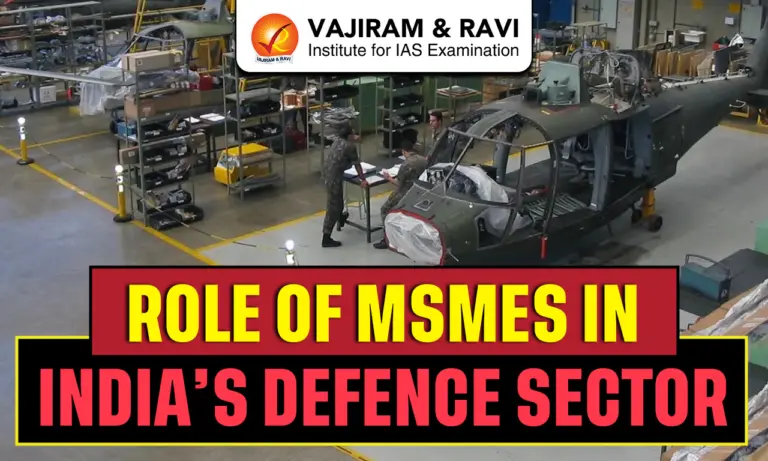
The role of MSMEs was highlighted during the National Defence Industries Conclave (NDIC) 2026, held at the Manekshaw Centre, New Delhi, which focused on ‘Advanced Manufacturing Technologies’ and industry participation in defence production.
MSMEs Catalysts of Defence Innovation
Micro, Small, and Medium Enterprises (MSMEs), along with start-ups, are emerging as pivotal contributors to India’s defence sector, playing a crucial role in strengthening national security, fostering innovation, and advancing the vision of Aatmanirbhar Bharat in defence manufacturing. Today, nearly 16,000 MSMEs are linked to defence production and supply chains, contributing to areas such as electronics, precision engineering, drones, materials and software systems.
MSMEs can contribute to the self-reliance vision by:
- Reducing Import Dependence: Defence platforms, from fighter aircraft to missiles, contain thousands of components. Domestic MSMEs can manufacture these parts, lowering reliance on foreign imports.
- Fostering Innovation: MSMEs are agile and flexible, enabling faster adoption of emerging technologies like drones, artificial intelligence, and robotics.
- Enhancing Cost Competitiveness: Global defence markets are highly price-sensitive. MSMEs can produce components at lower costs compared to large industrial firms, improving competitiveness.
- Strengthening Strategic Autonomy: By reducing dependence on imports, MSMEs and start-ups enhance India’s strategic autonomy and contribute to self-reliance in defence manufacturing.
- Transforming India into a Defence Hub: Integration of innovation, advanced manufacturing technologies, and global best practices by MSMEs is positioning India as a globally competitive defence manufacturing hub.
Government Support and Policy Initiatives
India has undertaken significant policy reforms over the past decade to integrate MSMEs into the defence sector. Key measures include:
Procurement reforms:
- The Defence Acquisition Procedure (DAP) 2020 prioritises indigenous procurement through categories such as Buy (Indian-IDDM) and Buy (Indian).
- These frameworks mandate high levels of domestic content, creating opportunities for local supply chains.
- Furthermore, 75% of the defence capital procurement budget is now earmarked for domestic industry, a major shift aimed at reducing import dependence.
Indigenisation push:
- The government has released multiple positive indigenisation lists banning the import of hundreds of defence items, from sensors and electronic warfare systems to ammunition components.
- For MSMEs, these lists effectively create guaranteed domestic markets.
- The SRIJAN portal further identifies imported items and invites domestic companies to manufacture them.
Innovation platforms:
- One of the most transformative initiatives has been Innovation for Defence Excellence (iDEX).
- The Innovation for Defence Excellence (iDEX) programme, launched in 2018, connects MSMEs and start-ups with the armed forces to develop cutting-edge technologies.
- From drone swarms to electronic warfare systems, hundreds of challenges have been issued, giving small firms a chance to work directly with defence organisations.
Defence industrial corridors:
- Industrial clusters are being developed in Uttar Pradesh and Tamil Nadu, designed to bring together manufacturers, suppliers, testing facilities and research institutions.
- Cluster-based development has historically been the most effective way to build high-technology industrial ecosystems.
Budgetary Support:
- The Union Budget 2026-27 allocated ₹7.85 lakh crore to the Ministry of Defence, creating opportunities for MSMEs and start-ups to participate in high-value projects.
Collaboration with DRDO:
- MSMEs are important partners in DRDO projects and DRDO transfers technologies to them. They are important partners in the industry ecosystem for the production of DRDO developed products. DRDO through its scheme Technology Development Scheme (TDF) funds industries, especially Start-ups and MSMEs upto an amount of Rs 10 Cr. for innovation, research and development of Defence Technologies in the field of Defence and Aerospace.
Strategic Production and Export Goals:
- The government aims for ₹3 lakh crore in domestic defence production and ₹50,000 crore in defence exports by 2030. MSMEs and start-ups are expected to play a key role in achieving these targets.
Public Procurement Policy for MSEs:
- Registered MSMEs benefit from 25% reservation in procurement by defence PSUs, ensuring steady market access.
Outreach and Promotion:
- The Department of Defence Production (DDP) organises seminars, conclaves, and outreach programmes in Tier II and III cities to promote MSME participation and highlight export opportunities.
Certain regions in India are becoming hotspots for defence-related MSME growth due to existing infrastructure and policy support:
- Uttar Pradesh Defence Industrial Corridor (UP DIC): Locations like Aligarh, Kanpur, and Jhansi are attracting strong investments.
- Tamil Nadu Defence Corridor (TNDIC): Cities like Chennai, Salem, and Coimbatore are emerging hubs for aerospace and defence manufacturing.
- Hyderabad: Known for missile and aerospace production, it houses DRDO labs and global OEM facilities.
- Pune-Nashik-Aurangabad Belt: Automotive and engineering MSMESs in this belt can easily shift to defence components
- Bengaluru: An innovation hub for defence tech, AI, and UAVs, with proximity to ISRO, HAL, and R&D labs.






Challenges in Role of MSMEs in India’s Defence Sector
Despite supportive policies, MSMEs face several hurdles that prevent them from fully leveraging opportunities in defence manufacturing:
- Procurement Complexity: Defence procurement processes are often complex and documentation-heavy. Small companies struggle to meet compliance requirements designed for large contractors, making it difficult to participate effectively.
- Payment Delays: Delayed payments from prime contractors or government agencies can disrupt cash flows, affecting the ability of MSMEs to scale production or invest in new technologies.
- Limited Access to Testing Facilities: Defence products require extensive testing—such as ballistics trials, environmental stress tests, and EMI/EMC certification. Access to these facilities is limited and expensive, putting small firms at a disadvantage.
- Technology Barriers: Advanced defence technologies often need specialised machinery, high-end materials, and significant R&D investment. Many MSMEs lack these resources, restricting their capacity to innovate and scale.
- Peripheral Role in the Supply Chain: Most MSMEs operate at the margins of the defence industrial architecture, often as subcontractors to larger system integrators. While layered supply chains are normal globally, this limits their involvement in subsystem design, innovation, and higher-value production.
- Structural Paradox: While policy frameworks encourage MSME participation in defence, operational and resource constraints continue to limit their growth, creating a gap between opportunity and actual engagement.
To transform India into a globally competitive defence manufacturing power, MSMEs must move beyond peripheral roles and become core drivers of innovation, production, and exports, participating in design, subsystem development, and high-value strategic projects.
Role of MSMEs in India’s Defence sector: Opportunities
The rise of low-cost, mass-produced drones and loitering munitions represents a strategic opportunity for India. Lessons from Iran’s drone programme show that scale, cost efficiency, and doctrinal clarity can outweigh high-end sophistication.
MSMEs have already demonstrated capabilities:
- Solar Industries & Motion (Nagpur & Bengaluru): Developed Nagastra-1, India’s first indigenous loitering munition, with over 80% localisation.
- NewSpace Research & Technologies (Bengaluru): Produces Sheshnaag-150 swarm loitering munitions, enabling deep strikes beyond 1,000 km.
- Johnnette Technologies (Noida): Developed JM-1 loitering munition, showcasing rapid procurement-to-deployment cycles.
Strategic Imperatives for MSME Growth
To scale these successes, India must:
- Shift from Platform-Centric to Volume-Centric Thinking: Mass-produce drones and loitering munitions as ammunition-class assets.
- Create Dedicated Production Missions: Similar to space or semiconductor programmes, to standardise designs and scale manufacturing.
- Empower MSMEs as Prime Integrators: Enable direct procurement, provide assured orders, and support scaling with financing and infrastructure.
- Build Component Sovereignty: Focus on domestic production of sensors, chips, propulsion systems, and other critical subsystems.
- Integrate MSMEs in Global Supply Chains: Leverage exports and align drones with modern warfare strategy.
About National Defence Industries Conclave (NDIC) 2026
The National Defence Industries Conclave (NDIC) 2026 was organised by the Department of Defence Production (DDP) at the Manekshaw Centre, New Delhi on the theme of “Advanced Manufacturing Technologies”.
The two-day event aimed to promote active industry participation in defence production, encourage innovation and adoption of emerging technologies, and identify capability gaps and opportunities for collaboration across the defence manufacturing ecosystem.
The conclave brought together MSMEs, start-ups, Defence Public Sector Undertakings (DPSUs), private defence companies, innovators, policymakers, and academia.
Key focus areas included artillery systems, small arms, infantry weapons, armoured vehicles, naval platforms, missile systems, advanced materials, composites, and emerging technologies such as artificial intelligence, robotics, smart manufacturing, and Industry 4.0.
It featured stalls from 20 large defence companies, along with 24 participation from Indian and international companies demonstrating advanced manufacturing technologies in areas such as automation, artificial intelligence, robotics, additive manufacturing and smart materials.
NDIC 2026 reinforced the role of MSMEs and start-ups as enablers of India’s defence self-reliance, promoted Aatmanirbhar Bharat in defence manufacturing, and strengthened India’s vision of a globally competitive and technologically advanced defence sector.

 Last updated on April, 2026
→ UPSC Final Result 2025 is now out.
→ UPSC has released UPSC Toppers List 2025 with the Civil Services final result on its official website.
→ Anuj Agnihotri secured AIR 1 in the UPSC Civil Services Examination 2025.
→ UPSC Marksheet 2025 is now out.
→ UPSC Notification 2026 & UPSC IFoS Notification 2026 is now out on the official website at upsconline.nic.in.
→ UPSC Calendar 2026 has been released.
→ Check out the latest UPSC Syllabus 2026 here.
→ UPSC Prelims 2026 will be conducted on 24th May, 2026 & UPSC Mains 2026 will be conducted on 21st August 2026.
→ The UPSC Selection Process is of 3 stages-Prelims, Mains and Interview.
→ Prepare effectively with Vajiram & Ravi’s UPSC Prelims Test Series 2026 featuring full-length mock tests, detailed solutions, and performance analysis.
→ Enroll in Vajiram & Ravi’s UPSC Mains Test Series 2026 for structured answer writing practice, expert evaluation, and exam-oriented feedback.
→ Join Vajiram & Ravi’s Best UPSC Mentorship Program for personalized guidance, strategy planning, and one-to-one support from experienced mentors.
→ Shakti Dubey secures AIR 1 in UPSC CSE Exam 2024.
→ Also check Best UPSC Coaching in India
Role of MSMEs in India’s Defence Sector FAQs
Q1. What is the role of MSMEs in India’s defence sector?+
Q2. How do MSMEs contribute to innovation in defence?+
Q3. Which regions in India are emerging as hubs for defence MSMEs?+
Q4. How does the government support MSMEs in the defence sector?+
Q5. What was the significance of NDIC 2026 for MSMEs?+
Tags: role of msmes in indias defence sector