RTE Act and Minority Schools Latest News
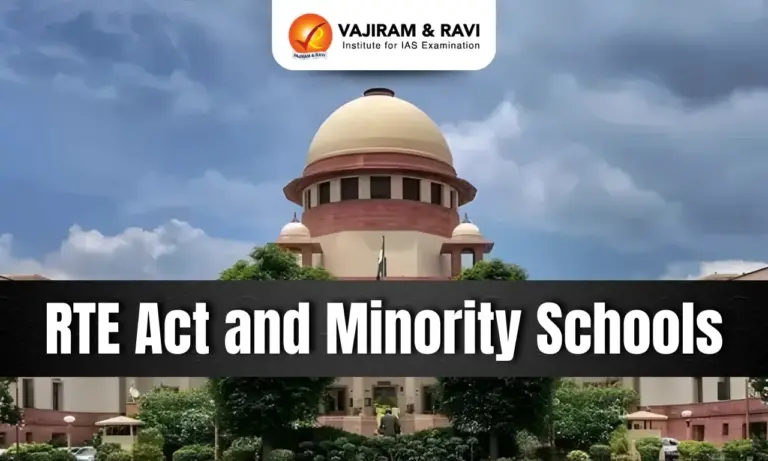
- The Supreme Court has cast doubt on its 2014 Pramati Educational and Cultural Trust judgment, which had exempted minority educational institutions from the Right to Education (RTE) Act, 2009.
- A two-judge Bench, while ruling on whether the Teacher Eligibility Test (TET) was mandatory for minority schools, referred the matter to a larger Bench for reconsideration.
- The court noted that excluding minority schools from the RTE Act’s ambit may have compromised children’s fundamental right to quality education, raising concerns about equal access to standards of learning.
Supreme Court’s TET Ruling: Minority Schools and In-Service Teachers
- The Supreme Court, while ruling in Anjuman Ishaat-e-Taleem Trust v. State of Maharashtra, addressed two key issues:
- Minority schools & RTE Act: The Bench referred to a larger Bench the question of whether the RTE Act applies to minority schools, casting doubt on the 2014 Pramati judgment.
- In-service teachers in non-minority schools: Teachers with less than 5 years of service left may continue without clearing the Teacher Eligibility Test (TET), but must pass it for promotions.
- Teachers with more than 5 years left must clear TET within two years to remain eligible.
- This nuanced order balanced continuity of service with the need to uphold minimum teacher qualification standards.





Supreme Court Flags Concerns Over Pramati Ruling
- The Supreme Court criticised the 2014 Pramati judgment, calling it “legally suspect” and “disproportionate” for exempting all minority institutions from the RTE Act based largely on Section 12(1)(c), which mandates 25% reservation for disadvantaged children.
- The Bench highlighted the conflict between Article 30(1) (minority institutions’ rights) and Article 21A (children’s fundamental right to education).
- It stressed that both rights “must co-exist mutually” instead of treating Article 30(1) as an absolute override, as the Pramati ruling had done.
2014 Pramati Ruling: Key Takeaways
- The five-judge Bench examined:
- 86th Amendment (2002): Introduced Article 21A, making education a fundamental right.
- 93rd Amendment (2005): Introduced Article 15(5), allowing the state to provide special provisions for backward classes, SCs, and STs in all institutions except minority schools.
- The Bench upheld both amendments, recognising education as a right and permitting state intervention for disadvantaged groups.
- However, it ruled that the RTE Act was unconstitutional for minority schools (aided or unaided) protected under Article 30(1).
Rationale for Exemption
- The Court reasoned that imposing Section 12(1)(c) — reserving 25% seats for disadvantaged children — could dilute the minority character of such schools.
- It emphasised that minority institutions have the fundamental right to establish and administer schools of their choice, and this must remain safeguarded.
Key Provisions and Spirit of the RTE Act
- The Right to Education (RTE) Act guarantees free and compulsory education for children aged 6–14. It mandates:
- Free education in government schools and proportionate free seats in aided schools.
- 25% seat reservation in private unaided schools for disadvantaged children, with state reimbursement (Section 12(1)(c)).
- Minimum standards for pupil-teacher ratios, trained teachers, infrastructure, and libraries.
- A ban on corporal punishment and capitation fees, making all schools responsible for universal education.
- According to experts, the Act is child-centric, not institution-centric, prioritising the fundamental right of every child over the administrative autonomy of schools.
Misuse of Pramati Exception and Renewed Judicial Push for Inclusion
- A study by the National Commission for Protection of Child Rights showed that only 8.76% of students in minority schools were from disadvantaged groups, while 62.5% were non-minority.
- This indicates that many institutions claimed minority status without serving their communities, yet benefited from exemption to RTE mandates.
- After the RTE Act (2010), private and minority groups challenged the 25% quota.
- While the 2012 ruling exempted unaided minority schools, the 2014 Pramati ruling extended this exemption to all minority schools, creating loopholes for elite private schools to adopt a minority label to avoid compliance.
- Experts noted that such institutions ignored disadvantaged children, undermining the spirit of RTE.
- They emphasised that the latest SC ruling rightly realigns with children’s rights, ensuring that students in minority schools also benefit from norms on libraries, pupil-teacher ratios, and qualified teachers.

 Last updated on March, 2026
→ UPSC Final Result 2025 is now out.
→ UPSC has released UPSC Toppers List 2025 with the Civil Services final result on its official website.
→ Anuj Agnihotri secured AIR 1 in the UPSC Civil Services Examination 2025.
→ UPSC Marksheet 2025 is now out.
→ UPSC Notification 2026 & UPSC IFoS Notification 2026 is now out on the official website at upsconline.nic.in.
→ UPSC Calendar 2026 has been released.
→ Check out the latest UPSC Syllabus 2026 here.
→ UPSC Prelims 2026 will be conducted on 24th May, 2026 & UPSC Mains 2026 will be conducted on 21st August 2026.
→ The UPSC Selection Process is of 3 stages-Prelims, Mains and Interview.
→ Prepare effectively with Vajiram & Ravi’s UPSC Prelims Test Series 2026 featuring full-length mock tests, detailed solutions, and performance analysis.
→ Enroll in Vajiram & Ravi’s UPSC Mains Test Series 2026 for structured answer writing practice, expert evaluation, and exam-oriented feedback.
→ Join Vajiram & Ravi’s Best UPSC Mentorship Program for personalized guidance, strategy planning, and one-to-one support from experienced mentors.
→ Shakti Dubey secures AIR 1 in UPSC CSE Exam 2024.
→ Also check Best UPSC Coaching in India
RTE Act and Minority Schools FAQs
Q1. Why did the Supreme Court revisit the Pramati ruling?+
Q2. What was the 2014 Pramati judgment?+
Q3. What are the key provisions of the RTE Act?+
Q4. How has the Pramati ruling been misused?+
Q5. What is the significance of the new SC ruling?+
Tags: mains articles RTE Act and minority schools upsc current affairs upsc mains current affairs