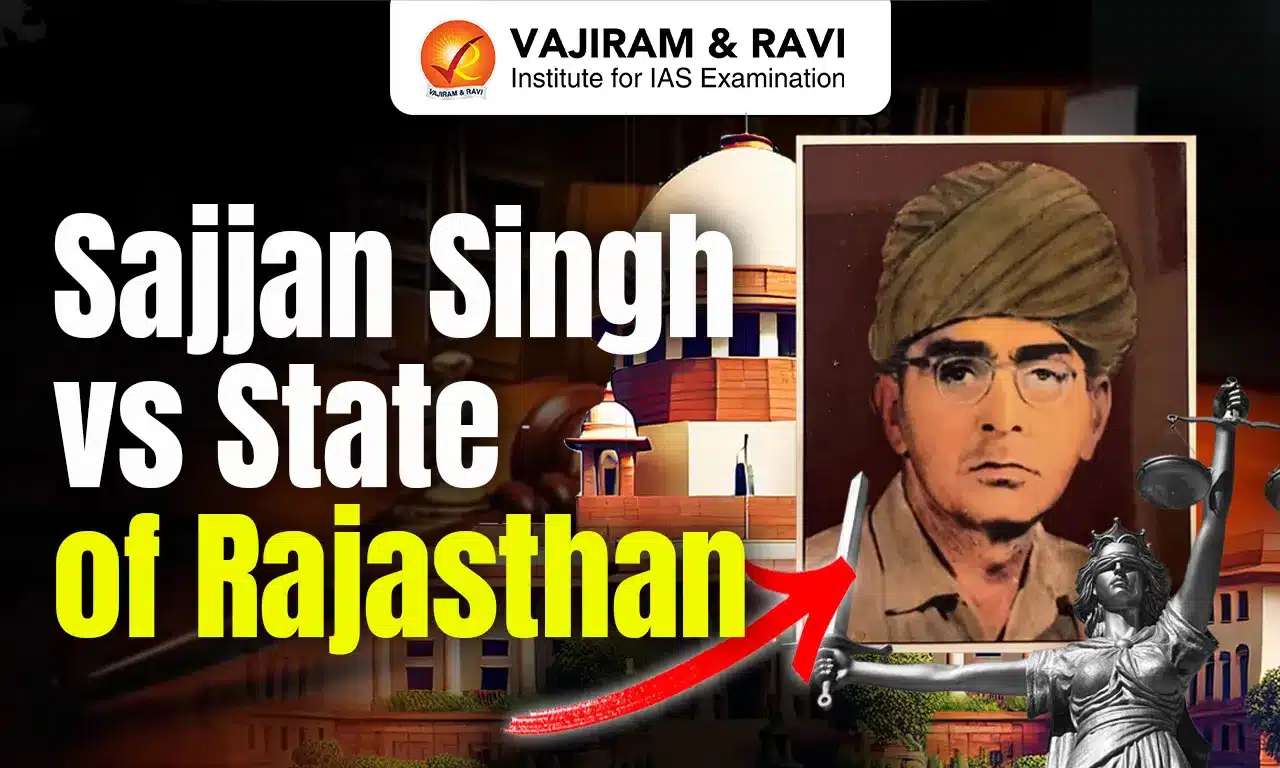
Sajjan Singh vs State of Rajasthan (1964) is a landmark Supreme Court judgment that examined Parliament’s authority to amend the Constitution, especially provisions of Part III relating to fundamental rights. The case was decided by a six-judge bench led by Chief Justice P.B. Gajendragadkar. The case addressed whether the Seventeenth Constitutional Amendment was valid, which added several land reform laws to the Ninth Schedule of the Constitution of India. The ruling reaffirmed the supremacy of Article 368 and upheld Parliament’s wide amending power at a critical stage of India’s constitutional evolution.
Sajjan Singh vs State of Rajasthan Issue Involved
The Sajjan Singh vs State of Rajasthan case arose from challenges to the Seventeenth Amendment which expanded Articles 31A and 31B.
- Parliament enacted the 17th Constitutional Amendment Act 1964 by adding 44 land reform laws to the Ninth Schedule of the Constitution.
- Petitioners affected by these State laws filed writ petitions arguing that their fundamental rights were diluted.
- They contended that the amendment altered Part III, indirectly impacting High Courts’ powers under Article 226.
- Petitioners argued that the proviso to Article 368 required ratification by half of the States, which was not done.
- They claimed the amendment exceeded Parliament’s jurisdiction since land is a State subject.
- Petitioners urged reconsideration of the Sankari Prasad Case ruling validating earlier amendments.
- The case raised critical constitutional questions linked to Parliament’s power to amend rights:
- Whether altering Part III required mandatory ratification under the proviso to Article 368.
- Whether Parliament could indirectly restrict the powers of High Courts under Article 226.
- Whether the term “law” in Article 13(2) included constitutional amendments.
- Whether Parliament had competency to amend or abridge fundamental rights.
- Whether the Seventeenth Amendment was a valid exercise of constitutional power.
Sajjan Singh vs State of Rajasthan Judgment
In the Sajjan Singh vs State of Rajasthan Case, the Supreme Court upheld the Seventeenth Constitutional Amendment by a majority decision.
- Majority held that amendments to Part III could be made under Article 368 without State ratification.
- Changes to fundamental rights caused only indirect or incidental impact on Article 226, so the proviso did not apply.
- Constitutional amendments were not “law” under Article 13(2), so they could not be struck down for abridging fundamental rights.
- Parliament possessed plenary power to amend any constitutional provision, including Part III.
- Minority (Hidayatullah and Mudholkar JJ.) warned that unlimited amending power risked damaging essential features of the Constitution.


Doctrine of Basic Structure
The Basic Structure Doctrine is a judicial principle stating that Parliament may amend any part of the Constitution but cannot alter its essential features. It was introduced by the Supreme Court in the Kesavananda Bharati case (1973) to protect core elements such as judicial review, rule of law, federalism, and fundamental rights from destructive amendments.
Although not explicitly recognized in the Sajjan Singh vs State of Rajasthan Case, it has played a crucial role in shaping the doctrine through the dissent of Justice Mudholkar questioning whether there existed certain fundamental features that Parliament could not amend, including judicial review and the democratic framework.
Seventeenth Constitutional Amendment Act 1964
The 17th Constitutional Amendment Act 1964 was enacted to protect land reform laws facing invalidation before courts.
- Amended Article 31A to further shield agrarian reform laws from judicial scrutiny.
- Added 44 State land reform Acts to the Ninth Schedule through Article 31B.
- Sought to protect ceiling laws, tenancy reforms, and land redistribution policies.
- Ensured previously invalidated laws would be deemed valid retrospectively (A- 31B).
- Enabled the continuation of socio-economic reforms linked to equitable land distribution.
- Became one of the most controversial amendments due to its sweeping immunities.

 Last updated on Oct, 2026
→ UPSC 2027 Notification will be released on 13 January 2027 at upsconline.nic.in.
→ Asian Games 2026 are being held in Aichi-Nagoya, Japan, from 19 September to 4 October.
→ Check Nobel Prize 2026 Winners List here.
→ Download PIB PRiSM Monthly Magazine 2026 here.
→ Check UPSC Monthly Current Affairs Magazine The Recitals here.
→ Check out the latest UPSC Syllabus here.
→ Download UPSC Model Answers for Mains 2026
→ UPSC Mains Question Paper 2026 is out now for Essay & GS Paper 1, 2, 3 & 4.
→ UPSC Calendar 2027 has been released.
→ Enroll in Vajiram & Ravi’s UPSC Mains Test Series 2027 for structured answer writing practice, expert evaluation, and exam-oriented feedback.
→ Join Vajiram & Ravi’s UPSC Mentorship Program 2027 for personalized guidance, strategy planning, and one-to-one support from experienced mentors.
→ Go through the UPSC Mains Previous Year Papers to enhance your preparation.
→ UPSC has released UPSC Toppers List 2025 with the Civil Services final result on its official website.
→ Also check Best UPSC Coaching in India
Sajjan Singh vs State of Rajasthan FAQs
Q1. What was the main issue in Sajjan Singh vs State of Rajasthan?+
Q2. Why was the Seventeenth Amendment challenged in Sajjan Singh vs State of Rajasthan Case?+
Q3. What did the Supreme Court decide in the Sajjan Singh vs State of Rajasthan case?+
Q4. Did the Sajjan Singh vs State of Rajasthan case influence the basic structure doctrine?+
Q5. What constitutional Articles were addressed in the Sajjan Singh vs State of Rajasthan judgment?+
Tags: sajjan singh vs state of rajasthan