About Salton Sea
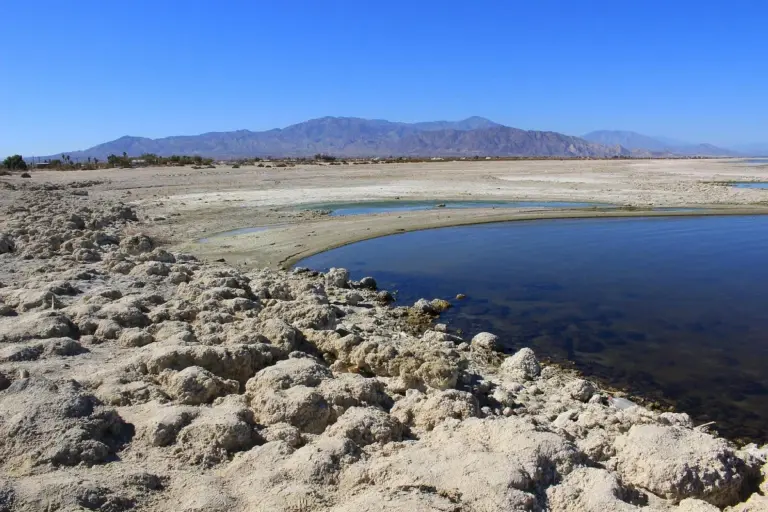
- It is a shallow, saline lake located in the lower Colorado Desert, southern California, USA.
- It is a geological depression tucked between mountain ranges and lying below sea level.
- Formation:
- The area that is now the lake was formerly a salt-covered sink or depression (a remnant of prehistoric Lake Cahuilla) about 280 feet (85 metres) below sea level until 1905–06, when diversion controls on the Colorado River broke a few miles below the California-Mexico border and floodwaters rushed northward, filling the depression.
- Subsequent deepening of the sink was stopped in 1907, when a line of protective levees was built.
- It is currently 228 feet below sea level.
- It covers an area of 970 square km and includes 130 miles of shoreline.
- It has an average depth of 29.9 feet and, at its deepest, 51 feet.
- Its salinity (some 45 parts per thousand) far exceeds that of seawater.
- The Salton Sea is an important stopping point for migratory waterfowl and serves as critical habitat for birds moving south to Mexico and Central America.
Key Facts about Lithium
- It is a soft, silvery-white metal that heads group 1, the alkali metals group, of the periodic table of the elements.
- Features:
- It has the lowest density of all metals.
- It is the lightest of the solid elements.
- It reacts vigorously with water.
- It has a body-centered cubic crystal structure.
- Occurrence:
- Lithium does not occur as a metal in nature but is found combined in small amounts in igneous rocks.
- Lithium is found in brine deposits and as salts in mineral springs.
- Its concentration in seawater is 0.1 parts per million (ppm).
- Uses:
- Lithium is important in rechargeable batteries for mobile phones, laptops, digital cameras, and electric vehicles.
- It is also used in some non-rechargeable batteries for things like heart pacemakers, toys, and clocks.
- Lithium metal is made into alloys with aluminium and magnesium, improving their strength and making them lighter.
Q1) What are alkali metals?
Alkali metals are a group of chemical elements found in Group 1 of the periodic table. The alkali metal group includes lithium (Li), sodium (Na), potassium (K), rubidium (Rb), cesium (Cs), and francium (Fr). These elements are highly reactive.Alkali metals are generally soft and can be easily cut with a knife. They have low densities compared to other metals.
Source: World’s Largest Lithium Reserve Discovered Beneath California’s Salton Sea






 Last updated on March, 2026
→ UPSC Final Result 2025 is now out.
→ UPSC has released UPSC Toppers List 2025 with the Civil Services final result on its official website.
→ Anuj Agnihotri secured AIR 1 in the UPSC Civil Services Examination 2025.
→ UPSC Marksheet 2025 is now out.
→ UPSC Notification 2026 & UPSC IFoS Notification 2026 is now out on the official website at upsconline.nic.in.
→ UPSC Calendar 2026 has been released.
→ Check out the latest UPSC Syllabus 2026 here.
→ UPSC Prelims 2026 will be conducted on 24th May, 2026 & UPSC Mains 2026 will be conducted on 21st August 2026.
→ The UPSC Selection Process is of 3 stages-Prelims, Mains and Interview.
→ Prepare effectively with Vajiram & Ravi’s UPSC Prelims Test Series 2026 featuring full-length mock tests, detailed solutions, and performance analysis.
→ Enroll in Vajiram & Ravi’s UPSC Mains Test Series 2026 for structured answer writing practice, expert evaluation, and exam-oriented feedback.
→ Join Vajiram & Ravi’s Best UPSC Mentorship Program for personalized guidance, strategy planning, and one-to-one support from experienced mentors.
→ Shakti Dubey secures AIR 1 in UPSC CSE Exam 2024.
→ Also check Best UPSC Coaching in India