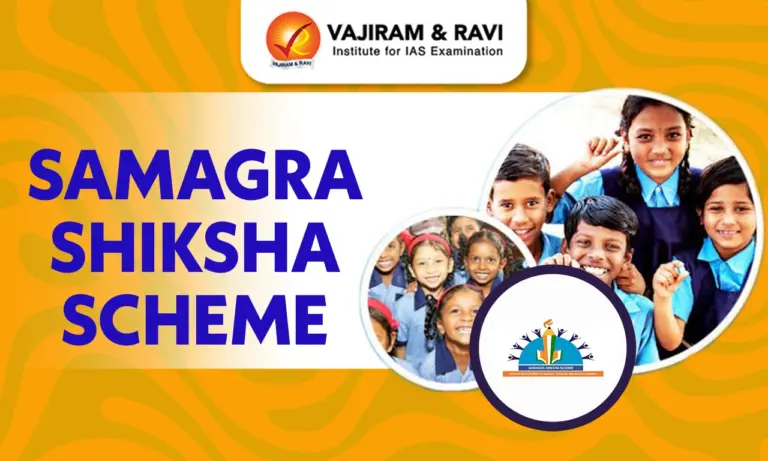
The Samagra Shiksha Scheme is a comprehensive initiative that brings together all aspects of school education from preschool to Class 12 under one umbrella. It was created by merging three earlier schemes: Sarva Shiksha Abhiyan (SSA), Rashtriya Madhyamik Shiksha Abhiyan (RMSA), and Teacher Education. The aim is to ensure a more coordinated and efficient delivery of quality education across all levels.
Recently, the Cabinet Committee on Economic Affairs expanded the scope of Samagra Shiksha to better align it with the Sustainable Development Goals (SDGs) on education. It has also been realigned to reflect the reforms and priorities outlined in the National Education Policy (NEP) 2020.
Samagra Shiksha Scheme
The Samagra Shiksha Scheme, launched in 2018 by the Ministry of Education, is a flagship initiative aimed at delivering equitable, inclusive, and cost-effective school education across India. It covers over 1.16 million schools, the scheme benefits around 15.6 crore students and 57 lakh teachers in both government and government-aided institutions. It spans the entire school spectrum, from pre-primary to senior secondary levels, ensuring a seamless learning experience. Implemented as a centrally sponsored scheme, the funding is shared between the central and state governments in a 60:40 ratio, reinforcing cooperative federalism in the education sector.
Also Read: PM Yasasvi Yojana
Samagra Shiksha Scheme Background
The Samagra Shiksha Scheme is a key initiative of the Government of India designed to improve the overall quality of school education. Launched in 2018, it brings together three previously separate schemes Sarva Shiksha Abhiyan (SSA), Rashtriya Madhyamik Shiksha Abhiyan (RMSA), and Teacher Education (TE) into a single, integrated framework. The primary goal of this unified approach is to provide holistic education from preschool to Class 12, enhance learning outcomes, and make quality education accessible to every child, regardless of their background or location.





Samagra Shiksha Scheme Vision
The Samagra Shiksha Scheme Vision is rooted in the idea of inclusive and equitable education for every child in India, from pre-primary through secondary school. It seeks to close the gaps in access and opportunity, ensuring that no child is left behind due to socio-economic, regional, or gender-based disparities.
At the same time, the scheme emphasizes raising the bar for educational excellence by improving infrastructure, teacher training, and learning outcomes across all levels of schooling.
Samagra Shiksha Scheme Objectives
- The Samagra Shiksha Scheme aims to transform the entire school education system in India from pre-primary to senior secondary level.
- It is implemented by the Ministry of Education (formerly the Ministry of Human Resource Development).
- The scheme is administered through the Department of School Education and Literacy.
- Its primary objective is to improve the quality and effectiveness of school education.
- It follows a comprehensive, integrated approach by addressing all stages of education in a single framework.
- The focus is on inclusive, equitable access to education and improved learning outcomes.
- In June 2021, the Ministry launched the NIPUN Bharat Programme under this scheme.
- NIPUN Bharat targets children aged 3 to 9 years and focuses on strengthening foundational literacy and numeracy skills.
Samagra Shiksha Scheme Features
- Samagra Shiksha Scheme 2.0 adopts a holistic approach by covering the entire school education system from pre-primary to Class 12 under a single umbrella.
- It replaces the earlier fragmented schemes by integrating SSA, RMSA, and TE to ensure smooth coordination and implementation.
- The scheme allows states the flexibility to plan and prioritize interventions based on local needs and conditions.
- A significant increase in funding supports infrastructure development, quality education initiatives, and learning outcomes.
- Improving learning outcomes is central to the scheme, with enhanced teacher training through SCERTs and DIETs, annual library grants, and tech-integrated pedagogy.
- Digital education is a major component, with smart classrooms, ICT labs, and platforms like DIKSHA making learning more interactive and accessible.
- Schools are being consolidated for better resource management, while funds are allocated for transport and improved infrastructure, including hygiene and sanitation.
- The scheme gives special attention to girls’ education by upgrading Kasturba Gandhi Balika Vidyalayas (KGBVs) to cover Classes 6 to 12 and offering stipends and self-defence training.
- Inclusive education is promoted through increased support for Children with Special Needs (CwSN), including scholarships and accessible learning materials.
- Vocational training has been introduced from Class 6 onwards to help students develop practical skills and early exposure to career options.
- Physical education and sports are integrated into the school curriculum, with financial support provided for sports equipment under the “Khelo India” initiative.
- The scheme ensures regional equity by focusing on Educationally Backward Blocks (EBBs), Left Wing Extremism (LWE) areas, and border and aspirational districts, aligning with the principle of “Sabka Saath, Sabka Vikas.”
Samagra Shiksha Scheme Funding Pattern
- The Samagra Shiksha Scheme operates as a Centrally Sponsored Scheme, meaning both the Centre and States share the financial responsibility.
- In Union Territories without a Legislature, the Central Government bears 100% of the cost of implementation.
- For States and UTs with a Legislature, the fund-sharing ratio is 60:40, with the Centre contributing 60% and the State covering the remaining 40%.
- The North-Eastern and Himalayan States receive greater central assistance, with a 90:10 funding split, where the Centre provides 90% and the State contributes just 10%.
Also Read: PM Vikas Scheme
Samagra Shiksha Scheme 2.0
- Samagra Shiksha Scheme 2.0 is an expanded version of the original scheme, designed to reform and strengthen school education across India.
- It covers education from pre-primary to higher secondary levels, with a focus on inclusive and equitable quality education.
- The scheme supports infrastructure development including classrooms, libraries, labs, and toilets to create better learning environments.
- It includes teacher training and professional development programs to build capacity and improve teaching quality.
- A key feature is the integration of technology in classrooms, promoting digital learning tools to increase educational outcomes.
- The scheme gives priority to marginalized groups including girls, children with disabilities, and socio-economically disadvantaged students.
- There’s a strong focus on accountability and data-driven governance, with systems to track student progress and monitor outcomes.

 Last updated on March, 2026
→ UPSC Final Result 2025 is now out.
→ UPSC has released UPSC Toppers List 2025 with the Civil Services final result on its official website.
→ Anuj Agnihotri secured AIR 1 in the UPSC Civil Services Examination 2025.
→ UPSC Marksheet 2025 is now out.
→ UPSC Notification 2026 & UPSC IFoS Notification 2026 is now out on the official website at upsconline.nic.in.
→ UPSC Calendar 2026 has been released.
→ Check out the latest UPSC Syllabus 2026 here.
→ UPSC Prelims 2026 will be conducted on 24th May, 2026 & UPSC Mains 2026 will be conducted on 21st August 2026.
→ The UPSC Selection Process is of 3 stages-Prelims, Mains and Interview.
→ Prepare effectively with Vajiram & Ravi’s UPSC Prelims Test Series 2026 featuring full-length mock tests, detailed solutions, and performance analysis.
→ Enroll in Vajiram & Ravi’s UPSC Mains Test Series 2026 for structured answer writing practice, expert evaluation, and exam-oriented feedback.
→ Join Vajiram & Ravi’s Best UPSC Mentorship Program for personalized guidance, strategy planning, and one-to-one support from experienced mentors.
→ Shakti Dubey secures AIR 1 in UPSC CSE Exam 2024.
→ Also check Best UPSC Coaching in India
Samagra Shiksha Scheme FAQs
Q1. What is the Samagra Shiksha Scheme?+
Q2. When was the Samagra Shiksha Scheme launched?+
Q3. What are the major objectives of Samagra Shiksha?+
Q4. Which levels of education are covered under the scheme?+
Q5. Who implements the Samagra Shiksha Scheme?+
Tags: samagra shiksha scheme