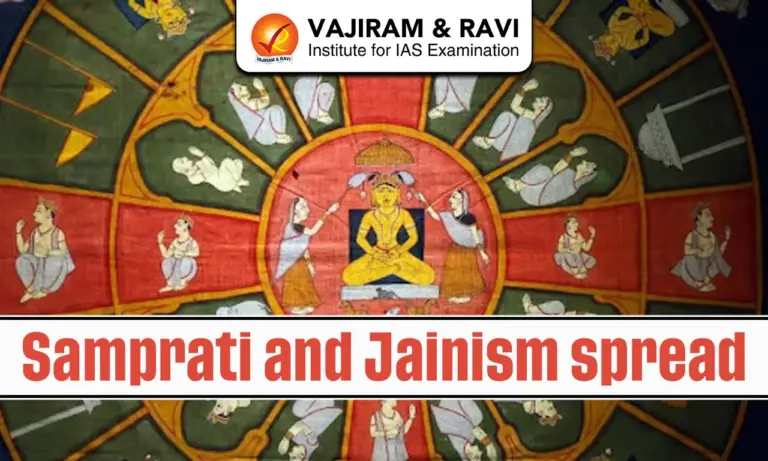
Samprati and Jainism Spread Latest News
- On Mahavir Jayanti (March 31), PM Modi inaugurated the Samrat Samprati Museum in Koba, Gandhinagar, dedicated to Jain history and Samrat Samprati, grandson of Emperor Ashoka.
- While Ashoka is known for spreading Buddhism, Samprati is remembered for promoting Jainism across India and beyond, playing a key role in expanding the faith’s influence.
Mauryan Legacy Beyond Ashoka
- The Mauryan Empire (3rd century BCE) is best known for Emperor Ashoka (c. 269–232 BCE), who expanded the empire and promoted a moral order based on Buddhist principles.
- His model of ethical kingship influenced regions beyond India, especially Buddhist Southeast Asia.
Jainism Within the Mauryan Era
- Despite Buddhism’s prominence, Jainism also remained significant during this period.
- Ashoka’s first wife, Padmavati, is believed to have been a Jain, and his grandfather, Chandragupta Maurya, is said in Jain traditions to have embraced Jainism, migrated south during a famine, and died in meditation at Shravanabelagola.
- While Chandragupta is central to the Digambara tradition, Shvetambara texts highlight Ashoka’s grandson, Samprati, as a key figure.
- After Ashoka’s death (in 232 BCE), the empire may have been divided between his grandsons Dasharatha and Samprati.
- Samprati, son of Kunala, is portrayed in Jain texts as a devoted follower who played a major role in spreading Jainism, particularly by promoting and distributing images of the Jinas across the subcontinent.





Samprati: The Jain Counterpart to Ashoka
- Samprati, believed to have ruled between 230 and 220 BCE, emerges in Shvetambara Jain texts as a key royal patron of Jainism.
- Over time, his legacy expanded through medieval works like Samprati Nripa Charitra, portraying him as a central figure in Jain religious history.
Conversion and Religious Commitment
- While some traditions claim he was Jain from birth, most accounts highlight his conversion under the monk Suhastin in Ujjain.
- He adopted Jain lay practices, including daily icon worship, and developed a deep personal commitment to Jain dharma, rather than acting out of political motives.
Expansion of Jainism Across Regions
- After his conversion, Samprati is credited with actively spreading Jainism by sending monks to distant regions, building and renovating temples, and installing numerous Jain icons.
- His efforts helped consolidate Jainism across regions like Andhra, Tamil Nadu, Karnataka, Maharashtra, Gujarat, Malwa, and Rajputana.
- Some traditions even extend his influence to China, Myanmar, Afghanistan, Nepal, Bhutan, and parts of Central and West Asia.
Temple Building and Religious Infrastructure
- Samprati’s contribution went beyond missionary activity.
- Like Ashoka with Buddhist stupas, he is said to have institutionalised Jain religious culture through large-scale temple construction and icon installation.
- Traditions credit him with building 125,000 temples, renovating 36,000, consecrating millions of icons, and establishing 700 charitable centres.
Legacy in Jain Tradition
- In western India, many ancient temples and icons without clear historical records are often attributed to Samprati.
- His role in Jain history is seen as parallel to Ashoka’s in Buddhism, symbolising a ruler who not only spread teachings but also embedded religious practices across regions.
Historical Sources and Death
- Samprati’s life is documented in texts like Sampratikatha, Parishistaparva, and Prabhavakcharita.
- He is believed to have ruled for about 50 years and died around 190 BCE, leaving behind a lasting legacy as a champion of Jainism.
Conclusion
- The story of Samprati and Jainism spread highlights how Ashoka’s grandson played a crucial role in expanding Jainism.
- The Samprati and Jainism spread effort involved sending monks, building temples, and installing Jain icons across regions.
- Through these actions, Samprati and Jainism spread became a defining chapter in ancient Indian religious history.

 Last updated on March, 2026
→ UPSC Final Result 2025 is now out.
→ UPSC has released UPSC Toppers List 2025 with the Civil Services final result on its official website.
→ Anuj Agnihotri secured AIR 1 in the UPSC Civil Services Examination 2025.
→ UPSC Marksheet 2025 is now out.
→ UPSC Notification 2026 & UPSC IFoS Notification 2026 is now out on the official website at upsconline.nic.in.
→ UPSC Calendar 2026 has been released.
→ Check out the latest UPSC Syllabus 2026 here.
→ UPSC Prelims 2026 will be conducted on 24th May, 2026 & UPSC Mains 2026 will be conducted on 21st August 2026.
→ The UPSC Selection Process is of 3 stages-Prelims, Mains and Interview.
→ Prepare effectively with Vajiram & Ravi’s UPSC Prelims Test Series 2026 featuring full-length mock tests, detailed solutions, and performance analysis.
→ Enroll in Vajiram & Ravi’s UPSC Mains Test Series 2026 for structured answer writing practice, expert evaluation, and exam-oriented feedback.
→ Join Vajiram & Ravi’s Best UPSC Mentorship Program for personalized guidance, strategy planning, and one-to-one support from experienced mentors.
→ Shakti Dubey secures AIR 1 in UPSC CSE Exam 2024.
→ Also check Best UPSC Coaching in India
Samprati and Jainism Spread FAQs
Q1. Who was Samprati in Jain history?+
Q2. How did Samprati and Jainism spread across India?+
Q3. Did Samprati spread Jainism outside India?+
Q4. What role did religion play in Samprati’s rule?+
Q5. Why is Samprati compared to Ashoka?+
Tags: mains articles Samprati and Jainism spread upsc current affairs upsc mains current affairs