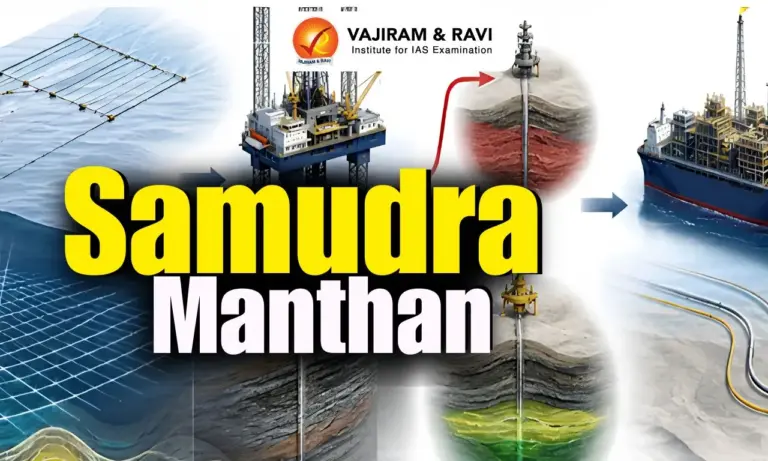
Samudra Manthan Latest News
- The Union Cabinet has approved the National Offshore Exploration Scheme (NOES), titled ‘Samudra Manthan’, with an outlay of ₹84,084 crore for implementation until FY 2030-31.
- The scheme seeks to accelerate offshore oil and natural gas exploration, particularly in deepwater and ultra-deepwater basins, reduce import dependence, and enhance India’s long-term energy security.
Need for the NOES
- India is the world’s third-largest consumer of crude oil and a major consumer of natural gas. However,
- Over 88% of crude oil requirements are met through imports.
- Around 50% of natural gas demand is import-dependent.
- Domestic production has stagnated, while existing oil and gas fields witness a 6–7% annual natural decline in output.
- Geopolitical disruptions, such as the West Asia crisis, expose India to supply and price volatility.
- The scheme addresses these challenges by promoting domestic hydrocarbon exploration in offshore regions.


Key Components of Samudra Manthan
- Deepwater and ultra-deepwater exploratory drilling (₹43,200 crore):
- Financial support for drilling 60 exploration wells, with a government assistance of up to 50% of eligible drilling cost or ₹675 crore per well, whichever is lower.
- Intended to reduce investment risks associated with expensive and uncertain offshore exploration.
- Offshore data acquisition (₹28,534 crore):
- Large-scale acquisition, processing and interpretation of high-quality seismic data.
- Scientific drilling in frontier basins to reduce geological uncertainty and improve exploration success.
- Common offshore infrastructure (₹10,000 crore): Development of shared offshore production and evacuation infrastructure to facilitate commercial production from discovered hydrocarbon reserves.
- Oil and gas manufacturing and services zones (₹2,000 crore): Establishment of integrated manufacturing and service hubs to promote domestic manufacturing, localisation of critical equipment, and development of indigenous capabilities.
Major Objectives
- The scheme aims to catalyse over 600 Million Metric Tonnes of Oil Equivalent (MMTOE) in additional reserves.
- Increase domestic hydrocarbon production from around 62 MTOE to nearly 80 MTOE annually, subject to successful exploration.
- Expand India’s hydrocarbon resource base from 1,600 MTOE to 2,200 MTOE.
- Reduce annual crude oil imports by nearly ₹1 lakh crore.
- Attract substantial investments across the exploration and production (E&P) value chain.
- Promote technological innovation and employment in the upstream petroleum sector.
Focus Areas for Exploration and Need for Government Support
- Focus areas:
- The scheme prioritises exploration in frontier offshore basins, including –
- Krishna-Godavari Basin
- Cauvery Basin
- Mahanadi Basin
- Andaman Offshore Region
- These regions are believed to possess significant untapped hydrocarbon potential but require advanced technology and large capital investments.
- The scheme prioritises exploration in frontier offshore basins, including –
- Government support:
- Deepwater exploration is characterised by –
- Extremely high drilling costs (US$100–250 million per well).
- Long gestation period of 5–10 years before commercial production.
- High geological and commercial risks, as discoveries may not occur or may not be economically viable.
- By adopting a risk-sharing approach, the government seeks to encourage greater participation by public and private upstream companies.
- Deepwater exploration is characterised by –
Expected Benefits
- Energy security: Lower dependence on imported crude oil and natural gas. Greater resilience against global supply disruptions and price shocks.
- Economic benefits:
- Potential annual savings of nearly ₹1 lakh crore in import expenditure.
- Increased investment across the hydrocarbon value chain.
- Employment generation in exploration, engineering, manufacturing and offshore services.
- Industrial development: Development of indigenous manufacturing ecosystem for offshore equipment. Enhanced localisation and reduced reliance on imported technologies.
- Technology and capacity building:
- Adoption of advanced seismic imaging, digital programme management and offshore drilling technologies.
- Strengthening India’s technical capabilities in deepwater exploration.
Challenges and Reforms
- Challenges:
- High geological uncertainty and exploration failure risks.
- Capital-intensive nature of offshore drilling.
- Requirement of sophisticated technology and specialised expertise.
- Environmental concerns related to offshore drilling and marine ecosystems.
- Commercial viability of discovered reserves remains uncertain.
- Expert views:
- Extensive seismic surveys and exploratory drilling will reduce geological uncertainty and encourage greater private investment.
- The scheme could improve exploration in previously underexplored offshore areas and modestly reduce import dependence by 3–5% through incremental production.
- Government reforms supporting the scheme:
- Samudra Manthan builds upon recent upstream sector reforms, including –
- Opening nearly the entire offshore acreage for exploration.
- Modernisation of the legislative and contractual framework.
- Strengthening of the National Data Repository (NDR).
- Promotion of advanced technologies and digital programme management.
- The scheme was first envisioned by the Prime Minister during his last year Independence Day address, calling for a modern “Samudra Manthan” to unlock India’s offshore energy potential.
- Samudra Manthan builds upon recent upstream sector reforms, including –
Conclusion
- The Samudra Manthan scheme represents a strategic shift towards unlocking India’s offshore hydrocarbon resources through public investment, risk-sharing, advanced technology and infrastructure development.
- While exploration outcomes remain uncertain, successful implementation can significantly strengthen energy security, reduce import dependence, promote domestic manufacturing under Atmanirbhar Bharat.

 Last updated on Oct, 2026
→ UPSC 2027 Notification will be released on 13 January 2027 at upsconline.nic.in.
→ Asian Games 2026 are being held in Aichi-Nagoya, Japan, from 19 September to 4 October.
→ Check Nobel Prize 2026 Winners List here.
→ Download PIB PRiSM Monthly Magazine 2026 here.
→ Check UPSC Monthly Current Affairs Magazine The Recitals here.
→ Check out the latest UPSC Syllabus here.
→ Download UPSC Model Answers for Mains 2026
→ UPSC Mains Question Paper 2026 is out now for Essay & GS Paper 1, 2, 3 & 4.
→ UPSC Calendar 2027 has been released.
→ Enroll in Vajiram & Ravi’s UPSC Mains Test Series 2027 for structured answer writing practice, expert evaluation, and exam-oriented feedback.
→ Join Vajiram & Ravi’s UPSC Mentorship Program 2027 for personalized guidance, strategy planning, and one-to-one support from experienced mentors.
→ Go through the UPSC Mains Previous Year Papers to enhance your preparation.
→ UPSC has released UPSC Toppers List 2025 with the Civil Services final result on its official website.
→ Also check Best UPSC Coaching in India
Samudra Manthan FAQs
Q1. What is Samudra Manthan (National Offshore Exploration Scheme)?+
Q2. Why has the Government adopted a risk-sharing approach under the Samudra Manthan?+
Q3. What is the significance of offshore seismic data acquisition in hydrocarbon exploration?+
Q4. What are the major economic benefits expected from the Samudra Manthan scheme?+
Q5. Why are deepwater and ultra-deepwater basins strategically important for India's future hydrocarbon production?+
Tags: samudra manthan