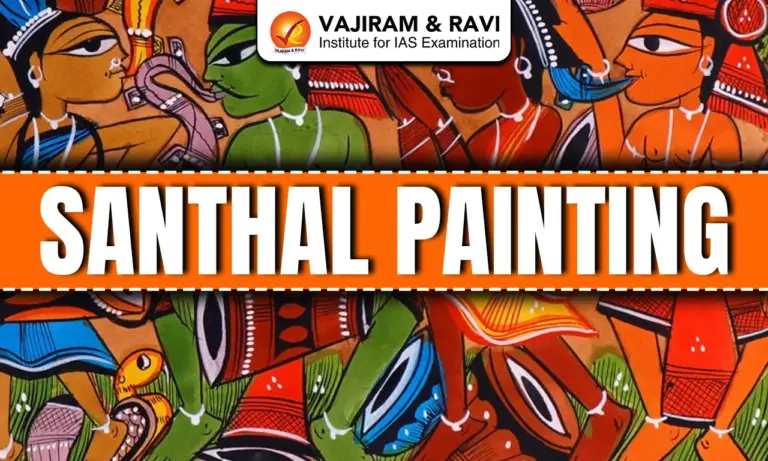
Sathal Painting is a traditional tribal artform of Santhal Community, majorly found in Jharkhand, West Bengal, Odisha and Bihar. These paintings use vibrant and bright colours to depict daily life activities, festivals, dance and nature. These paintings symbolize a close connection between the tribal people and nature.
Santhal Painting
- Santhal Painting is a tribal art form of the Santhal tribe, mainly found in Jharkhand, West Bengal, Bihar, Odisha and Assam.
- These paintings show simple scenes of daily life such as farming, dancing, hunting, festivals and village activities.
- Nature, animals, birds and plants are common themes, showing the close bond of the Santhal people with their environment.
- Bright colours and simple shapes are used to express culture, beliefs, folklore and traditions.
- Santhal paintings are made during festivals and ceremonies and help preserve the cultural heritage of the tribe.
- They worship a Stone, a formless representation of the divine.
Read about: Miniature Paintings
Santhal Painting Background
Historical Background
- Santhal paintings developed among the Santhal tribe who live in forest regions of mainly eastern India.
- Forests influence their art, as they provide food, livelihood and spiritual meaning.
- Scenes of farming, fishing, cattle rearing and hunting are commonly shown in the paintings.
Cultural Life and Society
- Earlier, Santhal paintings were made on the walls of huts during festivals and marriages.
- Paintings show village life, nature, dancing, singing and social customs.
- The Santhals were earlier nomadic but later settled and took up agriculture and related activities.
Religious Beliefs
- Santhals are nature worshippers and believe that divine power exists in trees, stones, animals and birds.
- These beliefs are clearly reflected through recurring natural motifs in their paintings.
Legends and Scroll Paintings
- Santhal scroll paintings are based on storytelling and folklore, especially related to death and the soul’s journey.
- Scroll painters called Jadupatua (meaning “magic painters”) travel to villages to narrate stories through paintings.
- These scrolls help preserve Santhal beliefs, traditions, and cultural memory.





Santhal Painting Features
Main Characteristics
- Santhal Paintings are simple, bold and expressive in nature.
- Natural colours and rhythmic patterns are important features.
- Figures show strong emotions and active movements.
- Nature plays a central role, showing the close bond between the Santhal people and their environment.
Central Motifs and Themes
- Santhal paintings mainly show animals, nature, village life and folk stories.
- Common scenes include women working in fields, harvesting crops, feeding cattle, children playing, flying kites and people on swings.
- Stories related to beliefs, life and death are also important themes in these paintings.
Medium Used
- Traditionally, Santhal paintings were made on cloth known as pata.
- Natural colours were prepared from forest materials like leaves, flowers, mud, stones and charcoal.
- Sticks, twigs, and handmade tools were used for drawing and colouring.
Style of Painting
- The paintings use bright primary colours and simple shapes.
- Human and animal figures are drawn in a basic and symbolic manner, not in a realistic way.
- Floral borders and natural elements like leaves, insects and flowers fill the background.
- The focus is on expression and storytelling rather than accuracy or realism.
Process of Painting
- First, outlines are drawn using black or brown colour made from charcoal or burnt wood.
- After that, colours are filled inside the figures.
- Earlier, paintings were done only on cloth, but today artists also use paper and canvas.
Read about: Mural Paintings
Santhal Painting Modern Outlook
- In modern times, many Santhal artists use canvas and synthetic colours like acrylic paints.
- Traditional artists still prefer natural colours and old methods, but their number is slowly decreasing.
- Changes in living areas and migration have affected the practice of traditional techniques.
- Rabindranath Tagore played an important role in studying and reviving Santhal paintings.
- He introduced this art form at Shantiniketan, which helped it gain recognition.
- Famous artist Jamini Roy was influenced by Santhal art and helped popularise its style in modern Indian art.

 Last updated on April, 2026
→ UPSC Final Result 2025 is now out.
→ UPSC has released UPSC Toppers List 2025 with the Civil Services final result on its official website.
→ Anuj Agnihotri secured AIR 1 in the UPSC Civil Services Examination 2025.
→ UPSC Marksheet 2025 is now out.
→ UPSC Notification 2026 & UPSC IFoS Notification 2026 is now out on the official website at upsconline.nic.in.
→ UPSC Calendar 2026 has been released.
→ Check out the latest UPSC Syllabus 2026 here.
→ UPSC Prelims 2026 will be conducted on 24th May, 2026 & UPSC Mains 2026 will be conducted on 21st August 2026.
→ The UPSC Selection Process is of 3 stages-Prelims, Mains and Interview.
→ Prepare effectively with Vajiram & Ravi’s UPSC Prelims Test Series 2026 featuring full-length mock tests, detailed solutions, and performance analysis.
→ Enroll in Vajiram & Ravi’s UPSC Mains Test Series 2026 for structured answer writing practice, expert evaluation, and exam-oriented feedback.
→ Join Vajiram & Ravi’s Best UPSC Mentorship Program for personalized guidance, strategy planning, and one-to-one support from experienced mentors.
→ Shakti Dubey secures AIR 1 in UPSC CSE Exam 2024.
→ Also check Best UPSC Coaching in India
Santhal Painting FAQs
Q1. What is Santhal Painting?+
Q2. What are the common themes of the Santhal Painting?+
Q3. What materials and colours are traditionally used in Santhal paintings?+
Q4. Who is Jadupatua?+
Q5. Who helped revive and popularise Santhal Painting?+
Tags: art and culture art and culture notes santhal painting