About Saora Tribe:
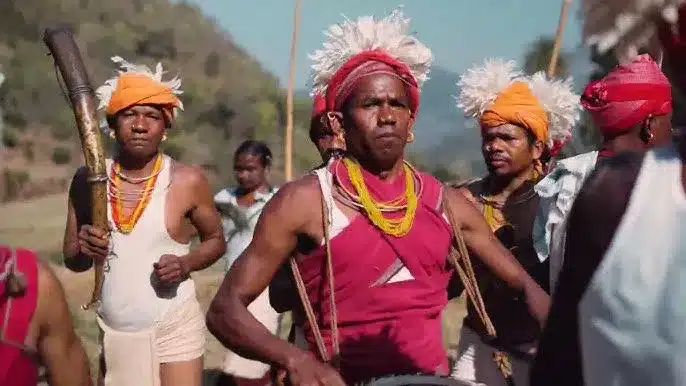
- Saora is one of the ancient tribes of Odisha, which is also mentioned in the epics Ramayana and Mahabharata.
- They are called by various terms such as Savaras, Sabaras, Saura, Sora, etc.
- Though Odisha is the main land for the tribe, a small number of people are also found in the states of Andhra Pradesh, Jharkhand, Madhya Pradesh, and Assam.
- Language: They have their own native language called Sora, which is a Munda language, and they are one of the very few tribes of India that have a script for the language, Sorang Sompeng.
- The Saoras show their racial affinity to the Proto Australoid physical characters, which are dominant among the aborigines of Central and Southern India.
- Religion: Saoras follow an ingrained and intricate religion, having faith in and worshipping a number of gods and spirits, who they believe are the supreme controllers of their regular lives.
- They have unique art practices, religious customs, as well as a dying tattooing tradition called ‘Tantangbo’.
- The Saoras can be divided broadly into two economic classes:
- The Saoras of the plains (Sudha Saora) depending on their wet cultivation or wage earning and selling firewood.
- The Hill Saoras (Lanjia Saora) practice shifting and terraced cultivation on the hill slopes.
- Settlement:
- Saora villages do not conform to any particular type of settlement pattern.
- Houses are scattered, and megaliths erected to commemorate dead kin are located close by.
- Village guardian deities like Kitungsum are installed at the entrance of the settlement.
- A typical house is a one-roomed thatched rectangular dwelling having stone and mud walls with a low roof and a high plinth front verandah. The walls are coloured with red earth.
Q1: Who are Particularly Vulnerable Tribal Groups (PVTGs)?
PVTGs are a more vulnerable group among tribal groups in India. These groups have primitive traits, geographical isolation, low literacy, zero to negative population growth rate and backwardness. Moreover, they are largely dependent on hunting for food and a pre-agriculture level of technology. Currently, there are 2.8 million PVTGs belonging to 75 tribes across 22,544 villages in 220 districts across 18 states and Union Territories in India. According to the 2011 Census, Odisha has the largest population of PVTGs at 866,000. It is followed by Madhya Pradesh at 609,000 and Andhra Pradesh (including Telangana) at 539,000.
Source: Saoras become 5th particularly vulnerable tribal group to get habitat rights in the state






 Last updated on March, 2026
→ UPSC Final Result 2025 is now out.
→ UPSC has released UPSC Toppers List 2025 with the Civil Services final result on its official website.
→ Anuj Agnihotri secured AIR 1 in the UPSC Civil Services Examination 2025.
→ UPSC Marksheet 2025 is now out.
→ UPSC Notification 2026 & UPSC IFoS Notification 2026 is now out on the official website at upsconline.nic.in.
→ UPSC Calendar 2026 has been released.
→ Check out the latest UPSC Syllabus 2026 here.
→ UPSC Prelims 2026 will be conducted on 24th May, 2026 & UPSC Mains 2026 will be conducted on 21st August 2026.
→ The UPSC Selection Process is of 3 stages-Prelims, Mains and Interview.
→ Prepare effectively with Vajiram & Ravi’s UPSC Prelims Test Series 2026 featuring full-length mock tests, detailed solutions, and performance analysis.
→ Enroll in Vajiram & Ravi’s UPSC Mains Test Series 2026 for structured answer writing practice, expert evaluation, and exam-oriented feedback.
→ Join Vajiram & Ravi’s Best UPSC Mentorship Program for personalized guidance, strategy planning, and one-to-one support from experienced mentors.
→ Shakti Dubey secures AIR 1 in UPSC CSE Exam 2024.
→ Also check Best UPSC Coaching in India