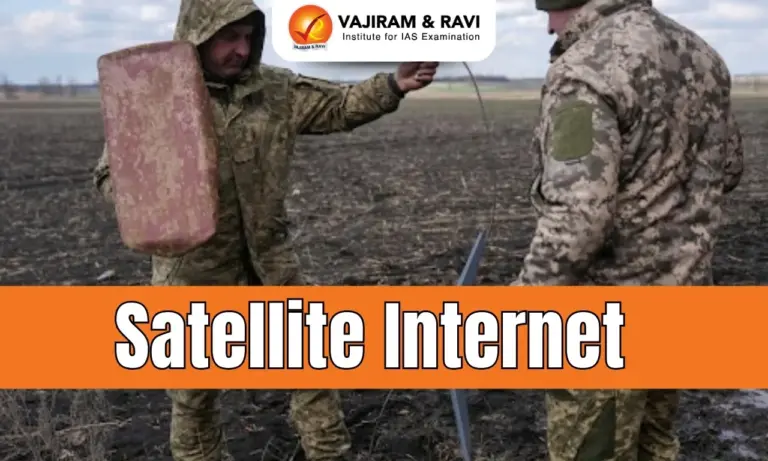
Satellite Internet Latest News
- Starlink’s upcoming launch in India has renewed focus on how satellite internet works, its applications, and regulatory challenges.
Introduction
- Satellite internet is emerging as a transformative solution in global connectivity, especially for remote and underserved areas.
- With Elon Musk’s Starlink set to debut in India, the country’s internet infrastructure is poised for a significant upgrade.
- Unlike traditional ground-based networks dependent on cables and towers, satellite internet can offer high-speed access in areas where physical infrastructure is unviable, ensuring resilience during disasters and operational continuity for both civilian and military applications.





Significance of Satellite Internet
- Ground-based broadband, while efficient in urban hubs, struggles in sparsely populated or disaster-prone regions due to high infrastructure costs and vulnerability to physical damage.
- Satellite internet overcomes these constraints by providing coverage irrespective of terrain, rapidly deploying during emergencies, and servicing mobile or remote operations such as on ships, aircraft, or oil rigs.
- This makes it not just a backup but a potential primary connectivity mode in specific scenarios.
Key Features and Dual-Use Nature
- The arrival of satellite mega-constellations like Starlink marks a new era. These networks, consisting of thousands of satellites, have applications across:
- Civilian sectors: healthcare, agriculture, transportation, education, and disaster response.
- Military sectors: secure communications, battlefield coordination, and navigation in remote conflict zones.
- Global examples highlight its importance. Viasat enabled disaster relief during Hurricane Harvey, while Starlink has been crucial to Ukrainian defence in the Russia-Ukraine conflict.
- In India, the Army has utilised satellite internet in strategic locations like the Siachen Glacier. However, its borderless nature also poses risks, as seen in cases of smuggled terminals being used by insurgent groups.
Working of Satellite Internet
- A satellite internet network comprises:
- Space Segment: Satellites in orbit, carrying communication payloads with a service life of 5-20 years.
- Ground Segment: Terminals and antennas that connect users to the satellites.
- The orbital altitude determines coverage and latency, with three main categories:
- Geostationary Earth Orbit (GEO) – 35,786 km altitude; large coverage but high latency; unsuitable for real-time applications. Example: Viasat’s Global Xpress.
- Medium Earth Orbit (MEO) – 2,000-35,786 km altitude; lower latency than GEO but still requiring multiple satellites for coverage. Example: O3b constellation.
- Low Earth Orbit (LEO) – below 2,000 km; very low latency and smaller, cheaper satellites, but requiring large mega-constellations for global coverage. Example: Starlink with over 7,000 satellites.
LEO Mega-Constellations and Innovations
- LEO constellations mitigate their limited coverage by using vast numbers of satellites with onboard processing capabilities.
- Optical inter-satellite links allow direct satellite-to-satellite communication, reducing dependency on ground stations and improving efficiency.
- These systems employ steerable antennas to ensure uninterrupted service as satellites move rapidly across the sky, handing off connections seamlessly between satellites.
Applications Across Sectors
- Communications: Internet access in remote regions, support for IoT networks.
- Transportation: Enhanced navigation, self-driving vehicle support, and real-time logistics.
- Disaster Management: Early warnings, emergency coordination, and resilient communication lines.
- Healthcare: Telemedicine, diagnostics, and remote monitoring.
- Agriculture: Precision farming and crop analytics.
- Defence: Secure communications, surveillance, and operational readiness in remote zones.
- Environmental Monitoring & Energy: Tracking natural resources, supporting renewable energy operations.
- Future innovations like direct-to-smartphone satellite connectivity could eliminate the need for dedicated terminals, integrating satellite capabilities directly into consumer devices.
Challenges and Strategic Importance
- While costs remain higher than terrestrial broadband (approx. $500 for hardware and $50/month for service), the benefits in remote connectivity and strategic resilience justify the investment.
- However, its dual-use nature raises regulatory and security concerns, making governance critical.
- For India, satellite internet offers the opportunity to:
- Bridge the digital divide.
- Strengthen disaster resilience.
- Enhance national security capabilities.
- Play a role in shaping the international governance of satellite networks.
Source : TH

 Last updated on March, 2026
→ UPSC Final Result 2025 is now out.
→ UPSC has released UPSC Toppers List 2025 with the Civil Services final result on its official website.
→ Anuj Agnihotri secured AIR 1 in the UPSC Civil Services Examination 2025.
→ UPSC Marksheet 2025 is now out.
→ UPSC Notification 2026 & UPSC IFoS Notification 2026 is now out on the official website at upsconline.nic.in.
→ UPSC Calendar 2026 has been released.
→ Check out the latest UPSC Syllabus 2026 here.
→ UPSC Prelims 2026 will be conducted on 24th May, 2026 & UPSC Mains 2026 will be conducted on 21st August 2026.
→ The UPSC Selection Process is of 3 stages-Prelims, Mains and Interview.
→ Prepare effectively with Vajiram & Ravi’s UPSC Prelims Test Series 2026 featuring full-length mock tests, detailed solutions, and performance analysis.
→ Enroll in Vajiram & Ravi’s UPSC Mains Test Series 2026 for structured answer writing practice, expert evaluation, and exam-oriented feedback.
→ Join Vajiram & Ravi’s Best UPSC Mentorship Program for personalized guidance, strategy planning, and one-to-one support from experienced mentors.
→ Shakti Dubey secures AIR 1 in UPSC CSE Exam 2024.
→ Also check Best UPSC Coaching in India
Satellite Internet FAQs
Q1. What is satellite internet?+
Q2. Which orbits are used for satellite internet?+
Q3. Why is LEO preferred for modern satellite internet?+
Q4. What are the key applications of satellite internet?+
Q5. What challenges does satellite internet pose?+
Tags: mains articles satellite internet upsc current affairs upsc mains current affairs