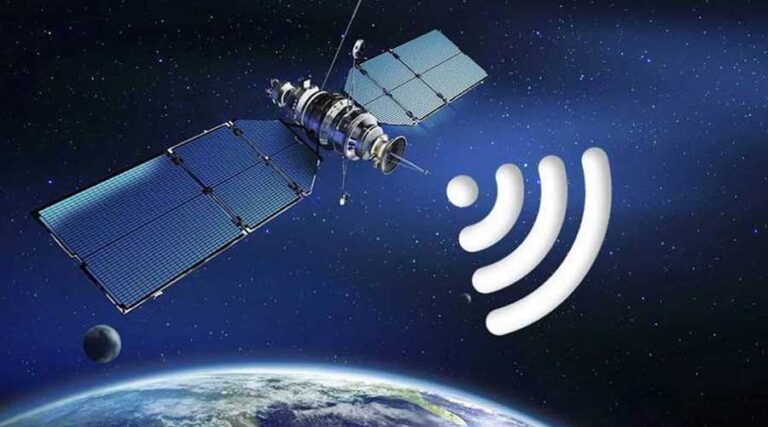
About Satellite internet technology
- Satellite internet works similarly to satellite TV.
- It begins with an internet service provider sending satellites up into space to orbit around the earth.
- That ISP then relies on a signal routed through one of those satellites in low- or high-Earth orbit and a receiver dish that picks up that signal.
- The receiver is typically placed on your home or business in a spot with as unobstructed access to the sky as possible.
- You’ll connect a modem to that dish to translate the incoming signal into a workable internet connection.
- The more common method of delivering high-speed satellite internet usually involves constellations of low-Earth orbit (LEO) satellites.
- LEO satellites orbit at a height of between 250 and 2,000 kilometres above the planet.
- The satellite that orbits the Earth communicates using radio waves.
- Advantages
- Most ideal internet access for users who live in rural areas, or live far away from cities or cable or phone offices.
- As it uses satellite dish for two-way communication, it does not need telephone cables or lines.
- Compared to other internet options, there are less or negligible network outages in case of satellite internet.
Q1) What is Low-Earth orbit?
It is a region of space located relatively close to Earth’s surface, extending from approximately 180 miles (290 kilometers) to about 1,200 miles (2,000 kilometers) above the Earth’s surface. It is the closest region of space to our planet and is home to various human-made objects, including satellites, space stations, and spacecraft.
Source: Reliance Jio demonstrates its satellite-based gigabit internet in India






 Last updated on April, 2026
→ UPSC Final Result 2025 is now out.
→ UPSC has released UPSC Toppers List 2025 with the Civil Services final result on its official website.
→ Anuj Agnihotri secured AIR 1 in the UPSC Civil Services Examination 2025.
→ UPSC Marksheet 2025 is now out.
→ UPSC Notification 2026 & UPSC IFoS Notification 2026 is now out on the official website at upsconline.nic.in.
→ UPSC Calendar 2026 has been released.
→ Check out the latest UPSC Syllabus 2026 here.
→ UPSC Prelims 2026 will be conducted on 24th May, 2026 & UPSC Mains 2026 will be conducted on 21st August 2026.
→ The UPSC Selection Process is of 3 stages-Prelims, Mains and Interview.
→ Prepare effectively with Vajiram & Ravi’s UPSC Prelims Test Series 2026 featuring full-length mock tests, detailed solutions, and performance analysis.
→ Enroll in Vajiram & Ravi’s UPSC Mains Test Series 2026 for structured answer writing practice, expert evaluation, and exam-oriented feedback.
→ Join Vajiram & Ravi’s Best UPSC Mentorship Program for personalized guidance, strategy planning, and one-to-one support from experienced mentors.
→ Shakti Dubey secures AIR 1 in UPSC CSE Exam 2024.
→ Also check Best UPSC Coaching in India