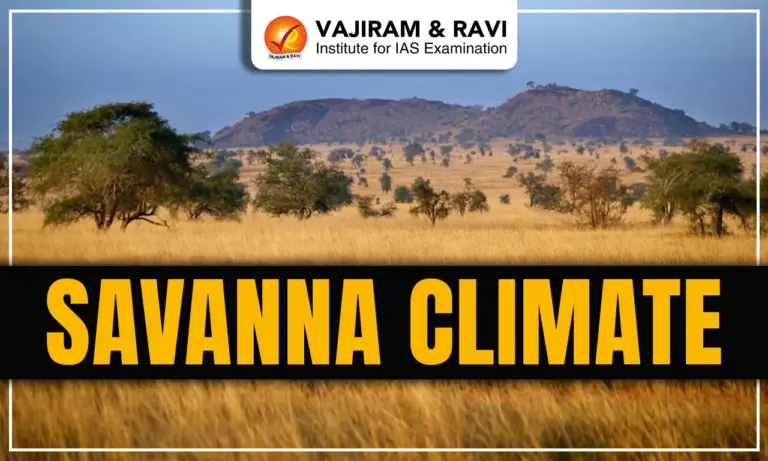
The Savanna Climate, also known as the “Tropical Wet and Dry Climate” and “Sudan Climate”, is one of the most distinctive climatic regions of the world. It lies between the equatorial rainforest climate and the hot desert climate, forming a transitional zone. According to Köppen’s Climate Classification, it is denoted as “Aw type”. The savanna climate is characterized by distinct wet and dry seasons, with high temperatures throughout the year. It plays a vital role in shaping the ecology, agriculture, and livelihoods of millions of people across continents.
Savanna Climate
The Savanna Climate is marked by seasonal rainfall controlled by the movement of the Inter-Tropical Convergence Zone (ITCZ). The wet season coincides with the overhead sun and lasts for about 4 to 6 months, while the remaining months are extremely dry. Average annual rainfall ranges from 750 mm to 1,250 mm, though variability is high. Temperatures remain warm throughout the year, usually between 20°C and 30°C.
Read About: Tropical Climate
Savanna Climate Characteristics
The Savanna climate exhibits features that make it distinct from both equatorial and desert regions.
- Temperature: Average monthly temperature remains high throughout the year, usually between 25°C and 35°C. Seasonal variation is low.
- Rainfall: Annual rainfall ranges between 500 mm to 1500 mm, concentrated during the summer months. Rainfall is often in the form of short, heavy showers.
- Seasons: There are two marked seasons: a wet season (summer) influenced by the Inter-Tropical Convergence Zone (ITCZ), and a dry season (winter) dominated by subtropical high-pressure systems.
- Humidity: High in wet season, low in dry season, leading to distinct vegetation patterns.
- Winds: Trade winds dominate in the dry season, while monsoonal winds bring rains in the wet season.





Savanna Climate Distribution
Savanna climate is found across continents, often near the tropics.
- Africa: The most extensive Savanna stretches across East Africa (Kenya, Tanzania, Uganda), West Africa (Nigeria, Ghana, Ivory Coast), and southern parts such as Zambia and Zimbabwe. Africa contains almost 65% of the world’s savannas.
- South America: Found in Brazil (Cerrado), Venezuela (Llanos), and Colombia. The Brazilian Cerrado covers about 2 million square kilometers.
- Australia: Northern regions like Queensland and Northern Territory.
- India: Certain parts of the Deccan Plateau, Madhya Pradesh, and Chhattisgarh show Savanna-like conditions.
- Other Regions: Central America, parts of Myanmar, and some Caribbean islands.
Savanna Climate Vegetation
Savanna Vegetation is characterized by a mix of grasslands and scattered trees, adapted to withstand seasonal changes.
- Grasses– Tall grasses like elephant grass (up to 4 meters) dominate, especially during the wet season.
- Trees– Scattered drought-resistant trees such as acacia, baobab, and eucalyptus.
- Adaptations– Many trees have thick barks to resist fire, deep roots to access groundwater, and small leaves to reduce transpiration.
- Deciduous Nature– Trees shed leaves during the dry season to conserve water.
- Regional Variations– African savannas have baobab and acacia; Brazilian Cerrado has shrubs and twisted trees.
Savanna Climate Wildlife
Savannas are biodiversity hotspots, particularly in Africa, supporting large herbivores and predators. The Savanna’s mix of grasses and shrubs supports herbivores, which in turn sustain predator populations, creating a balanced food chain.
- Africa– Home to iconic species such as elephants, giraffes, lions, zebras, wildebeests, cheetahs, and rhinoceroses. Serengeti National Park in Tanzania hosts the annual wildebeest migration, one of the world’s largest animal movements.
- South America– Capybaras, jaguars, giant anteaters, and maned wolves.
- Australia– Kangaroos, wallabies, and emus.
- India– Nilgai, blackbuck, and chinkara in semi-arid savanna tracts.
- Birds– Ostriches in Africa, rheas in South America, and bustards in India.
Human Adaptations in Savanna Climate
Human societies have long adapted to the challenges and opportunities of Savanna environments.
- Pastoralism– Nomadic herding of cattle, goats, and sheep is common, especially among the Maasai in East Africa.
- Agriculture– Crops like millet, sorghum, maize, groundnuts, and cotton are cultivated in wet seasons. Shifting cultivation and subsistence farming are common.
- Tourism– Wildlife tourism contributes significantly to the economies of countries like Kenya, Tanzania, and South Africa.
- Settlement– Population densities are moderate, concentrated near water sources.
- Modern Development– Urbanization and infrastructure growth have increased in savanna belts, particularly in Brazil and Nigeria.
Savanna Climate Economy
Savanna Regions contribute significantly to global and regional economies.
- Agriculture– Major source of food grains, livestock, and cash crops like cotton and groundnuts.
- Tourism– Wildlife safaris in African savannas attract millions of tourists annually, contributing billions of dollars. For example, tourism in Kenya contributes nearly 10% of GDP.
- Forestry– Provides timber, fuelwood, and non-timber products.
- Mineral Resources– Many savanna regions are rich in minerals like gold, diamonds, and iron ore (e.g., South Africa, Brazil).
- Energy– Potential for solar energy due to long dry seasons and high insolation.
Challenges in Savanna Regions
Despite their importance, Savanna climates face major ecological and human challenges. According to UNEP’s Global Land Outlook (2022), over 50% of savanna ecosystems are at risk of degradation due to human pressures and climate change.
- Deforestation– Clearing for agriculture, timber, and fuelwood.
- Overgrazing– Leads to soil erosion and desertification.
- Wildfires– Natural and man-made fires threaten biodiversity.
- Climate Change– Increasing droughts, irregular rainfall, and rising temperatures worsen land degradation.
- Population Pressure– Expansion of agriculture and urbanization reduces natural habitats.
- Poaching– Threatens wildlife, including elephants and rhinoceroses.
Proposed Reforms and Way Forward for Savanna and Grassland Governance:
- Scientific Mapping– Proper classification and mapping of grassland and savanna ecosystems in India.
- Restoration Projects– Launch national-level missions to restore degraded grasslands similar to afforestation drives.
- Community Participation– Involve local communities and pastoralists in sustainable management.
- Eco-Tourism Development– Promote regulated eco-tourism in savanna regions to balance economy and ecology.
- Integration with Climate Policy– Include savanna conservation explicitly under climate adaptation and mitigation strategies.
- Global Learning– Adopt best practices from African and South American savanna conservation models.
Savanna Regions of the World
Few major regions of Savanna across the globe are listed below:
- Sudan Savanna (Africa)– Extends across West Africa, supporting millet cultivation and cattle rearing.
- Serengeti (Tanzania, Africa)– Known for biodiversity and wildebeest migration.
- Brazilian Cerrado (South America)– One of the world’s richest savanna ecosystems, under threat from soy cultivation.
- Northern Australia– Characterized by eucalyptus-dominated savannas.
- Indian Savanna (Deccan Plateau)– Semi-arid grasslands interspersed with drought-resistant trees.
Read About: Equatorial Climate
Provisions Related to Savanna Regions
Though India has only localized patches of savanna-like conditions, their governance ties into broader constitutional provisions, environmental policies, and global treaties that regulate grassland ecosystems, biodiversity, and land use.
- Constitutional Framework in India
- Article 48A- Directs the State to protect and improve the environment and safeguard forests and wildlife.
- Article 51A(g)- Makes it a fundamental duty of every citizen to protect and improve the natural environment including forests, lakes, rivers, and wildlife.
- Article 21 (Right to Life)- Judicial interpretations (e.g., Subhash Kumar vs. State of Bihar, 1991) have expanded it to include the right to a clean environment, indirectly protecting grassland and savanna ecosystems.
- Judicial Pronouncements
- M.C. Mehta vs. Union of India (1987-1991)- The Supreme Court emphasized sustainable development as a constitutional mandate.
- T.N. Godavarman Thirumulpad vs. Union of India (1997)- Expanded the definition of forests, which indirectly includes grasslands and savanna ecosystems.
- Centre for Environmental Law, WWF vs. Union of India (2013)- Recognized the need for scientific identification and conservation of unique ecosystems.
- Policies and Institutional Responses in India
- National Forest Policy (1988)- Though forest-focused, it indirectly addresses grasslands and savannas under ecological balance.
- National Biodiversity Action Plan (2008, updated 2014)- Emphasizes conservation of threatened ecosystems including grasslands.
- Grassland and Desert Ecosystem Division under the Ministry of Environment, Forest and Climate Change (MoEFCC)- Specifically works on restoration and conservation of grassland ecosystems.
- Protected Area Network- Some Indian savanna-like ecosystems are preserved in sanctuaries and national parks such as Kanha, Gir, and Ranthambore.
- International Conventions and Agreements
Savanna regions worldwide are protected under various conventions:
- Convention on Biological Diversity (CBD, 1992)- Calls for conservation of ecosystems including savannas.
- UN Convention to Combat Desertification (UNCCD, 1994)- Relevant for savannas threatened by desertification.
- Paris Agreement (2015)- Climate change mitigation strategies indirectly benefit savanna ecosystems vulnerable to drought.
- UNESCO World Heritage Sites- Many savanna parks such as Serengeti (Tanzania) and Pantanal (Brazil) are recognized for their global ecological importance.
- India’s Global Commitments
- India is a signatory to the CBD and UNCCD, which influence policies for protecting grassland ecosystems resembling savannas.
- The National Action Plan on Climate Change (NAPCC) and State Action Plans include components relevant to biodiversity conservation, desertification control, and ecosystem restoration.
Global vs Indian Savanna Ecosystems
A comparative table based on the location, climate, vegetation and wildlife features of savanna has been provided below:
| Global vs Indian Savanna Ecosystems | ||||
| Region/ Country | Example of Savanna | Climate Features | Vegetation | Wildlife |
|
Africa |
Serengeti (Tanzania, Kenya), Sudan Savanna |
Wet and dry seasons, 500-1200 mm rainfall |
Tall grasses, acacia, baobab |
Elephants, lions, zebras, wildebeest |
|
South America |
Brazilian Cerrado, Venezuelan Llanos |
Seasonal rainfall, 800-1600 mm |
Shrubs, scattered twisted trees |
Jaguars, capybaras, giant anteaters |
|
Australia |
Northern Territory, Queensland |
Monsoonal wet-dry climate, high insolation |
Eucalyptus, spinifex grasses |
Kangaroos, wallabies, emus |
|
India (Savanna-like) |
Deccan Plateau (Madhya Pradesh, Chhattisgarh, Maharashtra), parts of Rajasthan |
Semi-arid, 600-1000 mm rainfall |
Drought-resistant grasses, acacia, neem |
Blackbuck, chinkara, nilgai, great Indian bustard |
Savanna Climate UPSC
The Savanna climate is a dynamic and transitional climate zone that plays an essential role in supporting biodiversity, human livelihood, and global ecological balance. Found in Africa, South America, Australia, Asia, and parts of India, it represents the delicate interplay between wet and dry seasons. However, increasing human activities, climate change, and environmental degradation pose serious challenges to the sustainability of savannas.
| Also Check Other Posts | |
| Coastal Regulation Zone | Global Plastic Treaty |
| Nitrogen Cycle | Carbon Cycle |

 Last updated on March, 2026
→ UPSC Final Result 2025 is now out.
→ UPSC has released UPSC Toppers List 2025 with the Civil Services final result on its official website.
→ Anuj Agnihotri secured AIR 1 in the UPSC Civil Services Examination 2025.
→ UPSC Marksheet 2025 is now out.
→ UPSC Notification 2026 & UPSC IFoS Notification 2026 is now out on the official website at upsconline.nic.in.
→ UPSC Calendar 2026 has been released.
→ Check out the latest UPSC Syllabus 2026 here.
→ UPSC Prelims 2026 will be conducted on 24th May, 2026 & UPSC Mains 2026 will be conducted on 21st August 2026.
→ The UPSC Selection Process is of 3 stages-Prelims, Mains and Interview.
→ Prepare effectively with Vajiram & Ravi’s UPSC Prelims Test Series 2026 featuring full-length mock tests, detailed solutions, and performance analysis.
→ Enroll in Vajiram & Ravi’s UPSC Mains Test Series 2026 for structured answer writing practice, expert evaluation, and exam-oriented feedback.
→ Join Vajiram & Ravi’s Best UPSC Mentorship Program for personalized guidance, strategy planning, and one-to-one support from experienced mentors.
→ Shakti Dubey secures AIR 1 in UPSC CSE Exam 2024.
→ Also check Best UPSC Coaching in India
Savanna Climate FAQs
Q1. What is Savanna Climate and where is it found?+
Q2. What are the main characteristics of Savanna Climate?+
Q3. Which countries have the largest Savanna Regions?+
Q4. What kind of vegetation is found in Savanna Climate?+
Q5. What is the economic importance of Savanna Climate Regions?+
Tags: savanna climate