SC Maternity Leave Adoption Latest News
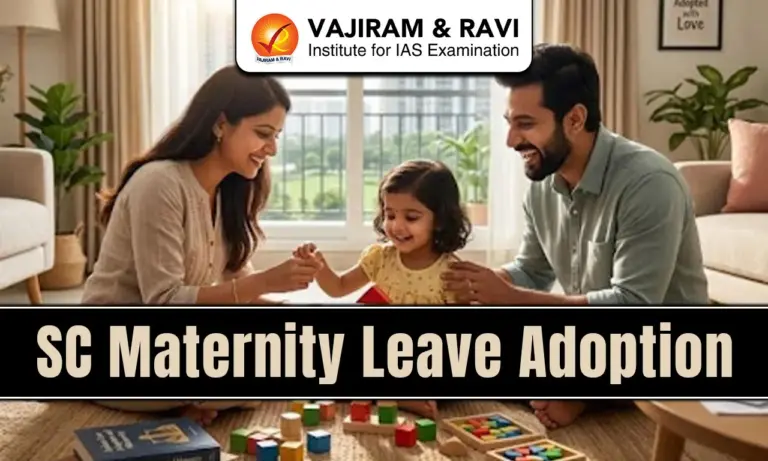
- The Supreme Court of India struck down a rule that denied maternity leave to government employees adopting children over three months of age, ruling it unconstitutional and discriminatory.
- The bench of Justices J.B. Pardiwala and R. Mahadevan delivered the verdict recently in the case Hamsaanandini Nanduri v. Union of India case.
Background of the Case
- The Maternity Benefit Act, 1961 and its successor, the Code on Social Security, 2020, were amended to include adoption-related benefits within their scope.
- Section 60(4) of the Social Security Code, 2020 restricted leave to adoptions of children under 3 months.
- However, petitioners argued that the three-month age cap was “artificial and violative of Article 14” — the right to equality under the law.
- The government defended the cap by saying women adopting older children could use crèche facilities instead; this argument was rejected by the Court.





What the Court Said
- The bench noted children raised in institutions often develop emotional bonds with caregivers there.
- Going beyond biology, the court relied on the meaning of “maternity” as the “state of being a mother” — not limited to childbirth only.
- Research was cited showing that caregiving is crucial for a child’s emotional development.
Impossible Criteria — Key Legal Findings
- Under the Juvenile Justice (Care and Protection of Children) Act, 2015 and central adoption regulations, a child cannot be placed for adoption until they have been declared “legally free” — a process that takes time.
- The bench held that “by the time the child is legally placed with the adoptive mother, the statutory age limit would, in most cases, stand exhausted” — calling the benefit “largely inoperative in practice.”
- Under Article 14, a classification between two groups is valid only if it rests on a real, meaningful distinction. The court found neither condition satisfied here.
- Article 14 also protects the right to life and personal liberty; the court said it includes a right to reproductive autonomy extending beyond biological parenthood.
- It argued that the right to autonomy, dignity, and bodily integrity cannot be denied to adoptive mothers.
- The bench also noted that adoption is an equally valid exercise of reproductive autonomy under Article 21, and not secondary to biological parenthood.
Purpose of Maternity Benefits
- The court broke down the purpose of maternity leave into two components:
- Biological care — time to develop an emotional bond between mother and child
- Integration into the family — for adoptive mothers, the first two months are legally spent holding the order, making the mandatory two-month window too narrow to consider
- The court pointed to the “Wollstonecraft Dilemma” — the tension between enabling women to work while also expecting them to participate equally in paid work.
- Wollstonecraft Dilemma highlights tension between women’s equality at work and caregiving responsibilities
- It described parenthood as “not a solitary function performed by one parent but a shared responsibility.”
Significance of the Verdict
- Principle of Equality and Non-Discrimination – The Court stressed that adoptive mothers must receive equal treatment as biological mothers. Denying maternity benefits based on age of the child amounts to discrimination against adoptive families.
- Recognition of Adoptive Parenthood – The judgment acknowledges that adoption involves emotional, psychological, and caregiving responsibilities similar to biological parenting. It reinforces the idea that family structures are diverse and must be treated equally under law.
Broader Legal and Social Significance
- Strengthens women’s rights and workplace equality.
- Promotes adoption as a socially supported institution.
- Aligns with constitutional values of dignity, equality, and social justice.

 Last updated on April, 2026
→ UPSC Final Result 2025 is now out.
→ UPSC has released UPSC Toppers List 2025 with the Civil Services final result on its official website.
→ Anuj Agnihotri secured AIR 1 in the UPSC Civil Services Examination 2025.
→ UPSC Marksheet 2025 is now out.
→ UPSC Notification 2026 & UPSC IFoS Notification 2026 is now out on the official website at upsconline.nic.in.
→ UPSC Calendar 2026 has been released.
→ Check out the latest UPSC Syllabus 2026 here.
→ UPSC Prelims 2026 will be conducted on 24th May, 2026 & UPSC Mains 2026 will be conducted on 21st August 2026.
→ The UPSC Selection Process is of 3 stages-Prelims, Mains and Interview.
→ Prepare effectively with Vajiram & Ravi’s UPSC Prelims Test Series 2026 featuring full-length mock tests, detailed solutions, and performance analysis.
→ Enroll in Vajiram & Ravi’s UPSC Mains Test Series 2026 for structured answer writing practice, expert evaluation, and exam-oriented feedback.
→ Join Vajiram & Ravi’s Best UPSC Mentorship Program for personalized guidance, strategy planning, and one-to-one support from experienced mentors.
→ Shakti Dubey secures AIR 1 in UPSC CSE Exam 2024.
→ Also check Best UPSC Coaching in India
SC Maternity Leave Adoption FAQs
Q1. What is the SC maternity leave adoption ruling?+
Q2. Why did the Supreme Court remove the age limit?+
Q3. How does the ruling interpret maternity?+
Q4. What constitutional principles are involved?+
Q5. What is the significance of the SC maternity leave adoption case?+
Tags: mains articles SC Maternity Leave Adoption upsc current affairs upsc mains current affairs