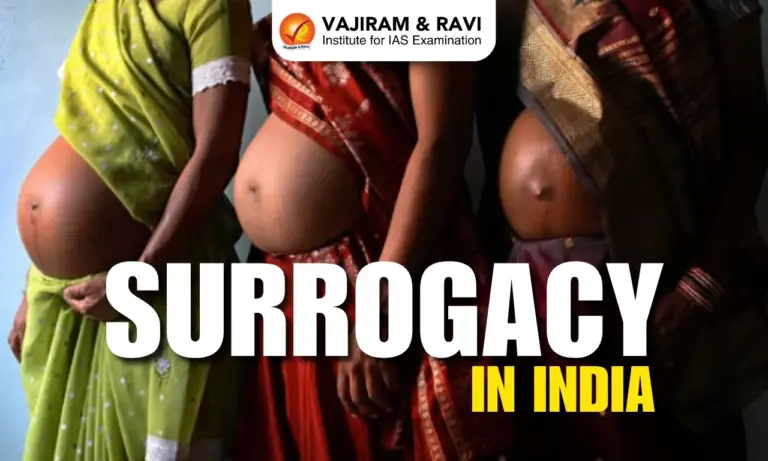
Surrogacy in India Latest News
- The Supreme Court of India has reserved its verdict on multiple petitions challenging the age restrictions imposed by the Surrogacy (Regulation) Act, 2021 and Assisted Reproductive Technology (Regulation) Act, 2021, especially where the surrogacy process was initiated before the enactment of these laws.
Background – Legal Framework Governing Surrogacy in India
- The Surrogacy and ART Regulation Acts (2021):
- Objective: Ban commercial surrogacy and promote altruistic surrogacy only.
- Key provisions:
- Age limit for intending couples –
- Woman: 23–50 years
- Man: 26–55 years
- For single women: Only widows/divorcees aged 35–45 eligible.
- Requirement of certificate of essentiality, including proof of infertility, parentage order, surrogate insurance.
- Age limit for intending couples –
- Purpose of the law:
- To prevent commodification of reproductive services.
- Ensure surrogacy is used only when medically necessary.
- Based on expert medical advice to safeguard child and mother’s health.




The Case Before the Supreme Court
- Petitioners’ arguments:
- Couples began fertility procedures before law came into force (Jan 2022).
- The age bar retroactively disqualifies them mid-process. For example, a couple aged 62 and 56 lost their child in 2018; failed embryo transfer in 2022; disqualified due to a new age cap.
- Violation of Article 14 (Right to Equality) – arbitrary classification.
- Violation of Article 21 – infringement on reproductive autonomy and personal liberty.
- No grandfather clause for transitional protection in law.
- Broader issues raised:
- Exclusion of unmarried single women from eligibility is arbitrary.
- The law’s narrow definition of “single women” is under constitutional challenge, though not part of current petitions.
Supreme Court’s Observations and Government’s Stand
- Government’s defence:
- Age limits based on natural reproductive timelines and medical safety.
- Advanced parental age poses risks to child’s health and parenting longevity.
- Aligns with international best practices.
- Court’s counterpoints:
- “Why bar surrogacy when natural geriatric pregnancies are allowed?” (Justice Nagarathna)
- The court –
- Questioned the rational nexus of age cap with the intent of the Act.
- Emphasised lack of compassion in the law – “Stop, no children! Look how harsh it is.”
- Stressed that the law aims to regulate commercial surrogacy, not to deny genuine parenthood.
Key Constitutional and Ethical Dimensions Involved in the Case
- Article 14: Right to Equality — challenge to arbitrary age-based discrimination.
- Article 21: Right to Life and Personal Liberty — includes reproductive rights.
- State vs. individual autonomy: Balancing medical regulation and individual choice.
- Judicial activism: SC’s proactive role in interpreting personal liberty and family rights.
- Lack of grandfather clause: Raises concerns on legislative foresight and transitional justice.
Conclusion
- The Supreme Court’s forthcoming verdict will be crucial in determining how laws regulating assisted reproduction balance medical ethics, legislative intent, and individual reproductive rights.
- It may also set a precedent for future legal treatment of transitional scenarios and personal autonomy in health-related legislation.
Source: IE

 Last updated on March, 2026
→ UPSC Final Result 2025 is now out.
→ UPSC has released UPSC Toppers List 2025 with the Civil Services final result on its official website.
→ Anuj Agnihotri secured AIR 1 in the UPSC Civil Services Examination 2025.
→ UPSC Marksheet 2025 is now out.
→ UPSC Notification 2026 & UPSC IFoS Notification 2026 is now out on the official website at upsconline.nic.in.
→ UPSC Calendar 2026 has been released.
→ Check out the latest UPSC Syllabus 2026 here.
→ UPSC Prelims 2026 will be conducted on 24th May, 2026 & UPSC Mains 2026 will be conducted on 21st August 2026.
→ The UPSC Selection Process is of 3 stages-Prelims, Mains and Interview.
→ Prepare effectively with Vajiram & Ravi’s UPSC Prelims Test Series 2026 featuring full-length mock tests, detailed solutions, and performance analysis.
→ Enroll in Vajiram & Ravi’s UPSC Mains Test Series 2026 for structured answer writing practice, expert evaluation, and exam-oriented feedback.
→ Join Vajiram & Ravi’s Best UPSC Mentorship Program for personalized guidance, strategy planning, and one-to-one support from experienced mentors.
→ Shakti Dubey secures AIR 1 in UPSC CSE Exam 2024.
→ Also check Best UPSC Coaching in India
Surrogacy in India FAQs
Q1. Do the age limits in the Surrogacy Act violate Articles 14 and 21?+
Q2. Why is the absence of a grandfather clause in the Surrogacy Act problematic?+
Q3. What are the key features of the Surrogacy and ART Acts, 2021?+
Q4. Does the Act unfairly exclude unmarried single women from surrogacy?+
Q5. How is the judiciary balancing reproductive rights and statutory restrictions?+
Tags: mains articles surrogacy in india upsc current affairs upsc mains current affairs