SC Status after Religious Conversion Latest News
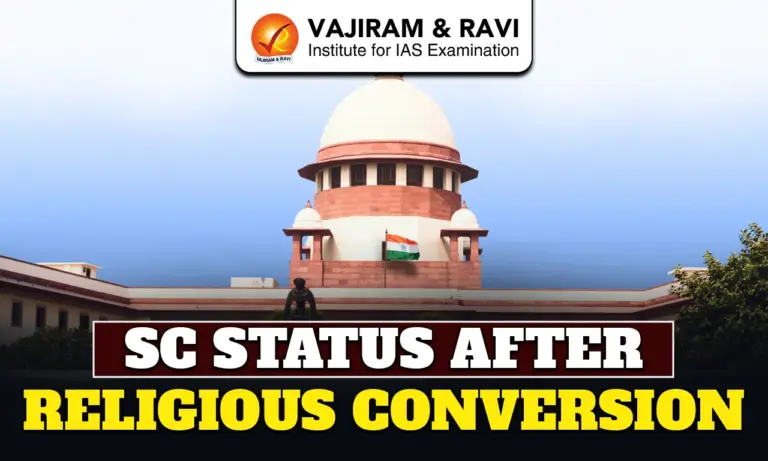
- The Supreme Court, in its recent ruling, held that a person who has converted to Christianity cannot continue to claim Scheduled Caste (SC) protections. The court upheld the Andhra Pradesh High Court’s order in this regard.
- The ruling sits at the intersection of two conflicting realities:
- Constitutional Design – SC status is a legal-social identity tied to specific religions under the 1950 Order.
- Ground Reality – Caste-based discrimination has been shown to persist even after conversion, particularly among Dalit Christians.
What the Court Said
- The SC ruled that other than Hinduism, Sikhism, or Buddhism, a person cannot simultaneously:
- Profess and practice a religion, and
- Claim membership of a Scheduled Caste
- The court described the bar as “absolute” with “no exceptions“, stating that the two positions are “mutually exclusive and contrary to the Constitutional scheme.”
- The court held that the loss of SC status upon conversion is not gradual — it is instant: “Once the appellant converted to Christianity, the caste status which he earlier enjoyed… stood eclipsed in the eyes of law.”
The Legal Basis
- SC status is defined through the Constitution (Scheduled Castes) Order, 1950, which restricts SC status to Hindus, Sikhs, and Buddhists.
- The court held that claiming SC benefits for statutory purposes while professing another religion is constitutionally impermissible.
Scheduled Tribes: A Different Standard
- The court clarified an important distinction:
- For Scheduled Tribes, religion is not the determining factor.
- ST identity depends on whether a person continues to be part of the community in terms of customs and social recognition.
- This makes the SC and ST frameworks legally distinct on the question of religious conversion.
What Does “Profess” a Religion Mean
- The court gave an important constitutional interpretation of the word “profess” as used in the 1950 Order:
- It is not merely a private belief or personal conviction
- It requires an outward, public manifestation of one’s faith
- “The term ‘profess’ connotes to publicly declare or practice a religion”
- By this standard, the appellant’s role as a pastor — leading prayers and organising gatherings — was itself conclusive proof of his religious identity.





The Case Behind the Ruling: Pastor Chintada Anand Paul vs The State
- In 2021, Pastor Chintada Anand Paul of Pittalavanipalem village, Andhra Pradesh, filed a complaint alleging: Repeated abuse using caste slurs; Death etc.
- A case was registered under the SC/ST (Prevention of Atrocities) Act, along with IPC provisions of wrongful restraint, criminal intimidation, and hurt.
- The accused approached the Andhra Pradesh High Court to quash the proceedings, arguing a single key point:
- The complainant had converted to Christianity years ago and was functioning as a pastor.
- Therefore, he could not claim SC status and could not invoke the SC/ST Act.
- The central legal question was: does this protection travel with a person after they voluntarily leave their community through religious conversion?
The Andhra Pradesh HC Ruling (April 2025)
- The AP High Court ruled in favour of the accused, holding that:
- The “caste system is alien to Christianity”.
- The SC/ST Act is “protective legislation” meant exclusively for members of the SC/ST community.
- A converted Christian falls outside the definition of SC and cannot invoke the Act.
The Legal Framework: Why SC Status Ends Upon Conversion
- The court’s reasoning is rooted in a clear chain of constitutional and statutory provisions that tie Scheduled Caste identity directly to the religion a person professes.
The Constitution (Scheduled Castes) Order, 1950
- Issued under Article 341 of the Constitution, this is the foundational document defining who qualifies as a Scheduled Caste. Its Paragraph 3 explicitly states:
- “No person who professes a religion different from the Hindu, the Sikh or the Buddhist religion shall be deemed to be a member of a Scheduled Caste.”
- This makes conversion to Christianity (or any other religion outside these three) a legal cut-off point — the moment at which SC status ceases to exist in the eyes of the law.
How the Constitution Reinforces This
- Article 366(24) defines Scheduled Castes as those groups notified by the President under Article 341
- Articles 341 and 366(24) work in tandem, creating a self-reinforcing framework that limits SC status to members of Hindu, Sikh, or Buddhist faiths
The SC/ST Act Follows the Same Definition
- The SC/ST (Prevention of Atrocities) Act adopts the same definitions as the constitutional provisions above.
- This means that the religious bar on SC status automatically extends to the protections and remedies available under the Act.
- The entire framework leads to one conclusion — SC legal identity is inseparable from religious identity.
- Once a person’s social membership to the SC community ends through conversion, the legal protections tied to that membership end as well.

 Last updated on March, 2026
→ UPSC Final Result 2025 is now out.
→ UPSC has released UPSC Toppers List 2025 with the Civil Services final result on its official website.
→ Anuj Agnihotri secured AIR 1 in the UPSC Civil Services Examination 2025.
→ UPSC Marksheet 2025 is now out.
→ UPSC Notification 2026 & UPSC IFoS Notification 2026 is now out on the official website at upsconline.nic.in.
→ UPSC Calendar 2026 has been released.
→ Check out the latest UPSC Syllabus 2026 here.
→ UPSC Prelims 2026 will be conducted on 24th May, 2026 & UPSC Mains 2026 will be conducted on 21st August 2026.
→ The UPSC Selection Process is of 3 stages-Prelims, Mains and Interview.
→ Prepare effectively with Vajiram & Ravi’s UPSC Prelims Test Series 2026 featuring full-length mock tests, detailed solutions, and performance analysis.
→ Enroll in Vajiram & Ravi’s UPSC Mains Test Series 2026 for structured answer writing practice, expert evaluation, and exam-oriented feedback.
→ Join Vajiram & Ravi’s Best UPSC Mentorship Program for personalized guidance, strategy planning, and one-to-one support from experienced mentors.
→ Shakti Dubey secures AIR 1 in UPSC CSE Exam 2024.
→ Also check Best UPSC Coaching in India
SC Status after Religious Conversion FAQs
Q1. Can a person retain SC status after religious conversion to Christianity?+
Q2. Which religions qualify for Scheduled Caste status under Indian law?+
Q3. How does SC status after religious conversion differ from Scheduled Tribe rules?+
Q4. What does "profess" a religion mean under the 1950 Constitutional Order?+
Q5. Does losing SC status after religious conversion affect SC/ST Act protections?+
Tags: mains articles SC status after religious conversion upsc current affairs upsc mains current affairs