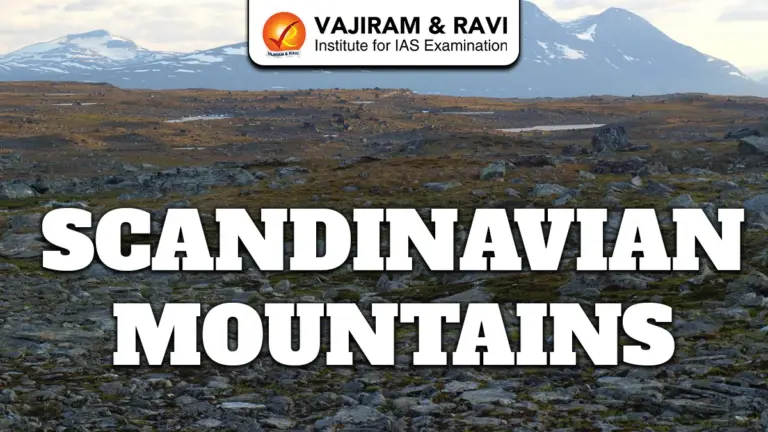
The Scandinavian Mountains are also called the Scandes. They form the main mountain system of Northern Europe, stretching across Norway, Sweden and marginally into Finland. The range is geologically young in its present form but rests on very ancient rocks shaped by repeated uplift and intense glaciation. These mountains strongly influence Nordic climate, drainage, biodiversity and human settlement. Their steep western margins create Norway’s famous fjords, while gentler eastern slopes merge into Sweden’s interior landscapes which makes the range a key physical and ecological divide in northern Europe.
Scandinavian Mountains
The Scandinavian Mountains run along the Scandinavian Peninsula, forming a continuous highland spine from southern Norway to the Arctic Circle and beyond. The western flank drops sharply into the Norwegian and North Seas, producing deep fjords, while the eastern side slopes gradually toward Sweden and Finland. The range reaches around 2,000 metres near the Arctic Circle and touches northwestern Finland as low hills. Galdhøpiggen, at 2,469 metres, is the highest peak in mainland Northern Europe.
Also Read: Mount Kosciuszko
Scandinavian Mountains Features
The major features of the Scandinavian Mountains has been listed below:
- Geographical Extent: The range stretches north-south across the peninsula, forming a natural boundary between Norway and Sweden and influencing continental scale drainage patterns.
- Western Escarpment and Fjords: Steep western slopes plunge into the sea, where glacially carved valleys flooded by seawater formed fjords like Sognefjord and Hardangerfjord.
- Eastern Slopes: The eastern side transitions into lower mountains and fore-fells (förfjäll), usually below 1,000 metres, extending across Sweden as a 650 km belt.
- Highest Peaks: The tallest summits lie mainly between Stavanger and Trondheim, with numerous peaks above 1,300 metres and several exceeding 2,000 metres.
- Peaks: Galdhøpiggen (2,469 m) in Norway, Kebnekaise Nordtoppen (2,097 m) in Sweden and Halti’s slope (1,324 m) in Finland mark national high points.
- Surfaces: Southern sections contain large plateaux like Hardangervidda, rising from ancient erosion surfaces uplifted during the Neogene period.
- Alpine Relief: Only about 13.6% of southern Norway shows true alpine topography, mostly near fjord regions and deep glacial valleys.
- Glacial Cirques: Cirques occur at both sea level and above 2,000 metres, indicating glacial processes independent of altitude alone.
- Permafrost Zones: Discontinuous permafrost appears above 1,500-1,700 metres in the west and as low as 1,100 metres in northern Sweden.
- Glaciers: The glacier equilibrium line ranges from about 1,500 metres in wet western Norway to around 2,100 metres in drier eastern regions.
- Caledonian Base: The mountains rest on Caledonian nappes formed around 390 million years ago during the closure of the Iapetus Ocean.
- Passive Margin Uplift: Modern elevation resulted from Cenozoic uplift, not active mountain building, similar to Greenland’s eastern mountains.
- Drainage Divide Shift: Glacial erosion shifted the watershed between Atlantic and Baltic drainage systems eastward by up to 50 kilometres in places.
- Karst Landscapes: Limestone areas, especially in northern sections, host caves and sinkholes with origins possibly dating back to the Pleistocene.
Also Read: Appalachian Mountains





Scandinavian Mountains Biodiversity
The biodiversity of the Scandinavian Mountains reflects strong climatic gradients, short growing seasons and adaptations to cold, wind and snow dominated environments. National parks like Jotunheimen, Sarek and Dovrefjell conserve these fragile mountain ecosystems.
Flora
The vegetation is dominated by hardy species adapted to alpine, subalpine and tundra conditions, forming a distinct montane ecosystem across the range.
- Montane Birch Forests: Mountain birch forms the upper tree line, creating extensive birch forest belts tolerant of cold, wind and snow pressure.
- Alpine Tundra Vegetation: Above the tree line, mosses, lichens and dwarf shrubs dominate, surviving with shallow roots and slow growth rates.
- Grasslands and Meadows: Alpine grasslands develop during short summers, providing rich forage due to long daylight and rapid plant growth.
- Cold Resistant Flowering Plants: Species like northern catchfly and water avens complete life cycles quickly during brief frost free periods.
- Coniferous Trees at Lower Slopes: Scots pine and Norway spruce occupy lower elevations and sheltered valleys with deeper soils.
- Lichen Dominance: Reindeer lichens thrive on poor soils and are critical winter forage in snow covered landscapes.
- Soil and Permafrost Influence: Shallow soils above permafrost limit root depth, shaping low, cushion like plant forms.
- Glacial Refugia Plants: Some plant species survived glaciations on ice free nunataks and recolonised after deglaciation.
Fauna
Animal life in the Scandinavian Mountains shows strong seasonal strategies to cope with extreme winters and short productive summers.
- Reindeer Populations: Wild and semi domesticated reindeer migrate seasonally, relying heavily on lichen rich alpine pastures.
- Large Carnivores: Brown bears and Eurasian lynx inhabit forested and mountainous zones, maintaining top predator roles.
- Arctic Fox: The Arctic fox survives in high altitude tundra, using thick fur and food caching to endure harsh winters.
- Red Fox Expansion: Red foxes occupy lower and mid elevations, sometimes competing with Arctic fox populations.
- Small Mammals: Lemmings and voles show population cycles that strongly influence predator numbers.
- Bird Diversity: Species such as ptarmigan, ravens, ospreys and willow warblers exploit seasonal insect abundance.
- Insect Abundance: Summer insect blooms support birds and small mammals, despite extremely short growing seasons.

 Last updated on April, 2026
→ UPSC Final Result 2025 is now out.
→ UPSC has released UPSC Toppers List 2025 with the Civil Services final result on its official website.
→ Anuj Agnihotri secured AIR 1 in the UPSC Civil Services Examination 2025.
→ UPSC Marksheet 2025 is now out.
→ UPSC Notification 2026 & UPSC IFoS Notification 2026 is now out on the official website at upsconline.nic.in.
→ UPSC Calendar 2026 has been released.
→ Check out the latest UPSC Syllabus 2026 here.
→ UPSC Prelims 2026 will be conducted on 24th May, 2026 & UPSC Mains 2026 will be conducted on 21st August 2026.
→ The UPSC Selection Process is of 3 stages-Prelims, Mains and Interview.
→ Prepare effectively with Vajiram & Ravi’s UPSC Prelims Test Series 2026 featuring full-length mock tests, detailed solutions, and performance analysis.
→ Enroll in Vajiram & Ravi’s UPSC Mains Test Series 2026 for structured answer writing practice, expert evaluation, and exam-oriented feedback.
→ Join Vajiram & Ravi’s Best UPSC Mentorship Program for personalized guidance, strategy planning, and one-to-one support from experienced mentors.
→ Shakti Dubey secures AIR 1 in UPSC CSE Exam 2024.
→ Also check Best UPSC Coaching in India
Scandinavian Mountains FAQs
Q1. Where are the Scandinavian Mountains located?+
Q2. What is the highest peak of the Scandinavian Mountains?+
Q3. Why are Norwegian fjords associated with the Scandinavian Mountains?+
Q4. Are the Scandinavian Mountains very old?+
Q5. What type of vegetation dominates the Scandinavian Mountains?+
Tags: scandinavian mountains