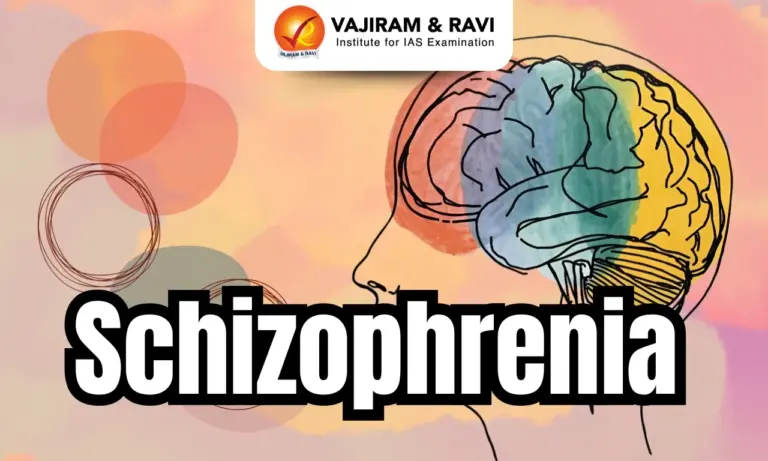
Schizophrenia Latest News
Researchers analysing data from more than half a million people find that compared to the general population, people with schizophrenia are more likely to have weaker bones and to suffer fractures.
About Schizophrenia
- Schizophrenia is a serious mental disorder characterized by disruptions in thought processes, perceptions, emotional responsiveness, and social interactions.
- Although the course of schizophrenia varies among individuals, schizophrenia is typically persistent and can be both severe and disabling.
- Cause:
- Researchers believe that several genetic and environmental factors contribute to the risk of developing schizophrenia, and life stressors may play a role in the start of symptoms and their course.
- Since multiple factors may contribute, scientists cannot yet be specific about the exact cause in each individual case.
- Symptoms:
- Symptoms of schizophrenia include psychotic symptoms such as hallucinations, delusions, and thought disorder, as well as reduced expression of emotions, reduced motivation to accomplish goals, difficulty in social relationships, motor impairment, and cognitive impairment.
- Suicidal thoughts and attempts are much higher than average in people with schizophrenia.
- Although symptoms typically start in late adolescence or early adulthood, schizophrenia is often viewed from a developmental perspective.
- Cognitive impairment and unusual behaviors sometimes appear in childhood, and persistent presence of multiple symptoms represent a later stage of the disorder.
- This pattern may reflect disruptions in brain development as well as environmental factors such as prenatal or early life stress.
- Schizophrenia affects approximately 23 million people, or 1 in 345 people (0.29%), worldwide.
- Stigma against people with this condition is intense and widespread, causing social exclusion and impacting their relationships with others, including family and friends.
- Treatment:
- There is no cure for schizophrenia. People with schizophrenia need lifelong treatment.
- This includes medicine, talk therapy, and help in learning how to manage daily life activities.
Source: TH





 Last updated on March, 2026
→ UPSC Final Result 2025 is now out.
→ UPSC has released UPSC Toppers List 2025 with the Civil Services final result on its official website.
→ Anuj Agnihotri secured AIR 1 in the UPSC Civil Services Examination 2025.
→ UPSC Marksheet 2025 Will be out soon.
→ UPSC Notification 2026 & UPSC IFoS Notification 2026 is now out on the official website at upsconline.nic.in.
→ UPSC Calendar 2026 has been released.
→ Check out the latest UPSC Syllabus 2026 here.
→ UPSC Prelims 2026 will be conducted on 24th May, 2026 & UPSC Mains 2026 will be conducted on 21st August 2026.
→ The UPSC Selection Process is of 3 stages-Prelims, Mains and Interview.
→ Prepare effectively with Vajiram & Ravi’s UPSC Prelims Test Series 2026 featuring full-length mock tests, detailed solutions, and performance analysis.
→ Enroll in Vajiram & Ravi’s UPSC Mains Test Series 2026 for structured answer writing practice, expert evaluation, and exam-oriented feedback.
→ Join Vajiram & Ravi’s Best UPSC Mentorship Program for personalized guidance, strategy planning, and one-to-one support from experienced mentors.
→ Shakti Dubey secures AIR 1 in UPSC CSE Exam 2024.
→ Also check Best UPSC Coaching in India
Schizophrenia FAQs
Q1. What is schizophrenia?+
Q2. What factors contribute to the development of schizophrenia?+
Q3. What are the main psychotic symptoms of schizophrenia?+
Q4. At what age do symptoms of schizophrenia usually begin?+
Q5. Is there a cure for schizophrenia?+
Tags: prelims pointers schizophrenia upsc current affairs upsc prelims current affairs