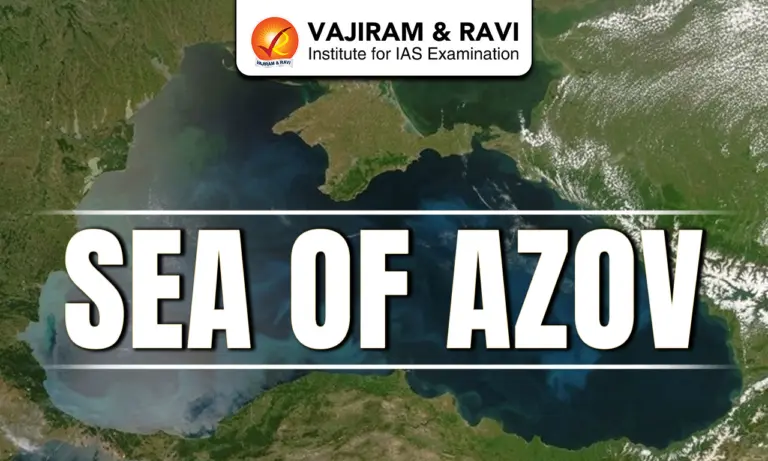
The Sea of Azov is a shallow inland sea in Eastern Europe. It is connected to the Black Sea through the narrow Strait of Kerch. The sea is bordered by Russia and Ukraine which makes it an important maritime and geopolitical region. It is globally recognized as the shallowest sea, with unique hydrology, low salinity, high biological productivity and significant historical, economic and strategic importance.
Sea of Azov Features
The Sea of Azov shows unique physical, geological and historical characteristics shaped by rivers, shallow depth and continental climate influences.
- Location: Situated in Eastern Europe, it lies north of the Black Sea and connects through the Strait of Kerch, about 4 km wide, forming part of a larger marine system linking to the Mediterranean.
- Size: The sea is about 360 km long and 180 km wide, covering nearly 39,000 sq km, making it the smallest sea in the former Soviet region.
- Depth: It is the shallowest sea globally with an average depth of 7 metres and maximum depth of 14 metres, with flat seabed gradually deepening toward the centre.
- Common Names: Historically called Maeotis Swamp, Lake Maeotis and Temarunda meaning “Mother of Waters”, while Ottoman Turks referred to it as Balük-Denis or “Fish Sea”.
- Geological Formation: Large sediment inflow from rivers deposits sand, silt and shells, forming a smooth seabed, numerous sandbanks, limans and long spits like Arabat Spit.
- Major Rivers: The Don and Kuban rivers contribute over 90% of freshwater inflow, reducing salinity and bringing nutrients, along with smaller rivers like Mius, Kalmius and Berda, which form estuaries on merging.
- Salinity Characteristics: The sea has low salinity (10-12 PSS), much lower than oceans and becomes almost fresh in regions like Taganrog Bay due to river inflow.
- Coastal Features: The coastline is low and flat with extensive vegetation, lagoons like Syvash and long sand spits including Arabat, Fedotov and Berdyansk.
- Climate Conditions: It has a continental climate with cold winters (-1 to -5°C, sometimes -30°C) and warm summers (23-25°C), with frequent storms and seasonal ice formation.
- Historical Importance: It has been a centre of Greek colonisation, Bosporan Kingdom trade, Russo-Turkish conflicts, Crimean War operations and modern geopolitical developments.
- Navigation and Connectivity: It connects Central Asia to global markets via the Volga-Don Canal, linking major river systems and enabling inland water transport.
Sea of Azov relation with Russia and Ukraine War
The Sea of Azov has become a major geopolitical hotspot due to its control, military activity and economic importance in recent conflicts.
- Shared Waters Agreement: In 2003, Russia and Ukraine agreed to treat the sea and Kerch Strait as shared internal waters, allowing free navigation and joint usage.
- Strategic Military Build up: Since 2018, both countries increased naval presence, with Ukraine deploying ships to Berdyansk and Russia strengthening control after constructing the Crimean Bridge.
- Kerch Strait Incident: In November 2018, Russia seized three Ukrainian naval vessels attempting to enter the sea, escalating tensions and highlighting control over maritime access.
- Navigation Restrictions: Russia restricted nearly 70% of the sea in 2021 for military exercises, raising concerns about maritime blockade and regional security instability.
- 2022 Conflict Impact: During the 2022 invasion, Russian forces captured Mariupol and controlled northern Pryazovia, effectively blocking Ukraine’s direct access to the Sea of Azov.
- Strategic Importance: Control over the western shore is crucial for Ukraine’s economy, while for Russia it ensures land connectivity to Crimea and secure maritime routes.
Also Check: Arabian Sea





Sea of Azov Biodiversity
The Sea of Azov is highly productive biologically due to shallow depth, nutrient rich waters and favorable climatic conditions supporting diverse flora and fauna.
- Plankton Diversity: About 600 species of planktonic algae exist, mainly diatoms and green algae, which give the sea its colour and support a strong food chain.
- Fish Species: Around 183 fish species are found, including sturgeon, pike perch, bream, anchovy, herring and sea roach, though some like Acipenser nudiventris are nearly extinct.
- Invertebrates: Over 300 invertebrate species exist, including mollusks, crustaceans and worms, with mollusks forming up to 98% of benthic biomass.
- Flora: Coastal regions contain reeds, sedges, Typha, Sparganium, water lilies and submerged plants like Charales and hornworts, with rich marsh ecosystems.
- Bird Life: The sea supports large colonies of waterfowl such as cormorants, pelicans, swans, herons, ducks and seagulls due to abundant food and wetlands.
- Mammals: Terrestrial fauna includes foxes, wild boar, hares, martens and muskrats, while marine mammals like dolphins have declined significantly in recent years.
- Migratory Species: Species like anchovy, mackerel and garfish migrate from the Black Sea, adapting to salinity variations, especially during periods of increased salinity.
- Ecological Challenges: Biodiversity has declined due to overfishing, pollution, dam construction reducing river flow and eutrophication leading to oxygen depletion in deeper layers.
Also Check: Ports in India
Sea of Azov Significance
The Sea of Azov holds major importance in strategic, economic, ecological and transportation contexts due to its location and natural resources.
- Strategic Significance: It acts as a crucial geopolitical zone linking Russia and Ukraine, with control over coastal areas influencing military access and regional dominance.
- Trade and Transport: It is an important inland waterway connecting the Volga-Don Canal, enabling trade between Central Asia, Russia and global maritime routes.
- Fishing Economy: Historically one of the most productive fishing regions, with annual catches reaching 300,000 tonnes, supporting local economies and industries.
- Port Infrastructure: Major ports include Taganrog, Mariupol, Yeysk and Berdyansk, handling cargo and passenger transport despite limitations due to shallow depth.
- Agriculture and Irrigation: River deltas, especially the Kuban, support irrigation systems, fertile lands and vineyards, contributing to regional agricultural development.
- Salt Production: The Syvash lagoons, with very high salinity, have historically supported large scale salt production industries.
- Environmental Importance: High nutrient inflow supports biological productivity, though it also increases risks of eutrophication and ecological imbalance.
- Tourism and Recreation: Coastal areas have served as health resorts due to climatic conditions, shallow waters and scenic lagoons, though conflicts have reduced tourism.
- Industrial Role: Historically important for transporting iron ore and supporting industrial hubs like Mariupol, contributing to metallurgical and manufacturing sectors.
- Ecological Concerns: Pollution, oil spills (such as 2007 Kerch Strait incident) and overuse of resources have degraded environmental quality and reduced fish populations.
Also Check: Important Seas of the World

 Last updated on March, 2026
→ UPSC Final Result 2025 is now out.
→ UPSC has released UPSC Toppers List 2025 with the Civil Services final result on its official website.
→ Anuj Agnihotri secured AIR 1 in the UPSC Civil Services Examination 2025.
→ UPSC Marksheet 2025 is now out.
→ UPSC Notification 2026 & UPSC IFoS Notification 2026 is now out on the official website at upsconline.nic.in.
→ UPSC Calendar 2026 has been released.
→ Check out the latest UPSC Syllabus 2026 here.
→ UPSC Prelims 2026 will be conducted on 24th May, 2026 & UPSC Mains 2026 will be conducted on 21st August 2026.
→ The UPSC Selection Process is of 3 stages-Prelims, Mains and Interview.
→ Prepare effectively with Vajiram & Ravi’s UPSC Prelims Test Series 2026 featuring full-length mock tests, detailed solutions, and performance analysis.
→ Enroll in Vajiram & Ravi’s UPSC Mains Test Series 2026 for structured answer writing practice, expert evaluation, and exam-oriented feedback.
→ Join Vajiram & Ravi’s Best UPSC Mentorship Program for personalized guidance, strategy planning, and one-to-one support from experienced mentors.
→ Shakti Dubey secures AIR 1 in UPSC CSE Exam 2024.
→ Also check Best UPSC Coaching in India
Sea of Azov FAQs
Q1. Where is the Sea of Azov located?+
Q2. Which rivers flow into the Sea of Azov?+
Q3. Why is the Sea of Azov the shallowest sea?+
Q4. What kind of biodiversity is found in the Sea of Azov?+
Q5. How is the Sea of Azov linked to the Russia and Ukraine conflict?+
Tags: geography geography notes sea of azov