Securities Transaction Tax Latest News
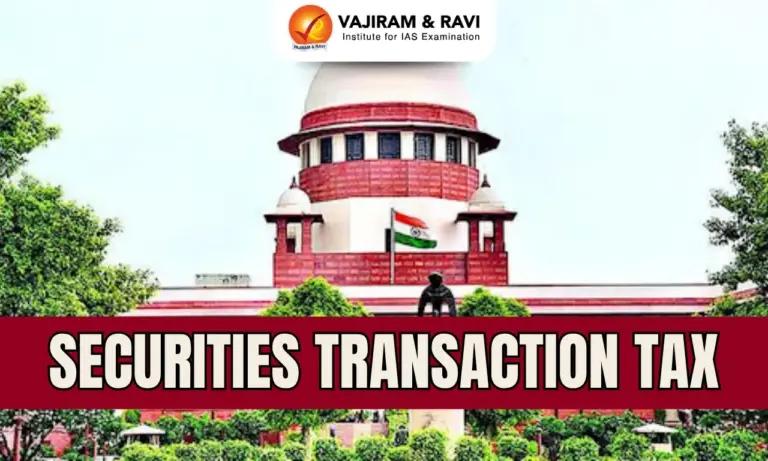
- The Supreme Court has agreed to examine the constitutional validity of the Securities Transaction Tax (STT) under the Finance Act, 2004, following a petition alleging that the levy amounts to double taxation and violates fundamental rights.
About Securities Transaction Tax (STT)
- The Securities Transaction Tax (STT) is a direct tax levied on the purchase and sale of securities listed on recognised stock exchanges in India.
- Introduced through the Finance Act of 2004, STT was designed to simplify taxation on securities trading and curb tax evasion in the capital market.
- It is administered by the Central Board of Direct Taxes (CBDT) under the Ministry of Finance.





Objective and Rationale
- Before 2004, profits from stock market trading were taxed under capital gains, but tax evasion was rampant due to underreporting of transactions.
- STT was introduced to create a transparent and traceable mechanism for collecting taxes on market transactions.
- The idea was to impose a small, upfront tax at the point of transaction, ensuring tax compliance and generating consistent revenue for the government.
- Essentially, STT acts as a Transaction-Based Tax (TBT), collected automatically when a security is traded, making it difficult to evade.
- This has improved tax buoyancy from capital market activities and reduced speculative trading in the long term.
Structure and Applicability
- STT applies to transactions executed on recognised stock exchanges involving:
- Equity shares of listed companies.
- Derivatives, including futures and options.
- Equity-oriented mutual funds (purchase and sale of units).
- Equity-oriented ETFs (Exchange-Traded Funds).
- The rates of STT vary depending on the type of transaction and whether it is a purchase or sale.
- STT is automatically deducted by the stock exchange and deposited into the government’s account, ensuring administrative simplicity and minimal scope for evasion.
Impact on Investors and Traders
- While STT has streamlined the taxation process and improved compliance, its impact varies across investor categories:
- Long-term investors view STT as manageable, given that it simplifies reporting and exempts them from certain documentation.
- High-frequency traders and day traders, however, argue that STT increases transaction costs and reduces profit margins, particularly for intraday or derivative trading where profit spreads are minimal.
- Unlike Tax Deducted at Source (TDS), STT is non-refundable, even if the trader incurs losses. This makes it punitive for loss-making transactions, as the tax applies to all trades, irrespective of profit or loss.
- Despite these concerns, STT has been a steady revenue contributor, generating over ₹30,000 crore annually for the central exchequer in recent years.
News Summary
- On October 6, 2025, the Supreme Court of India decided to examine the constitutional validity of the Securities Transaction Tax (STT) under the Finance Act, 2004.
- The Court issued a formal notice to the Union Government, specifically the Ministry of Finance, seeking its response to the petition.
Key Grounds of the Challenge
- Violates Fundamental Rights: The tax allegedly infringes on the fundamental rights to equality (Article 14), the right to trade or practice a profession (Article 19(1)(g)), and the right to livelihood and dignity (Article 21).
- Constitutes Double Taxation: The petitioner argues that market participants already pay Capital Gains Tax on profits from trading, and paying STT on the same transaction constitutes double taxation.
- Arbitrary and Unjustified: The plea highlights that STT is imposed irrespective of profit or loss. A trader operating at a loss must still pay STT, making it punitive in nature and equivalent to taxing the act of the profession itself.
- Lacks Refund Provisions: Unlike TDS, which is adjusted or refunded at the end of the financial year, STT offers no such provision for refund, even in the case of losses or no gains.
- The petition also pointed out that while STT was initially introduced as a deterrent to tax evasion, its continued imposition without adjustment mechanisms has led to unfair tax burdens on retail and professional traders alike.
Background and Judicial Context
- The STT has been in force since 2004 and has faced criticism from sections of market participants, though previous challenges were dismissed as policy matters.
- This fresh petition, however, brings constitutional arguments into focus, prompting the Supreme Court to scrutinise its fairness and proportionality under Article 265, which states that no tax shall be levied or collected except by authority of law.
- If the court finds merit in the arguments, it could potentially redefine the legal basis of transaction-based taxes in India.
Possible Implications
- A ruling against the tax could affect government revenue streams and compel a redesign of securities taxation.
- Alternatively, the Court could uphold STT but recommend procedural reforms, such as introducing refund or offset mechanisms similar to TDS.
- The verdict will likely set a precedent for how transactional taxes are treated under the constitutional framework of economic equality and fairness.
Source: TH

 Last updated on March, 2026
→ UPSC Final Result 2025 is now out.
→ UPSC has released UPSC Toppers List 2025 with the Civil Services final result on its official website.
→ Anuj Agnihotri secured AIR 1 in the UPSC Civil Services Examination 2025.
→ UPSC Marksheet 2025 is now out.
→ UPSC Notification 2026 & UPSC IFoS Notification 2026 is now out on the official website at upsconline.nic.in.
→ UPSC Calendar 2026 has been released.
→ Check out the latest UPSC Syllabus 2026 here.
→ UPSC Prelims 2026 will be conducted on 24th May, 2026 & UPSC Mains 2026 will be conducted on 21st August 2026.
→ The UPSC Selection Process is of 3 stages-Prelims, Mains and Interview.
→ Prepare effectively with Vajiram & Ravi’s UPSC Prelims Test Series 2026 featuring full-length mock tests, detailed solutions, and performance analysis.
→ Enroll in Vajiram & Ravi’s UPSC Mains Test Series 2026 for structured answer writing practice, expert evaluation, and exam-oriented feedback.
→ Join Vajiram & Ravi’s Best UPSC Mentorship Program for personalized guidance, strategy planning, and one-to-one support from experienced mentors.
→ Shakti Dubey secures AIR 1 in UPSC CSE Exam 2024.
→ Also check Best UPSC Coaching in India
Securities Transaction Tax FAQs
Q1. What is the Securities Transaction Tax (STT)?+
Q2. When was STT introduced in India?+
Q3. Why is the constitutional validity of STT being challenged?+
Q4. Who filed the petition against STT?+
Q5. What could be the implications of the Supreme Court’s ruling on STT?+
Tags: mains articles securities transaction tax upsc current affairs upsc mains current affairs