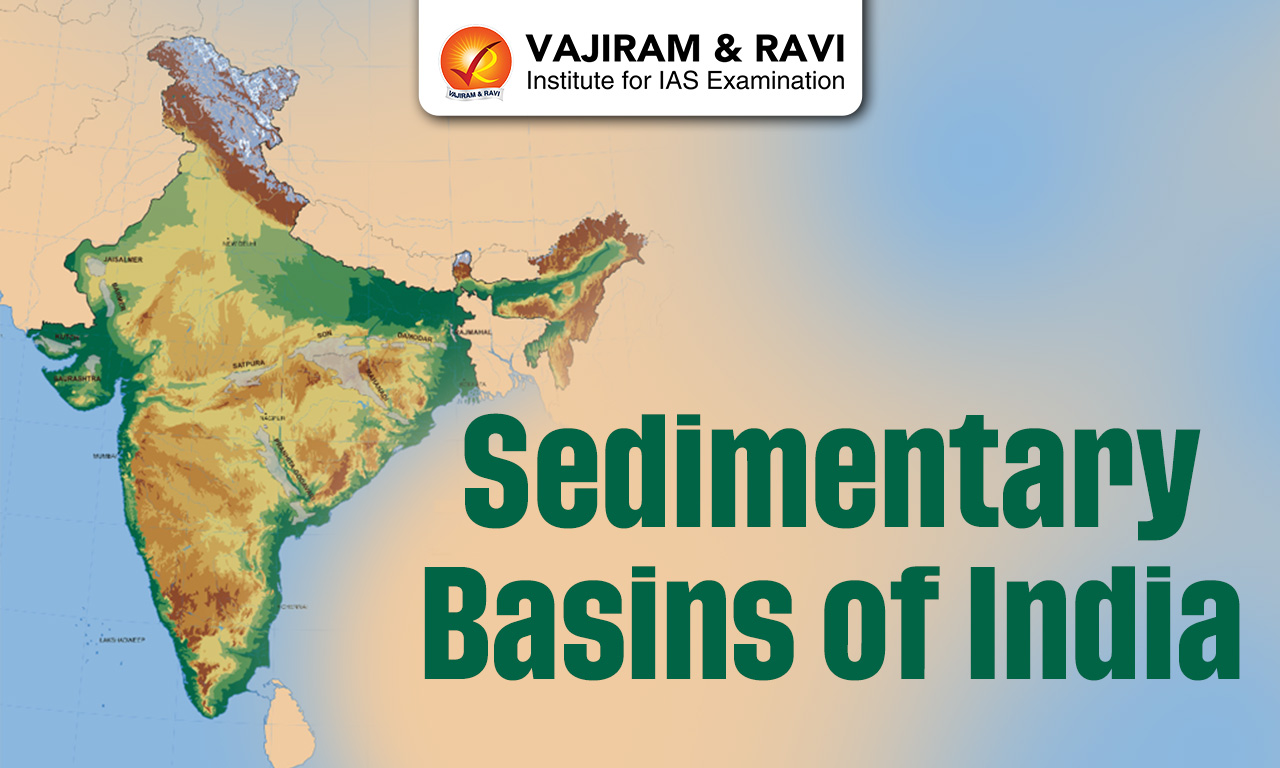
Sedimentary basins are large structural depressions in the Earth’s crust where sediments such as sand, silt, clay, and organic matter accumulate over millions of years. These basins are highly significant as they act as major repositories of petroleum, natural gas, coal, groundwater, and other mineral resources.
India, with its diverse geological history, contains extensive sedimentary formations both onshore and offshore. According to the Directorate General of Hydrocarbons (DGH), India has 26 sedimentary basins, covering about 3.14 million sq. km (nearly 39% of the total geographical area including offshore regions).
Sedimentary Basins in India Classification
The sedimentary basins of India are classified based on their hydrocarbon potential and level of exploration:
- Category I Basins: These are well-explored basins with established commercial production such as Mumbai Offshore, Krishna-Godavari, and Assam Basin.
- Category II Basins: These basins have discovered hydrocarbons but are still under active exploration, such as Rajasthan, Cauvery, and Vindhyan basins.
- Category III Basins: These basins show limited hydrocarbon indications with few exploratory wells, such as Andaman, Kutch, and Himalayan Foreland basins.
- Category IV Basins: These are frontier and largely unexplored deep-sea basins with high uncertainty but potential for future discoveries.
Major Sedimentary Basins of India
- Mumbai Offshore Basin: The Mumbai Offshore Basin lies along the western continental shelf and is India’s most productive hydrocarbon basin. It is home to the Mumbai High oilfield, discovered in 1974 by ONGC. The basin originated due to rifting of the Indian plate during the Mesozoic era and remains a key contributor to India’s crude oil production.
- Krishna-Godavari (KG) Basin: The KG Basin is located along the eastern coast of Andhra Pradesh and extends into offshore regions. It is one of India’s richest natural gas basins, with major discoveries in the KG-D6 block operated by private companies. The basin has strong potential for future energy security.
- Assam and Assam-Arakan Basin: This is India’s oldest producing sedimentary basin. Oil was first discovered at Digboi in 1889, making it one of the earliest oilfields in the world. The basin lies in the Brahmaputra valley and extends into the Indo-Myanmar orogenic belt, reflecting its complex tectonic origin.
- Rajasthan Basin: The Rajasthan Basin is a major onshore basin located in the Thar Desert region. It gained prominence after large discoveries in the Barmer (Mangala) oilfields, transforming the region into an important hydrocarbon-producing area.
- Cauvery Basin: The Cauvery Basin lies along the southeastern coast, mainly in Tamil Nadu and adjacent offshore areas. It contains both oil and gas reserves, with fields such as Narimanam and Kovilappal contributing to regional energy supply.
- Vindhyan Basin: The Vindhyan Basin is a large intracratonic basin covering parts of Madhya Pradesh, Uttar Pradesh, and Rajasthan. It remains under active exploration and is considered to have significant untapped hydrocarbon potential.
- Cambay Basin: The Cambay Basin in Gujarat is one of India’s most productive onshore basins. It hosts major oil and gas fields such as Ankleshwar and Kalol. It is a rift basin formed during the Paleogene period and has been a long-standing contributor to India’s petroleum output.


Offshore Sedimentary Basins
India’s offshore region, within its Exclusive Economic Zone (EEZ) of about 2.37 million sq. km, contains several important sedimentary basins:
- Western Offshore Basins: Mumbai Basin, Kutch Basin, and Kerala-Konkan Basin
- Eastern Offshore Basins: Krishna-Godavari, Mahanadi, and Bengal Basins
- Andaman Basin: A frontier deep-sea basin in the Bay of Bengal with largely unexplored hydrocarbon potential
Sedimentary Basins of India Significance
Sedimentary basins play a critical role in India’s resource and energy landscape:
- They are the primary source of hydrocarbons such as oil and natural gas, supporting India’s energy security.
- They also contain coal deposits (Gondwana basins like Damodar Valley) and serve as important groundwater reservoirs (Indo-Gangetic Basin).
- They provide industrial minerals such as limestone and phosphates, supporting industrial development.
- Their exploration is supported by policies like Hydrocarbon Exploration and Licensing Policy (HELP) and Open Acreage Licensing Policy (OALP), 2017.
- Despite their potential, India imports nearly 70% of its energy needs, making these basins strategically important for self-reliance.

 Last updated on Oct, 2026
→ UPSC 2027 Notification will be released on 13 January 2027 at upsconline.nic.in.
→ Check Nobel Prize 2026 Winners List here.
→ Download PIB PRiSM Monthly Magazine 2026 here.
→ Check UPSC Monthly Current Affairs Magazine The Recitals here.
→ Check out the latest UPSC Syllabus here.
→ Download UPSC Model Answers for Mains 2026
→ UPSC Mains Question Paper 2026 is out now for Essay & GS Paper 1, 2, 3 & 4.
→ UPSC Calendar 2027 has been released.
→ Enroll in Vajiram & Ravi’s UPSC Mains Test Series 2027 for structured answer writing practice, expert evaluation, and exam-oriented feedback.
→ Join Vajiram & Ravi’s UPSC Mentorship Program 2027 for personalized guidance, strategy planning, and one-to-one support from experienced mentors.
→ Go through the UPSC Mains Previous Year Papers to enhance your preparation.
→ UPSC has released UPSC Toppers List 2025 with the Civil Services final result on its official website.
→ Also check Best UPSC Coaching in India
Sedimentary Basins of India FAQs
Q1. What are sedimentary basins?+
Q2. How many sedimentary basins are there in India?+
Q3. Why are sedimentary basins important for India?+
Q4. Which is the most productive sedimentary basin in India?+
Q5. What is the importance of the Krishna-Godavari Basin?+
Q6. What are frontier sedimentary basins?+
Q7. How do sedimentary basins support energy security?+
Tags: sedimentary basins of india